
Voice, Faith, & Staying True to Your Values with Deanna Othman
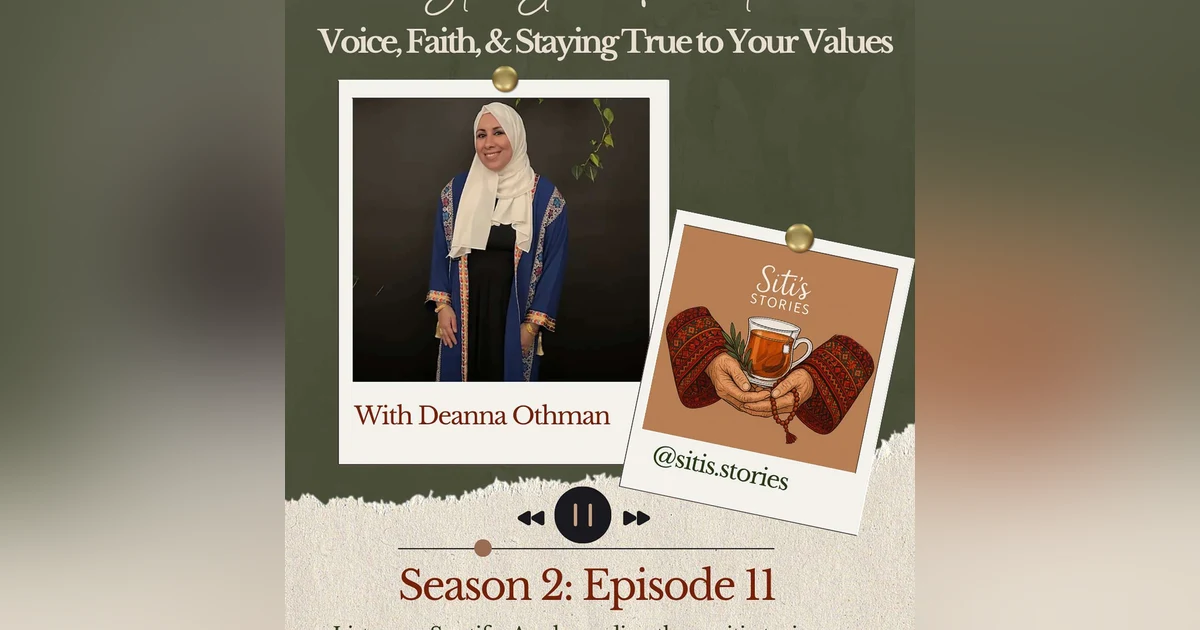


In this episode of Siti’s Stories, Laila sits down with Deanna Othman; a writer, journalist, educator, and community advocate and organizer.
In this conversation, she reflects on the realities of working within media and the moment she realized that pursuing mainstream journalism would come at the cost of her values. From there, she made a different choice. One rooted in integrity, in education, and in staying aligned with what she believes.
We also talk about how that shows up in her classroom and how she teaches her students to think critically about what they’re consuming, especially in a time where information is constant, fast-moving, and often shaped by AI. Also how intentional she is about making sure her students see themselves reflected in what they read and learn.
She also shares a meaningful moment meeting Ta-Nehisi Coates, a writer she has long admired.
And woven throughout all of this… is her Siti.
Deanna shares the story of her grandmother, who came to Chicago after the Nakba and held tightly to her faith, her culture, and her values. She passed that down in a way that still shapes Deanna today. Especially when it comes to prayer, conviction, and not being afraid to stand on truth.
This episode is about staying rooted in your values, your voice, and the path you choose to walk.
🔗 Connect with Deanna: @deannaothman
🔗 Connect with Siti’s Stories:
Instagram: @sitis.stories
Website: sitisstories.com
📌 Resources from this episode:
American Muslims for Palestine (AMP): https://www.ampalestine.org
AMP Chicago: https://www.ampalestine.org/chapters
The Message by Ta-Nehisi Coates
When I asked DNF what securities most for her to faith, stories or a place, faith, conviction, and always speaking the truth and making sure to stand up for what you believe in. And you can see all of that in every role the NFAN steps into the first time. And this conversation is part of DNS stories. And it weaves together her work, her voice, and her faith and where it all comes from. Since you are one who's really talented with words and language, I thought you would be the perfect person to ask this. But is there a quote, a poem, or an ayah that reminds you of your sister?
SPEAKER_00Yeah, actually, she always used to say the one who loves me makes me cry. That was kind of her famous quote. Because she was very real. She wouldn't sugarcoat things. She would just tell it like it is. She always reminded us that harsh criticism is in your best interest in the long run from somebody who loves you.
SPEAKER_02So she she always used to say, Wow, that's very insightful and a great way to get us started. So let's take it back to the beginning. Can you tell us a little bit about yourself? Sure.
SPEAKER_00So I am a mother of four kids. I have two girls and two boys. I've grown up in the Chicago area my entire life. I was born in Oklahoma and I still live in Oklahoma. I've pretty much lived here. So I've pretty much grown up in this community of Little Palestine, and I'm raising my kids in this community. So I feel like very attached to it. I'm from the West Bank from a village called Bitunia, which is pretty well known in Chicago.
SPEAKER_02That's true. Oh, I've actually heard you speak on a couple occasions about your husband's family and them. How are they doing?
SPEAKER_00They're doing okay, alhamdulillah. They're doing as best as they can on the situation. They've been trying to kind of reap some of the benefits of the ceasefire lately, but unfortunately, bombing has restarted. So it's still a very precarious situation. But alhamdulillah, we're grateful that his mom and brother and sister and their families are doing okay. They suffered a lot of losses, like in cousins and extended family, but alhamdulillah.
SPEAKER_02We'll definitely keep them in our dots. I just wanted to kind of make sure to let you know that they're on the top of our minds. I'm sure you living in Chicago suburbs with such a prominent Palestinian community and then having ties to Fuzda with your in-laws, they really set the stage for kind of the multiple roles that you now have continued to play. You carry many titles, which all in a journalist, educator, community advocate, an activist. They all have a line that kind of like runs through them, like a theme that kind of pulls them all together. So what drew you to like language, writing?
SPEAKER_00I didn't necessarily expect to kind of go down that route when I was younger. I didn't really see it as something that other people did or something that was well known. But honestly, it was my mom who encouraged me to pursue that path because she believed that I had a talent in this area that I didn't really think about myself. And so I ended up studying English in college and international studies, kind of was interested in the way the world functions and also using that in combination with writing and expression. And then I ended up going into journalism for my master's degree. So that kind of path of education led me to combine both writing and um teaching and organizing all together. And I think it has all sort of come related to Palestine eventually. That's kind of where I ended up. And I think a lot of it has to do with being in college and seeing the conversations around Palestine. Back when I was in college, there wasn't SJP quite yet, and any activism that was happening for Palestine was through MSA. And it I knew it wasn't enough. And as I got older and I gained more experience learning the different things that my husband's family faced, being in the things that I was not familiar with because I actually hadn't been to Palestine until after I got married. And so it wasn't something I was exposed to firsthand. It was just things that anyone else growing up in America, I heard from others, watched on TV. Not like this generation growing up with the internet and having exposure to pretty much everything. Um, and I think the first time that a major bombing happened in Gaza in like 2007-2008, that led me to get engaged with the Palestine activism community and just kind of try to find my role there and what I could do in order to help the cause. And I started writing more about Palestine, started reaching out to different newspapers and writing app ads. Eventually, people started to come to me for like interviews whenever something was happening in Palestine to speak on behalf of our experiences and also a community when it came to those issues.
SPEAKER_02As your role as a writer and journalist, have you witnessed certain patterns how the mainstream media tries to frame Palestine or Palestinians? And how do you push back against those narratives?
SPEAKER_00Ever since media in this country has existed, it has demonized Palestinians. I mean, we kind of think of it as something more recent, but really isn't. However, far back we look, we see that the language that's used to describe Palestinians as leads them to be seen as less than human. It blames them for their own suffering, it doesn't acknowledge them as victims. There are so many different examples that we've seen of this. And I think since my experience and kind of analyzing media and looking at it, especially post 2007, I would see many of these patterns are just repeated over and over, like the same thing. So whether it's like the passive voice when talking about Palestinians who are killed, who killed them, why were they killed, focusing on this issue of terrorism, denying Palestinian rights and self-determination, not even mentioning the fact that they're occupied. I mean, there you could go on and on and on about the different ways that media have basically manufactured consent leading up to a genocide, right? And only now are we starting to see kind of this narrative shift because of the immense horror that people can no longer deny what they're seeing, whether it's through social media or even mainstream media now. Obviously, we're not at the point that we need to be in terms of how Palestinians are talked about, but there has been a bit of an improvement in that area. And past times where Gaza has been bombed, we really did not see many human interest stories about people in Gaza and what they're doing to survive or what they've lost or what has happened to individuals who had certain hopes and dreams and how they've been those things have been robbed of them. Like we never really used to see the stories. And now we're finally getting a little bit of that exposure. But obviously, this is a battle that we continue to fight. We know that in mainstream media, there's always the pushback from the top, even if there are reporters who want to tell these stories and want to speak them fairly. There's this myth of objectivity that when it comes to these mainstream outlets, that a Western outlet is going to talk about Palestine objectively, unlike a Middle Eastern outlet or a Palestinian reporter or an Arab reporter, a Muslim or whatever it might be. And so they try to kind of maintain that guise of objectivity, but it's really just a myth, right? We know that there's no such thing as objectivity when it comes to this topic in Western newsrooms. And so whether it's silencing certain authors or censoring articles or holding interviews that were done by Palestinian sources, this this sort of thing continues to happen. But at least now we can talk about it and we're more aware of it and we're able to push back. Recently, the writers against the war in Raza put out a petition of 300 writers basically who said that they would not write for the New York Times um if they were asked to do an opinion piece, for example, in protest of their treatment of Palestine in their in their pages.
SPEAKER_02Even just the starter is like they think that they're being so progressive by it, but it's only just for the opinion pieces. A huge emphasis on opinion. This could be your own opinion. It's your own opinion that there's a genocide happening, not as if it's like a fact that it's happening.
SPEAKER_00Yeah. Yeah. And so they've reached out to certain people to do editorials. And it's like, okay, you're reaching out to people to do editorials, fine. But what about the reporting that you do? At what perspective? Yeah. You're setting a fire here, and then you're trying to put it out with one article. It doesn't make sense. So this is something that's gotten a bit of attention, and hopefully that will continue to grow and to to get the attention of not just the New York Times, but all the other outlets who are basically playing by the same label.
SPEAKER_02I think we're all seeing it kind of unfold and we can see through it, we can see through the lines. You're also a dedicated educator. So how do you take the things that we just spoke about to help and guide students think critically about?
SPEAKER_00I think that if we are not doing that as educators, then what's the point of an education, right? If you're not teaching students to think critically. And today there's so much discussion about students losing that ability because of AI and being so dependent on AI. But obviously, I uh coming through that lens as a Muslim Palestinian teacher who's teaching Muslim students, first and foremost, I want them to be critical consumers of the media around them. So whether that's a TikTok or a news article or whether it's a textbook or a novel, you're applying the same skills, right? Anything that you read, anything that you watch, you're watching through the lens of your own identity. And so how can you engage with those texts, engage with those videos or those news pieces with that in mind, right? Because the the goal is to just not absorb things that face value and just believe them, right? Now we even have to ask if something is real or not. Forget about criticizing it for the content, but we first have to kind of verify if it's authentic or not. And so that's something that I really try to like impart to my students. I try to also include texts in our curriculum that are relatable to them, not just the traditional like white male authors that everyone has kind of gone to school reading. While I still think it's important to read them for the sake of criticism and being aware of the society that we're living in, we also deserve to read people that we identify with, topics that we can identify with. So whether that's learning about immigration or the experience of being in exile, um, reading different authors who come from different backgrounds that have a very similar experience of feeling othered, right, in the United States. And that doesn't have to be a Palestinian, that could be somebody that is Latino, that could be somebody who is a black American, right? That could be somebody that's not necessarily Muslim or Arab, but you can identify with that experience. There's an article that we read in the beginning of the year by Professor Stephen Falita, and it was about literary criticism during genocide. He was talking about what is the role of a literary critic, a professor, a teacher during a time of genocide. Is it just to read books and then move on with your analysis as usual? Or is it to relate what you're reading to the context of the society you're in and the time that you're living in and how it relates to those dynamics? And I think in an English classroom, it's part of the job. It's important to expose our youth to those discussions before they go to college, before they're confronted with people who don't see the world through the same lens as them and may push back on them. And so I think these kind of conversations give them confidence to to learn how to engage with people.
SPEAKER_02Yeah, even to be able to go out into the world and be the next generation of leaders. It gives them that confidence, it gives them those talking points that they could kind of always have in their back pocket. When working with this next generation of youths, what kind of gives you hope for the future, not just for Palestine?
SPEAKER_00I think that they are exposed to more of these discussions around the ideas of justice and what that looks like and how to organize for justice and the different means that we do so. I think they're exposed to that a lot younger than maybe we were or I was at their age. I think I was more introduced to the concept of like, let's say, Dawah, for example, through an Islamic lens, but not necessarily combining that with like the social justice slash activism lens. Now they really have the tools to make a difference, whatever their age is, right? Because they're adept with social media, with TikTok, with videos, and all these different things that they have at their disposal to make a difference. I think they're a lot less limited than we were in the past. As far as like if I wanted to communicate something, I'd have to get someone that would agree to publish something, right, that I would want to write. But now you can pretty much publish on your own. You can have your own platform, you can create your own audience. And so I think that does give me hope because with the knowledge that they have technically and also the the knowledge that they have about these issues and the awareness that they have and the connections that they feel, I think that they're able to make um hopefully a learning.
SPEAKER_02Yeah. That ties into the kind of larger conversation of like as parents, you kind of are scared of too much technology for your kids or for the next generation, but it could always be used for good as well. They kind of have the tools of justice like at their fingertips and they could have a wider reach to do those things. You're also very involved with a lot of local groups within Chicago, AMP and AJP within that role that you play. It's it I could imagine it's extremely emotionally taxing and mentally taxing as well, especially when you do have such a personal connection. How do you push through that burnout and balance?
SPEAKER_00I don't know if I do that well, but I try. I mean, obviously the past two years have been emotional in a way that I don't think we've ever experienced, just in general, right? For everybody. It's been difficult, but what leads me to try to bounce it is like, if I don't do it, who is? Like if we all kind of give up or feel burnt out or tired, the work is not gonna get done, right? And so we have to kind of make way for whatever we can. Not everyone has the same talent, not everyone contributes the same thing, but everyone has an avenue through which they can contribute. And so whatever you can do, I feel like you have an obligation to do it, right? And there are people with different talents and different niches that have really gone above and beyond, especially in the past two years. Like you feel a little bit hopeless, like, okay, what where is this gonna get us? But at the same time, this is the option in front of us right now. We don't have another option. We're not gonna hold people accountable if we're not gonna speak out, if we're not gonna rally, if we're not gonna protest. What are we gonna do? We can't just sit back and allow this to happen. When some people are, yo, it's not making a difference. What did protesting do? What did lobbying do? But it's about you feeling the responsibility to do something, whether it's effective or not. You at least need to try. That's what kind of keeps me going as far as the work that's necessary. I definitely always feel like it's not enough. I didn't do anything, it's not making a difference. And those are, I think, normal human reactions to these kind of situations, especially when people brush you off or refuse to meet with you or don't give you the warmest reception or don't respond to your email or call or whatever it is. But we just have to keep going and we see this as a responsibility of Muslims, right? Not just as Palestinians, but as Muslims that we don't just give up. It's it's about our intention.
SPEAKER_02It's also just about like knowing that you did everything that you could in your own power, because like you said, so many of us, especially within the last two years, have felt this hopelessness and helplessness of being like, Well, what am I gonna do all the way over here? But as long as if you know that you have played your role, every person plays their small little role within that larger picture, we could definitely put pressure and you can't leave away expecting an immediate result. This is the dunya, unfortunately. This is like what it is. Have many hyphenates within your identity. How do you feel those separately or together have kind of shaped?
SPEAKER_00I think that's an interesting question. I have been having this discussion actually with students about identity and which part of your identity goes to the forefront in certain situations. When you're visibly Muslim, I think that's the first identity that people judge you by. I think it's interesting because for some people, let's say men, they don't wear hijab or anything like that, but people may immediately classify them as Muslim by seeing them. And they may not be practicing, right? They might not even identify as Muslim, but their name is Muhammad or whatever it is that makes people identify them as such, and that's how they become judged, right, in the public sphere, whether it's in the workplace, at school, in whatever interactions, and they still face the same racism or Islamophobia that a practicing Muslim will face. And so I think my identity as a Muslim is is to me obviously the most important, but it also is the one by which I'm first judged according to, because that's what visibly I am. Ethnicity and everything else is not necessarily as a parent unless like I begin to talk about it. And I think gender is probably the next one because Muslim women in particular have a bunch of stereotypes that are attached to them, whether they apply or not, Islam is racialized in this country. So you can be a white convert who is hijabi, but you're still others, right? As a Muslim. So even though maybe my Palestinian identity to me might be more important, comes after my Muslim identity. I think my identity as a woman goes to the forefront just because of social conventions and social assumptions, right? But I think all of them kind of work together in order to give me a unique experience and a voice that I think in some situations others want to hear, and in other situations, people want to silence. So it kind of just depends on who the audience is and what the interaction is. But sometimes people seek out the voices of Palestinian Muslim women or Palestinian women or Muslim women, and in some situations, obviously they're not.
SPEAKER_02I also think that even within America, just our society alone is so misogynistic. They love to see Muslim women as being oppressed and submissive, but women across the board are all having the same experience. Hearing the way that you use your voice so powerfully within our community to really kind of move us forward really reminds me about our sittis, who were kind of their original storytellers and keepers. I would love to hear a little bit more about your sittis, just to kind of preface that it doesn't necessarily have to be your Siddhi herself if that wasn't a relationship that you've really fostered. It could be your mother-in-law, your mom, elders within the community.
SPEAKER_00Unfortunately, I never met my Siddhi from my dad's side. She passed away before I was born. But I did grow up with my my Sitti. That was one of the biggest blessings of my life is to grow up around her. And her and my mother, and you mentioned mother-in-law's my mother-in-law as well, are I think among like the strongest women that I know. Uh-huh. Just thinking about my mother-in-law, like she's in her 80s. She raised all of her kids in a refugee camp. And seeing where they are today, and that she's still in that camp, but she sacrificed so much to be able to achieve what they achieved. And my grandma, we're talking about women and misogyny and like our society, but she's somebody who was never quiet. She never lowered her voice. She never was afraid to say her opinion. She goes against every stereotype that people have about Muslim women. That they're meek and they're submissive and they have no autonomy. She was somebody who came here very young as a young teenager in nineteen forty nine is when she got to the US. And so she got married here. Her and my grandfather got married here in Chicago. Which is very not usual for people of their generation. And so she was very independent. She spoke English perfectly. Anytime I would meet somebody and they I would be with my grandma because she was with us a lot, like in different occasions and different stages in life, and everyone would be like, You're gonna speak English. People would always be amazed, like, why is this 60, 70, 80 year old lady that's from Palestine speaking English? She was very intelligent and she learned things on her own. And so she raised her kids in this country in the 60s, 70s, when there wasn't a lot of Muslims in the area. There wasn't a community like there is now. Mestid was built in the early 80s, 1980s, Canadian ones.
SPEAKER_02Wow, subhanAllah. So there was like years, like 20, 30 years. Wow, before kind of that resurgence of the community came about.
SPEAKER_00That's a main And my gr my great-grandparents were in the US. Like my great grandparents died in the US school. My grandmother's father, he died when I was very young. I have faint memory of of when he passed away. I'm not even sure how old I was, but my great-grandmother passed away when I was like in eighth grade. But I knew I remember her and my family's been here for generations. And so my grandmother raised my mom and her siblings um in an environment that was hostile to Muslims where they didn't have as uh access to means to educate their kids, to teach them the deen and the culture, that was something you had to do at home. And eventually when these institutions came around, her and my grandfather made sure that their kids and their grandkids became part of them. So whether it was the masjid when it first opened or schools, the Islamic schools, my grandma was insistent that my mom and my aunts and uncles bring us. Like I was at the time, like in third grade when the school opened. And she was like, Whatever you have to do, you're putting your kids there. Like I don't care if I have to pay for it, I don't care what, like whatever the situation is. And I think that at the time, you know, nobody understood how pivotal that decision was and how it changed, I think, our family completely because we now had the exposure to actual knowledge that we didn't necessarily she came to America at such a young age and at a young age for the community where she, like you said, she didn't have access to that.
SPEAKER_02And so she was kind of gripping at whatever that identity was left of it. And so once the resources kind of came available, she knew that that was her chance to kind of make sure to instill that identity within her kids and grandkids. That's an amazing quality and like kind of foresight to um really kind of you know hold on to your roots uh and your identity, whether like Muslim or Palestinian, and that's an incredible. Um I just want to clarify. So your Sid born in Batunia before the Nekba, because you said she was a teenager uh 49.
SPEAKER_00Yeah, I believe so. I'm pretty sure that's when she came, 1949. I remember she told us about them walking from there to Jordan and carrying their possessions, and even though Betunia was not an ethnically cleansed village, it was just the tumult of the situation and them having to basically leave wherever they were at and having her younger siblings and having to like help with that. And obviously it's a very traumatic process, and I regret not being able to record some of those details before she passed away. And she always used to say, I'm gonna write a book, I'm gonna write a book.
SPEAKER_02Maybe you can write a memoir on her behalf.
SPEAKER_00Yeah, yeah, that would be But like she she did share with us parts of those stories and her and then eventually like coming here to the US. Do you know what brought her over to the US? Her father was here before like her mother and her siblings came. So he was here working earlier, I think 1930s.
SPEAKER_02Wow, my great grandfather came in 1914 to New York. Oh wow Yeah, you can find his name in New York. It's really incredible on Alice Island, and oh it's a story that I rarely hear. Yeah, it definitely is.
SPEAKER_00We had done the ancestry DNA thing with my grandma, and they had sent us certain documents and like things that they that were on like record in her that had her name, and one of them was like wedding announcement of her and my grandfather, which was so funny to see. I think it was in the Tribune, and then there were other documents of her dad or her brother, something like that coming like into the US. So it's it's definitely something like you said, you don't hear it often with other families.
SPEAKER_02It seems like you guys were doing a great job of kind of documenting your family's history. That I think it's so special to be able to pass that on to your kids and your grandkids. And these are people that you were very highly, like you are very close to your Siddhi, but you know, your kids or your grandkids, they might have not met her, and so it's so nice to be able to get that piece of history to share with them. And what was your Siddhi's name? Absolutely. Adla. Adla. Okay, so for Siddhi Adla, was there a lesson or a piece of advice that she shared with you that's a good thing?
SPEAKER_00The thing I told you in the beginning was I think one of her most quoted phrases. But one of the most, I think, important things that I always remember her by is how Fala played such an important role in her life and how that was like what her whole day revolved around, no matter where we were, what we were doing. She always reminded us that we have to stop here to pray, or we have to like leave later to pray or earlier, whatever it was. And she always instilled how important that was in us, and that was something that I'll never forget as far as her lessons to me. That's something that all of her grandkids and kids treasure because that's not a habit that you build easily. So you really have to have enforcement from family to ensure that this is something that remains, right? If it wasn't for her, I don't think that we would have stayed on that path away.
SPEAKER_02That's amazing. She had so much steadfastness, and there's definitely something to be said of how much faith she had even coming to America at such a young age, because we've seen that when immigrants come to America that many years ago, they kind of dropped that identity. And so it is beautiful within itself that she was able to stay so steadfast. But the reason why I got emotional is because it just reminded me of my own Siddhi. That was the thing that was just so important in her life. I'll never forget when she got sick, literally on her deathbed, and the whole time she had to her next salah.
SPEAKER_00Yeah. I mean, I definitely had that experience. My Siddhi had Alzheimer's, and so she started to forget everything, what she did and what she didn't do, and like who was there and who wasn't. But she always remembered her salah. She always wanted to get up and make buldu it, regardless of whether she could get up or not. She always remembered her du'as and her the ayahs that she would read. Those are all things that never left her memory, despite everything else, right? And it's amazing to see that you can forget the people closest to you, but you will not forget Allah's words, you will not forget your du'a, you'll not forget what you see as your main like responsibility.
SPEAKER_02Yeah, yeah. It wasn't in a way of like wanting to hold on to this life, it was more of like I would be so lucky to get to pray another salah to my creator, and that has just stuck with me. I think we can learn so much from our cities and our elders. On a lighter note, was there was there any uh food dish that your city would make that you would be most excited?
SPEAKER_00Yeah, just finish. Yeah, so that's something that I always remember her making. She used to make the dessert. That was something that she like it was her specialty, and like nobody else really used to make it, like she made it. Those are the two main things that I remember from her. And it's interesting because she was kind of atypical because she also liked to go out. And so she would be like, I'm gonna take you for steak. I remember back in the old days, like old country buffet. Like, we're gonna go to old country buffet, and I'm like, okay. She enjoys doing that kind of stuff, which was funny because it wasn't the typical old house cleaning grandma behavior, but she loved doing that with her kids. She loved to take us out. She would just insist, and that was very special too, just to spend time with what was her love language.
SPEAKER_02I know Cities didn't have a love language in that, so they didn't know about what their languages were, but well Honestly, like anything she knew you may possibly want, she would go in for you.
SPEAKER_00Regardless of what it was. My sister always tells a story of one time when she wanted a comforter for her room. She was little, and it was sold out at the malls in our area, and she drove to some like random mall somewhere to go get it for her, or times when I was younger, she'd take me to the mall and buy me a new jacket. Even when I was older, when I got married, when I had kids, like she was always like just so giving with whatever it was. It doesn't even matter how much it costs or what it was, if she thought like you needed it or you just wanted it, not even if you needed it, it would be there. This is before the days of instant delivery, but she would go get it herself. All of my kids were born at Hamdena before she passed away so they met her. But for my my older three, they have memories of her. She even did that with them. For their occasions, she would want to go get them a gift, or she would ask me what did they want. That was something that she always loved to do.
SPEAKER_02Yeah, it seems like she was extremely generous within her gift giving or with her time and even like time and salah as well, being generous within time and your relationship with Allah. So she sounded like an amazing Siddhi and even great grandmother, which is so special to have. So, in your opinion, what do you think our responsibility to honor our Siddhis and their generation is? And and how do you think we should go about doing that?
SPEAKER_00Oh, that's that's tough because I don't even know if we could live up to those standards. I think of all the things that my Siddhi did for me, and I'm just like, I can't even imagine. And she had so many grandchildren, mashallah, being there for all of them. It's a very daunting task, like a huge shoes to fill. But I think just keeping their memory alive and making sure that our kids and their kids know who they were and connect them to their stories and their photos. And unfortunately, I don't really have things necessarily that were passed down, but I think just traditions, like honoring those traditions, their clothing, their food, their stories, the things that they held important in their life, like the deen, like salah, like generosity, giving charity, all of those kinds of things I think are important in preserving their legacy and preserving their memory and the actions that they held very dear to them.
SPEAKER_02That makes total sense. Like you said, it's not just about the materialistic things that you get passed on. It's also about embodying their characteristics and passing that on forward to your kids. I think that's so beautiful. Your work is extremely impactful, but as we know, some impactful work does not go be past critique and backlash, unfortunately. What are some of the hardest moments or pushback that you've encountered?
SPEAKER_00You know. It's kind of odd because I feel like, yeah, I've gotten the pushback in terms of rejection and people not wanting to publish certain things or not or getting hate messages from people on the internet who've read things I've written or whatever, those kind of things. But I think that one of the hardest forms of pushback or realizations that I came to was the fact that I really could never see myself working in the context of a mainstream media news outlet, being the person that I am, because I would not be willing to compromise certain principles and beliefs and positions as a Palestinian. And so I wouldn't be welcome in those spaces. It's not a specific pushback, but kind of had going to school, you have these aspirations like, oh, I'm gonna be this reporter and this newsroom or an editor or an anchor, all these different things. And then you realize that the world is not really the place that you thought it was. It's not as simple as like, oh, having skill and talent and drive and I can get a job. It's not how it works. And so I think that was a harsh reality that took kind of time to come to terms with. But I think that the path that I've kind of been down and the different choices that whether I've made them or they've been what Allah has pushed me towards have been the best for me. But it's it's just hard to think about like, you know, you'll never be acceptable to certain people in places.
SPEAKER_02You're not the most palpable person that they could put in the box and kind of package up and prop up. But I think your intentions are so pure, and I just love that you even have that perspective within yourself of whatever's best for you, God will provide that. And I think within your intentions of wanting to uplift your community and stay on the right path of history will take you way further than having to compromise on your own beliefs. That was even something that before I even started this podcast, which this podcast is just kind of like a small little passion project, but it is my digital footprint of being someone who is a Palestinian who's very vocally pro-Palestine and giving platforms to other people who are very pro-Palestine. And so I was like very uh conscious and aware of the fact that like once I go forward with this, it's like, all right, well, you know, my background is in higher education. So I'm like, okay, I know that like this might be to some closed doors in the future, but yeah, I'm okay with that because I was really grappling at the fact of what else am I doing? What else am I doing here, like on this earth with watching a genocide streaming live on our phones? I can't just sit with myself in good conscious. And so if that slams some doors in my face, I know Allah will open other ones. So I'm okay with so it's just it's refreshing kind of seeing your honesty about that, but also kind of your positive perspective on it as well. On the flip side, what are some moments that really reaffirm the path that you're on that really tug at your heartstrings?
SPEAKER_00I think definitely seeing the students that I teach and seeing how they grow and once they leave like high school, what are the the places that they go and the conversations that they have and the work that they do and knowing that I had maybe a small part in that to impact them and to open their mind up to certain things that they may not have been exposed to otherwise. That's one of the most rewarding things. I think a specific moment that I think about is when I got the opportunity to meet Tonic on the boats. Yeah. Just getting to meet somebody that I admired as a writer and as a thinker, and to have him seek out my thoughts about something, I think was something I never experienced. Yeah, I do like interviews and this and that, and it's it's always very surface level. What's your comment on this or your re reaction on this? But I think that the talking to him when he was in the process of writing his book, The Message, was something that was very impactful to me because I don't think I had ever been really seen in the way that I think he saw me and the other Palestinians that he spoke to, and really was there just to understand our perspective and what we go through as Palestinian Americans and what opportunities we think have gone by us because of our identity or our beliefs. That was an impactful moment for me, and then seeing him use part of our interview in his book and being able to meet up with him a year later and just kind of follow up and the sort of conversations that that led to, I think were really important. And I hope that this is something that we can continue as far as whether it's with him or with other authors who seek to help amplify our cause. I also think it's a unique perspective coming from a black American and the unique experiences of black Americans in this country and what they have suffered and continue to suffer in the racism that in some ways continues to get worse, even though we're supposedly becoming a more progressive society. I don't even want to pretend.
SPEAKER_02That's what I think is happening is I think marginalized communities are becoming more intertwined and more connected. That is a beautiful thing, but it's also like, why do we even have to have these things in common to begin with? Absolutely. But yeah, I did see that. I was like, well, oh my god, I was like so proud of you, even though I just know of you, but I was like, oh, I'm so proud of her. That's amazing. Within that note, before we wrap up, um, what are some things that are kind of on the horizon for you and where can we follow up?
SPEAKER_01So taking it day by day.
SPEAKER_00I'm still teaching and I'm, you know, still working with AMP. So we're actually gearing up for our convention in November, Thanksgiving weekend. So that's something that currently working on, and I'm excited for that and hope that it'll be a space for the community to both come together and learn, but also process everything that we've been going through together the past two years. So that's something that I've been working on and just kind of came back recently from a trip to Washington, DC, where we lobbied as part of Palestine Advocacy Day with our senators and representatives. So hoping to continue that work locally in Illinois through AMP. We're also working on repealing the anti-BDS law in Illinois, and so that's something that we've been working on since last year and hope to continue so that hopefully we can get this law repealed. So yeah, there's a number of projects that we're constantly working on, and one thing ends and another thing begins. It doesn't stop. So, you know, that's kind of currently what what's happening at the moment. And where can people follow along with your journey and support? So you can you can follow me on Instagram or on X. That's just my name, DNA. You can follow AMP Chicago as well, and that's where a lot of the Chicago-wide initiatives related to Palestine are posted, whether it's teach-ins, rallies, all all kinds of different activities related to Palestine advocacy, following.
SPEAKER_02Yeah, awesome. I'll put all the links like in the episode show notes, so really easy for everyone to go ahead. So the last question is we always end with the way that we started, with kind of closing in on a Siti inspired question. So if your Siti Adla was here drinking her shea and joining in on the conversation, what do you think she would be proud of you for? Oh, that's a tough question.
SPEAKER_00I think she would be proud of me for speaking up and because I was a pretty shy kid. I wasn't somebody who spoke a lot. I used to have like a mini heart attack every time I had to speak. And I think she would be proud of how I've developed in that area, that I'm more confident in the way that I speak and I'm able to speak to larger audiences. I think she really embodied that, like having no fear to speak the truth. If there was something that I remember her by, she had no fear to stand up to whoever it was and say what she needed to say. And so I think she would be proud of me.
SPEAKER_02Yeah, I'm sure she's very proud of you, and you make the whole community very proud with the work that you do, mashallah. Deanna, thank you so, so, so much for your insight and your knowledge. Deanna's story is such a powerful reminder that the voices we carry didn't start with us, and they don't end with us either. It truly is something that we're entrusted with to make sure that those voices continue to be heard for generations to come. If you felt connected to this episode, I really encourage you to check out AMP, and see how you can get involved or volunteer. And if you've been thinking about your own city, your own roots, your own stories, this is your reminder to ask, to document, and to always preserve. Also, an important note is that since this episode has been recorded, Deanna's mother-in-law has unfortunately passed away, only F5. Please take a moment to make thoughts for her and for all of those that has done full stage. You can find ways to stay connected with Deanna and extra resources down below in the show notes, as well as always making sure to stay connected with City's Stories. You can stay connected with us on Instagram at city's dot stories or going to our website citystories.com. Thank you so much for listening, and stay tuned for an incredible student finale coming to us. As always, last time.


