
Centering Palestinian Voices: Film, Education & Community with Dr. Nina Shoman-Dajani
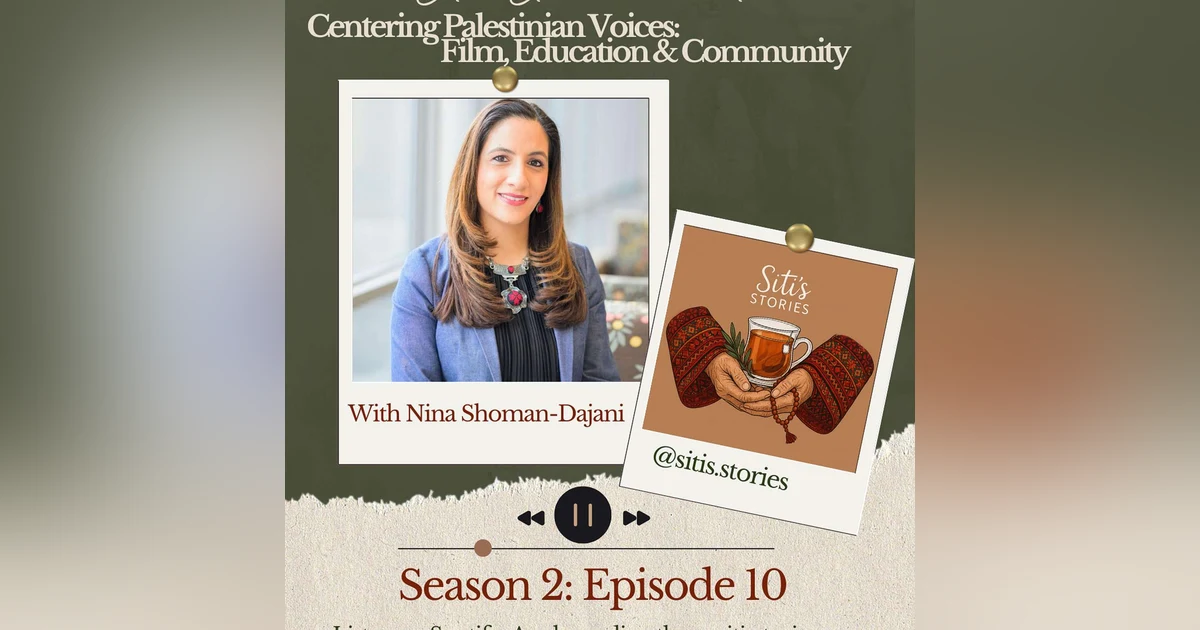


In this episode of Siti’s Stories, we sit down with Dr. Nina Shoman-Dajani, Executive Director of the Chicago Palestine Film Festival and Assistant Dean of Learning Enrichment at a local college for a conversation about community leadership, Palestinian cinema, and the power of representation.
Through both education and the arts, Nina has devoted her career to creating spaces where Palestinian voices can thrive. Whether she’s working with students in higher education or helping bring Palestinian films to audiences across Chicago, her work is rooted in a deep commitment to community, representation, and meaningful impact.
Founded in 2001, the Chicago Palestine Film Festival is the longest-running Palestinian film festival in the world. Now celebrating its 25th anniversary, the volunteer-led festival brings filmmakers, artists, and audiences together to create space for collective connection, healing, and cultural preservation.
But Nina’s work extends far beyond the screen.
As a leader in higher education, she is deeply committed to equity, representation, and uplifting minority and Arab students. After growing up in the Bay Area with little Palestinian community, moving to Chicago, home to one of the largest Palestinian diasporas deepened her connection to culture, identity, and collective belonging.
In this episode, we talk about:
• The role of education in creating representation, opportunity, and meaningful change for minority and Arab students
• The power of Palestinian cinema and the impact of the Chicago Palestine Film Festival as it celebrates 25 years
• How storytelling and film create space for Palestinian voices, creativity, and collective healing
• Nina’s mother, a Nakba survivor whose resilience shaped Nina’s connection to her Palestinian identity
• The traditions, values, and love of the land passed down through generations and how Nina is now carrying that legacy forward to her own children
This episode is about community, leadership, and the ways we carry our people forward.
Today's guest is someone who has dedicated her life to education, advocacy, and cultural preservation, both in the classroom and on the stage. Dr. Nina Shoman Dajani is the executive director of the Chicago Palestine Film Festival, the longest-running Palestine Film Festival in the world. Founded in 2001 and now celebrating its 25th anniversary, the festival has become a powerful platform for Palestinian cinema. Nina's work extends far beyond film. She's also the assistant dean of learning enrichment and college readiness at a local college, where she works every day to uplift students and ensure that minority and Arab voices are represented in spaces of higher education. Nina's story is one of connection, representation, and meaningful impact, and I'm excited for you to hear her story. This is Sitsy Stories. I'm your host, Leila, asking you to pour yourself a cup of tea and listen into the stories that remind us of who we are and where we come from. So it's really nice for us to kind of sit down and be able to hear your story as well.
SPEAKER_00Thank you for having me. I'm really excited to be here and I appreciate you taking the time to record this with me today.
SPEAKER_02So we always get started with a Siti-inspired icebreaker. And so if we were at your Sitti's house, what would be the first thing she would serve us?
SPEAKER_00I think if we were at my sitti's house, she would probably serve us tea with mint. Shay, of course, manana. If anyone complains of a tummy ache, she'll probably throw some meramiya in there. But using herbs like na, babu nij, yansun, and mera mia were part of our tea recipes growing up. And I'm pretty sure that's been handed from my city to my mother to us. Always a good recipe for tea.
SPEAKER_02I love that. And just that's a classic. You can't go wrong with a good cup of shag. Um so uh I would love to share a little bit about your background, where you grew up and where you live now, and what part of Fulstine you're from.
SPEAKER_00So I was born and raised in Northern California. I was the youngest of seven, born in San Francisco. And I grew up in Sacramento, which is a couple hours away from the San Francisco Bay Area. My parents were living in a two-bedroom apartment with seven children and figured by the time I was born, it was time to move. So we moved to Sacramento, where my parents could have a backyard and a big garden where they can grow plants and carry on their traditions as Falahin. And I've lived in Chicago now for about 20 years. I moved here in 2005, and I've been here ever since. So I still consider myself a California girl, but my family is originally from Bethanaina, Palestine, both on my mom and my dad's side. I didn't know that. I didn't know that.
SPEAKER_02I have a lot of Hanaina friends, and I didn't know who are from Bet Hanina. And you were living in New Jersey, right? Exactly.
SPEAKER_00Yeah, they're all on the East Coast. Yeah. There is a lot in New York. So my parents originally lived in New York when they first came to the States and then eventually moved to San Francisco. So I have a lot of cousins in the New York and New Jersey area and Ohio as well, and some in Detroit and uh Michigan.
SPEAKER_02That's awesome. I love your parents moving to California, I feel like is like every Palestinian's dream because the climate is just so similar and like the landscape is so similar. Yeah. I'm sure they were like able to grow so many beautiful things in their garden.
SPEAKER_00Oh, yeah, absolutely. That was the benefit of it, you know. Everybody always would say California is Jose Blood, right? So it's a reminder of the climate that they grew up in, which was, I'm sure, a treat.
SPEAKER_01Mm-hmm.
SPEAKER_02Was there ever a time of you growing up in the US as a Palestinian where you truly felt like your Palestinian identity, whether that was in a good way or like a negative way?
SPEAKER_00I mean, I think our Palestinian identity was always reinforced from birth. My parents were both very much focused on making sure that we grew up with our identity. My father was a Palestinian activist. We grew up going to events for Palestine, to fundraisers. We grew up going to family events and weddings that were always embedded with Palestinian culture. My parents spoke fondly of Palestine at all times. And my mother took us back home several times as children. So I think from a very young age, we knew we were Palestinian. We very much knew of our identity. I think that our identity as Arab Americans came later in life because growing up first generation in a household where Palestine was at the forefront at all times, you don't really tend to negotiate your identity of being like both Arab or Palestinian and American until you get older and you're confronted with instances in which you're realizing, like, oh, I'm also an American. So that that's always that's a whole podcast in itself.
SPEAKER_02Yeah. I like to ask my guests the first time that they felt that weight of their Palestinian identity. I feel like, yeah, we do grow up holding such a strong Palestinian identity, especially in the diaspora. I feel like it's taught to us even extra to be able to make sure that we hold on to it tighter. But just kind of like that first time that you fully experience that, oh, I'm I'm a hyphen it. I am moving in a world where as a Palestinian, but I'm also made to feel like I have to carry also this other large part of the identity as well.
SPEAKER_01Yeah.
SPEAKER_00I think one of the things that reinforced our Palestinian identity was also growing up in a community where there were not many other Palestinians, and we were surrounded by non-Arabs and people who weren't of our heritage. So in that sense, your identity kind of sticks out even more. Um, and I actually wrote an article in which I referred to some childhood experience in which I was othered or experienced microaggressions I had not realized were that at that time, because I was in elementary school. I went to an elementary school where we had to do a country of heritage project in sixth grade. I did a country of heritage project on Palestine. And there were like three other kids in my class that chose Israel. So that gives you a sense of like kind of some of the environment in which I was confronted with at a very young age. And now having that experience and also living in the Chicagoland area where there's a sizable Palestinian community, I've kind of experienced both being in a very much um, I wouldn't say like a completely white community, but a sizable white community and as I got to high school, a more diverse community, but very much feeling isolated in my Palestinian identity in terms of school and environment, besides my family and my cousins, and those were my first like Palestinian friends, to now living in an environment where there's an abundance of Palestinians and there's no shortage of us here, which is also really beautiful and wonderful. But you learn to appreciate it more if you lived in an environment in which you didn't have that.
SPEAKER_02Thank you so much for sharing that. I always love to kind of root us in our guests' background and their childhood because I feel like it really shapes our identity and who we become and what we move forward in doing. You are now serving as the assistant dean at a local college. What made you pursue education to begin with as a career?
SPEAKER_00I always envision myself working in higher ed, not so much in administration where I am now, but as a professor of Middle Eastern studies or SWANA studies of Arab American culture and basically being in a situation where I have the opportunity for my career to teach other people about who we are and our heritage and about Palestine and about our community at large, which I still have the opportunity to do, but not in my full-time job. I love the energy of being on a college campus. Um, when I was a college student, I was very active on my campus. And I knew that one day I would find myself back at a college or university working in some type of capacity. Love the diversity on university and college campuses and what that brings, what the students bring to campus. And I love being in that environment every day. When I was pursuing my education, um, I think after my master's degree, I found myself working in um nonprofit organizations and working really close to the community in a different capacity. And I loved the closeness to the community, but also working within like literacy programs and working closely with education programs in a nonprofit setting. And so when I transitioned to a community college, it kind of gave me the best of both worlds, being very close to the community, but also working in a higher ed setting in which I could utilize my degrees and experience in that sense. Then I eventually went on to get my doctorate. And that's when I decided to kind of follow the path of administration because I noticed that while there were a handful of Arab professors and advisors and counselors, et cetera, there were not very many in the administrative roles in colleges and universities. And administrators are those who make the decisions that affect our communities and our students and our children who are attending these places. And so I found myself in a situation where I was working at a community college with a very sizable Arab and specifically Palestinian population, and we didn't have representation in that sense in administration. And so I think that's what motivated me even more to take that path.
SPEAKER_02Love that you took that initiative. It's it's really amazing because, like you said, being in an area that has that diverse of a population, but then when you look at the leadership, it doesn't really represent their population. How do you navigate the cultural representation within an academic setting for you yourself, but then also for the people that you are leading?
SPEAKER_00Yeah, I mean, I think that at a community college where we serve people from all walks of life, traditional age college students in which we consider those who just graduate high school and then returning adult students, that it's really important to always remember that we serve people from all backgrounds, from marginalized communities, from immigrant communities to students who have special needs. And within the department where I work, we serve those who are, I would say, most vulnerable on campus. Um, and I oversee some programs for English language learners and for um individuals who are coming back to earn their high school diplomas. And so I've I think my activist and advocacy um uh passion comes in in that role because it allows me to advocate for those who are most marginalized on our college campus, but also speak for those who um don't always have a voice at the table. That's an Arab American woman that could be our Arab student population, but also all students at large need uh need a voice at the table. But when you come from a marginalized background, you tend to identify with and feel compassion for those who need help the most. And so I kind of bring that into the room as an administrator.
SPEAKER_02Yeah, I think you tend to have like a larger sense of empathy just because you know exactly what that that path took to walk into those shoes. That was actually the reason why I wanted to become an academic advisor was because I struggled so much in college.
SPEAKER_00Yeah.
SPEAKER_02Or like in high school, just because my parents didn't go to college. And I I unfortunately met so many like academic advisors who were not helpful. And I was like, wow, I like really want to be one of the helpful ones because I really understand like how it feels to get the door slammed in your face and not get the guidance that you need. And so um yeah. Academic advisors can make or break your whole college experience. Totally, totally. And I think it even starts in like senior year of high school as well, guiding you to even get into college as well.
SPEAKER_00Yeah, absolutely. I always there's always specific advisors I tend to, you know, refer students to when they ask me because you know, you uh we have good advisors at Marine, but there's some that I know will like take, you know, extra time and and really um provide a an environment which like a student really needs.
SPEAKER_02Yeah, I think that's also where the cultural competency piece plays into play as well, because you have to have the understanding that these students as parents never walked that path before. So they they're not gonna have the generational knowledge to, you know, the way that maybe other students have. I love that you are able to lead in that way. What have your students taught you about resilience?
SPEAKER_00Oh, my students have taught me so much over the years. I've had the honor of serving as the advisor to the Arab Student Union for about 15 years now at the college. Um, not only have I learned so much from them regarding their lived experiences and what they need in order to be successful and what type of support they can utilize to continue on their journeys as professionals in the community. But I've also had the opportunity to learn from students from all over the world because in my department, we serve students from all over the world. I believe there's students from about 45 different countries that are taking courses with us. And I've had the opportunity to interact with people who have come from um more-torn countries, from hardships in which we could never imagine. We have students in our programs that are monks, that are nuns, that have um come with different journeys and lived experiences. And I've learned from all of them over the years. And what I think I've taken away the most in terms of resilience is that kind of that old saying, like, where there's a will, there's a way. Our students embody that, especially our adult returning students, mothers of young children, individuals who are balancing working full-time or even more than one job and coming back to school. And they've really demonstrated in a spirit to me that where there's that will, they'll find a way. Um, and also we have those students that also step out and come back in and leave and come back. And that also goes to show you that there's quite a bit of resilience that comes with an educational journey. Um, and that's why it's great to be at a community college because our doors are always open. Um, students can take classes as they see fit for their lifestyle. And I really enjoy observing and learning from the journey of our students as well.
SPEAKER_02That's amazing. There's something so clear that, you know, you do a lot of your work is like rooted within culture and community and like kind of mixing the two together. You are now the executive director of the Chicago Palestine Film Festival. And for those who don't know, can you share a little bit about it and how you became involved within it?
SPEAKER_00Yeah, the Chicago Palestine Film Festival is the longest-running Palestine Film Festival in the world. We're very proud of that. So I have to share that. Um and it's an organization, or shall I say, an institution at this point, in which we have the opportunity to share Palestinian stories and Palestinian narratives, to celebrate our culture and heritage, and also document the lived experiences of Palestinians living in occupied Palestine and in the diaspora. I've had the opportunity to serve as the executive director now for about five years. And prior to that, I was uh a supporter of the film festival for many years. I would attend. Um, I had many friends that were involved in organizing the film festival. And I first became more involved with the festival by creating spaces on our college campus for us to invite the Chicago Palestine Film Festival to co-host with our Arab Student Union. So we presented a few films at the college, and that gave me an opportunity to interact with the committee a little bit more. But I've been a longtime supporter really as an audience member. A few years ago, the committee was looking for a new executive director, and I was approached by a few of the former directors to consider the position, and I learned a little bit more about what it entails and ended up signing on. And here I am five years later. It's a 100% volunteer-run organization. Myself, including all of our committee members, are volunteers. It's a labor of love. It's an opportunity for us to have an outlet in which we can share our creative ideas, but also really channel our grief and find space and comfort amongst our community in a place that celebrates arts and culture and film.
SPEAKER_02Yeah, that's beautiful. You are the perfect person for the role, mashallah. Um, how do you balance the two? Because this is a totally volunteer role, but yeah, it kind of from the outside, it would literally look like a full-time position. How do you balance that within your like education role?
SPEAKER_00That's a really good question. I get asked that all the time. I mean, you literally have to be comfortable, like losing sleep, allowing this organization to take over your life, neglecting your kids a little bit. And but with all that aside, the passion to do the work comes from being dedicated to the Palestinian cause. It's an opportunity for us to elevate Palestinian voices. And that does something for us personally, but also does something for our community. And so it's an honor and a privilege to do the work. I think those of us who are involved in the committee and the everyday work of planning the film festival understand that this is a labor of love. And if you weren't passionate about the Palestinian cause and wanting to elevate Palestinian voices, you simply wouldn't do this work. We're also very fortunate to have a dedicated audience space that comes out to our events, that celebrates our film festival with us every year and that keeps us going. And we wouldn't be able to do this work without them and without the many community sponsors that we have as well.
SPEAKER_02Yeah, I think I think it when you see it as a necessity, it kind of lights that fire and that passion for you guys to keep going as well as feeding off of the passion of the community as well and the interest of the community as well. So this year was a really huge year for Palestinian films. How do you go through that process of selecting which films are going to be featured each year?
SPEAKER_00Yeah, we have a competitive process for our film festival. It's always been that way, but we also are um gifted by having many Palestinian and non-Palestinian filmmakers who are making films about Palestine, which also in a sense makes our job easier because we're at the point now in Palestinian cinema where there's so many films. It's a matter of which ones can we select and put in the film festival this year and which ones might we have to wait and screen later. Um, there were many years where I think, from what I understand from those who have been involved with the film festival longer than me, where it was a struggle to find enough films to include in the festival. And so it's a testament to how much Palestinian cinema has grown and that we have an abundance of films to choose from now. And the process to get in our festival has become so much more competitive because we just can't feasibly include all of the submissions that that come our way. Um, we also solicit films from filmmakers who are presenting at large international film festivals, and we want to bring those films to Chicago and to our audience. But we also pride ourselves in being a film festival that invites films from filmmakers who are considered up and coming filmmakers, who may also still be in university as graduate students and are working on projects, or that are local filmmakers from Chicago and trying to get their foot in the door in the film industry. So that's something that's a little bit different with our festival than other festivals. We present award-winning internationally known films. And then we are also a space in which you can find a short film made by a local filmmaker who may still be in school. As long as the guidelines fit and our film procurement committee feels that it's a film in which our audience would love to see, you have a good chance of making it into our festival.
SPEAKER_02That's awesome. I love that you guys are giving that space to other people as well. Um, having too many options is a great problem to have for Palestinian films. Within kind of viewing this year's lines of films, what are kind of the re-emerging themes that you keep coming across?
SPEAKER_00Some of the re-emerging themes that I think will never go away in Palestinian cinema is the documenting of our lived experiences on the ground. So whether that be in Gaza or in Jerusalem or throughout the West Bank and occupied Palestine, we are always going to see films that document the everyday lived experiences of our people on the ground. That could include films that document this ongoing genocide that our people are experiencing in Gaza, the horrific military occupation of our brothers and sisters living in the West Bank, of the checkpoints and the land grabs and all of the torturous experiences in which our Palestinian siblings endure on a daily basis. But we are also seeing an emergence of archival films dating back many decades, coming back to the to the film festival scene and giving us an opportunity to share older footage that many times is not used or utilized in films. So that's been really Cool to see. We're also seeing historical films. An Marie Jasset's film, Palestine 36, is one of the most amazing films because it documents a point in our history in which no other filmmaker, to my knowledge, has produced a film and in such a way that reminds us today, this day and age in 2025, 2026, that once upon a time in 1936, this event happened. And I don't want to give out too much information about the film because there's many who haven't had the chance to see it yet, but it's a film that everyone needs to see. We also see historical films like Farha or All That's Left of You that also document moments in time and the historical experiences of Palestinians who were around during the Nekbah and what that has done now to our experiences in the diaspora. So there's a lot of really special films that we've been gifted with in this last few years. And I think that we'll continue to see films coming from Gaza and about Gaza as we should. We have filmmakers who are still on the ground, like shooting films and sending them to us and documenting for the world what's happening. And it's important that we continue to elevate those voices and share those films as well. So across the gamut, we're we're seeing many different genres and different themes emerging. We also have a genre of films that, for lack of a better way of putting it, we can call them diaspora films. Those of us who are living in the diaspora, experiencing everyday life, whether it be here in Chicago or in Europe or somewhere else where there's a Palestinian diaspora community. And those films are super important as well because the Palestinian experience is not one that is monolithic. It's very diverse and it's an intergenerational display of experiences that we're seeing come to the big screen. Thank you for that insight.
SPEAKER_02I'm not like a film connoisseur or anything, but I've been noticing the themes among the films. A lot of them have a historical context, which I personally love. That's I think it's so beneficial for us to know where we came from and exactly the facts that had happened to how that led us to where we are today. So I love the emphasis on those kind of films. And inshallah, maybe this upcoming year we could see a lot more films coming out of Gaza, because like you said, those really are the voices that deserve to be amplified and needs to be amplified. And I think it goes in a circle as well because the films that have been coming out this year uh showing the historical context, and then maybe the films that are going to be coming out next year within Gaza kind of shows exactly how we got to where we are now today, unfortunately. Yeah. At the film festival, you guys have really strong pulse on the conversations that are happening, the reactions that are happening. Uh, what kind of conversations and reactions do you notice happening among the audiences once kind of the film has concluded?
SPEAKER_00Yeah, I mean, I think when we have filmmakers in the room, sometimes post-film interaction with the filmmaker or the filmmaking crew, which is always really great to see. And it gives an opportunity for our audience members to ask questions that they're curious about, whether it was about the filmmaking process or about like how the story was inspired. I think depending on your background, your lived experience and your perception of what's happening in Palestine and what's happening amongst the Palestinian community, you may receive a story differently than the person sitting next to you, or when we absorb these films through a lens in which is based on our own personal experiences, our own biases. Our audience is so diverse and comes from so many different walks of life and is intergenerational in a way that is just so beautiful to see that we understand that the film fest committee itself also has to reflect the diversity of our audience. And it does. So not everyone receives films the same way. And we may watch a film as Palestinians and absorb it as a completely different experience than someone who is non-Palestinian and hasn't experienced what it's like to be an occupied Palestine. And that's okay too, because it creates questions. It's also an opportunity for people to learn and to think about ways that they could advocate for and expand their knowledge of Palestine. And then many of the folks who are entering our film festival space may be coming for the first time. And some of them have been coming for many, many years. So you see a little bit of everything. And what I've noticed is that the space that we create post-film, whether it be in the lobby of our theater or um in a post-film reception, the conversations that people are having are those in which they're processing the film, they're asking questions, they're exchanging ideas, they're talking to other people about what they thought about the film. And that's a special thing about film. It raises questions, it gets you thinking. It's a lot to absorb sometime, depending on the content. And so I think that those film discussions, post-film and in the lobby and having those spaces, it's super important because it's a lot to take in and then just like get in your car and go home. So I'm glad you asked about the conversations because that's a really critical piece. And we're always trying to think of new ways to allow our audience to process and really take in what they've heard. And I think when we have those opportunities to bring filmmakers or actors who were in the films, that gives us a chance for them to process a bit with those who were on the ground making the film. And that's always great.
SPEAKER_02I love the collective nature of it because, like you said, it is a lot to absorb. Sometimes I don't want to just watch the movie in my own home and then be left with that heavy feeling. I would much rather be in a room, in a space where I know that there's that kind of camaraderie within the people that are with me and we're all watching it together. And yes, we're having a heavy feeling, but we're all having that heavy feeling together. And so we're kind of all processing it together. We chatted a lot about how much you are doing in terms of preservation of culture and heritage within even your education role, and then also within your work with the film festival. And I always like to think about our sitthis or our elders as the people who really helped solidify that preservation of cultural and heritage. So now we get to my favorite segment, which is the Siddhi segment. Which I always like to preface that your Siddhi doesn't have to be your literal Siddhi. They could be a great aunt, your mother, you know, it's just who you attribute, the person who's been passing down that Palestinian identity or heritage. So feel free to shift any of these questions to your mother. So if you could tell us a little bit about her and what year she was born and what benefits she's from, where is she now, and kind of everything in between.
SPEAKER_00She was born in Bethanina, um, the only girl of four children. She was the eldest. Her mother, Siti Zahia, did have additional children who unfortunately passed away, which was not uncommon in those times in the 40s due to lack of resources. So my mother, Mona, was born in 1942. She is what I would consider a child of the Necobah because she was about six years old when the Nekaba happened. And so she does have childhood memories of what happened in 1948. Although my family's from Betanina, which is where my mother was born, she still experienced some dispossession in terms of having to leave home and go to another village for some time and then eventually go back to Betanina when she, when her family felt it was safe. So that experience of having to leave home and go to another um village until safety, if that's what you would like to call it, in terms of what was happening. There was nothing really safe at at the time or now. But they did have the opportunity to go back to their homes, which is much more than, as you know, hundreds of thousands of other people who didn't have that opportunity. And so she did live her whole life and grow up in Bethany. Um, and there's a section of Bethanina now that is very much cut off from the other section due to the apartheid wall and and highways being built right through our village. And what was known as a Falahi village, and is to, I think, my mother's generation still, is very much a sprawling city now. And um, also a city that's surrounded by settlements and that has also experienced the loss of land, home demolitions, and the occupation in a way that those who live in the greater Jerusalem area have experienced. So no one is off limits, whether you're in Bethany or East Jerusalem, or wherever you are, as you know, they're they're land grabbing, they're stealing. I mean, the acres and acres of land that my grandparents owned with fruit trees and that they received their sustenance from is gone. Like it's been taken away. And so, in terms of land dispossession, it's happened really to pretty much everyone. And even if Bethany is still standing and in terms of like its existence, it has still experienced the brutal occupation um and and the strangling of the occupation in ways that other cities and villages also have.
SPEAKER_02Yeah. Yeah. When did your mother make the move to America?
SPEAKER_00Was that her first first time my mother ever left uh Bet Hanena was in 1967. She came to New York, where my father was, and he had come five years prior. She had my oldest sister, Wafat Aliyah Hamha, with her at the time, and she was about five years old at the time. So my father had left in 1962 to pursue an opportunity to come to the States and to work and establish himself. And he had gone back to visit prior, but she wasn't able to come until five years later. And so she came in 1967, December, cold snow, experiencing for the first time a completely different environment, and uh lived in Brooklyn for a few years and had my brother Nadid and my sister Manada there, and had an experience where she was in a new city for the first time amongst a new community. And she speaks still fondly of her neighbors that she met, some of which were Syrian or Lebanese or a few other Palestinian families, and built a community there with my father and other Arabs who had lived in the area in Brooklyn, in which many Arabs were migrating to at the time. And then eventually my parents moved to San Francisco, um, where my mother's father, C. D. Daheed, was already living and having had established himself, and her brothers were also your grandfather. When would he have come to San Francisco? Yeah. So he came in, I want to say the early 60s, from my understanding. Um, during the time my mom was still in New York. Um, and I don't like the timeline, I'll have to double check with my mom, but I think my grandfather had come, went back home. He had come back to San Francisco. And prior to that, he had gone to Venezuela, he had gone to Brazil. He was of that generation that would like leave his family for months on a time, get on a ship and go look for work. And he was in South America, so he would be gone for a long time. He would come back, go back. I would love like for the opportunity for you to interview my mom because she's told me these stories of them not having their father around for, I think at some point it was like two years, one stretch he had left to go work. And that was not uncommon, like to have to leave and to get on a ship and to go to Venezuela or something like that. No, yeah. My my grandfather went to Brazil.
SPEAKER_02So yeah. And with his brother, who then met a Brazilian woman who then became his wife. And so it's a very like common theme.
SPEAKER_00I would love for someone to make a documentary about the families who had like fathers or grandfathers who went to South America and had that journey. Because my father, he was actually in South America before he came to New York. It's it's very un Palestinian to have like a very linear path to where you are now. And so many of our parents experienced their moves and steps, right? They first went to a certain city and then they had family there, and then they just decided that there was another opportunity in another city, and they went there and then they settled there for a few years, and then they ended up somewhere else.
SPEAKER_02There's so many stops along the way. And like that's like the whole point of like being Palestinian is that like we constantly are being thrown into new environments and then adapting to those environments. And then by the time we adapt to those environments, we're thrown into the next environment. And um, but never letting anything get in our way.
SPEAKER_00Yeah. One of the things my mom says my father told her when she moved to the states was in order to survive here, you have to learn how to do two things, especially living in New York. You need to learn English and you need to learn how to use public transportation because that's how people get around here. And I think that my my mother's ability to learn the language and to get around is really a testament to like her ability to survive in different environments. And for anyone that's lived in New York or had an experience living in in Brooklyn and being a new immigrant, you can imagine it's not an easy life and it's not an easy change. And the weather is different, the environment is different, and the pace is much different. And so those first few years of her living there probably prepared her for living in another big city and which was San Francisco. And then settling in Sacramento, which is a much slower pace, was probably a nice change by the time she got there. What took my parents to California was my grandfather, my mom's father, C. D. DeGiel, who had been there and said, you know, the weather is better here, the life is better here, there's business opportunities here, you should come to California. And so that's how my family ended up in California. I love that. I wish my parents took that route too. Yeah, we were lucky.
SPEAKER_02We were we were one of the I would say the f the some of the fortunate ones. So you you talked about a piece of advice that your father gave your mother, but has there been a piece of advice that your mom has passed on to you that you know you still think of fondly?
SPEAKER_00My mom has passed on so much advice to us over the years and has really demonstrated what it is to be resilient. I think her strength and ability to adapt to environments is something that we've inherited. I'm the youngest of seven. We were six girls and one boy in my family. And I find my siblings to all be very resilient, people in which can adapt to new environments. And I think we inherited that from my mom. She has demonstrated an amount of strength in her life that I think that we have embodied in our experiences through life and not giving up, working hard, pursuing our education, not forgetting who you are, tradition and culture and adat, this was all part of our upbringing. And so I really credit my mom for instilling that in us because if it wasn't for her passing on our Palestinian traditions, our traditions from Bithanina, I think that we could have lost much of that along the way.
SPEAKER_02Yeah. Was there a favorite phrase that she would always say or says?
SPEAKER_00You know, they always have their like one-liners. I'm gonna say, like, probably not something that I would want to expose on the internet. My mom is a balaha through and through. Uh, tough, tough love was part of our upbringing. And that probably is also what created such a squad of strong women and in my family. My sisters and I really learned that when the tough gets going, you just gotta be tough. And whether that is fair or not, people can argue, because of course, to a certain degree, we've all inherited an amount of generational trauma and which, you know, is based on our family history. But my mom has just an incredible amount of strength and resilience and an ability to be a problem solver, to accept challenges and work towards overcoming them versus feeling just stuck and you can't do anything about it. And I think that the attitude of keep on going, keep on pushing, trying to find the silver lining in all experiences, and also instilling in us a faith in which we that if something comes to us that is not always positive, that God has a greater plan for us and there's a reason why it happened. And I think that her instilling that in us helped us persevere through life. As I got older and had my own children, I understood my mother's perspective and why she did certain things much more than I did when I was a teenager or young adult. And I just owe her so much respect for encouraging us and really reaffirming our identity throughout the process of us growing up. Because without that, I don't know that I would have all of the understanding about our culture and traditions that I have now that I can now pass on to my children and specifically to my daughter.
SPEAKER_02How do you continue to pass that on to your kids?
SPEAKER_00So being a mother of second-generation children is not an unchallenging circumstance. I'll just start with that. I think those of us who are children of immigrants and holding on so much to um our culture and traditions in which our parents passed on to us, we are trying very hard to make sure that our children also inherit that. And my husband and I speak about Palestine, take our children to Palestinian events, to protests, to artistic events, um, family events in which they can witness and experience our Palestinian traditions, identify as Palestinians and learn about their history and culture. Um, but it's also challenging, right? Because they're not always in an environment where they're surrounded by other Palestinians or other Arabs. And so making an effort to expose them to those opportunities is super important. And we're lucky in Chicago because we have an abundance of opportunities to expose our children. There's no loss of that. Yeah, there's no, I mean, you could literally just drive down Harlem and take your children to a Palestinian restaurant and you've transported them to Little Palestine. And so we're just so grateful to have that opportunity. I mean, taking our children to a Palestinian-owned restaurant in Little Palestine is an opportunity for them to learn about their culture and be exposed to it and to eat the food that has been passed down from generation to generation. And so we really have zero excuse to not expose our children to all things Palestine living in the southwest suburbs of Chicago because of the abundance of Palestinian everything here. Yeah. But it's alhamdulillah. It's a learning, it's a learning process, right? Our children ask questions, you know, they have an opportunity to still develop their knowledge of Palestine in a way that is a little bit different than our experiences. And you know, they'll have to do their own work as well. Reading and acquiring knowledge is also something that they have to do. When they get older, I think they'll continue to learn and want to go back and visit Palestine. And I think it's something that they're looking forward to having the opportunity to do, inshallah. My daughter went to Palestine for the first time last summer, and I really believe it was a life-changing experience for her.
SPEAKER_02Oh, that's so beautiful. Was there something that you noticed like she came back thinking about or, you know, saying that really stuck out to you?
SPEAKER_00You know, it wasn't until I witnessed my daughter walking through the streets of old Jerusalem and watching her and observing her during times we were stopped at checkpoints or having to answer questions to an Israeli soldier, that it really struck me that she has truly inherited the strength and resilience of her ancestors.
SPEAKER_01Yeah.
SPEAKER_00My mother and my mother's mother, and my mother's mother, and hopefully from me as well, being passed down to her, because she displayed such an incredible amount of pride and also ability to seem unfazed by what we were encountering, that I was just really proud of her. And it's not easy, right? Because you are experiencing the occupation, also with the privilege of being an American citizen. So I just want to point out that that privilege in which we carry a passport that gives us the opportunity to enter spaces that we would not have had the opportunity to enter without that passport. She took it all in. She loved it. And she also had the opportunity to visit Jordan and Egypt on the same trip. And after all the travel was done, I asked her what the favorite part of all of the travel was. And she said, going to Palestine. I'm sure that made your heart like sing. You're like, oh, my work is done. Yeah. I mean, we were we were crossing the Jisid from Jordan to go to Palestine. And I said to her, listen, I don't know what's going to happen. There, this could be a very traumatic experience. I'm not even sure if I should expose you to this right now, the possibility that they might separate us and they're going to question you. And I don't know if I should do that to you. And she said, you know what, mom, if we don't go, that's exactly what they want. And I said, you know what? You're ready. You're ready. You know, she she had already clearly thought about this and knew that this is not something that the occupation wants us to do, which is visit our homeland. And the defiance in which she understood entering Philistine exhibits is something that I was just so proud to witness her understanding of.
SPEAKER_02I I love this segment, the Siddhi segment, because at the end of it, I feel like we really get to see kind of what was passed down to you from your mother and your city, and now your daughter, you know, this is her city that you're talking about. And it really is this trail of resilience and strength. And I think it's so beautiful to see that it's gone from each generation to generation. And that resilience and that strength really pushes you forward even within the struggles or challenges that you might face. And being very publicly outspoken about Fulstein, and then also just kind of juggling so many roles. What has been something that you found really difficult that you overcame?
SPEAKER_00Well, I feel like two things. One is I always find it a challenge to talk about things that we've overcome and how difficult they were, because I feel this whole like we have no right to complain about anything because we have it easy in comparison to our Palestinian brethren who are suffering. But um, I think one of the largest challenges we face doing work in which we're trying to elevate Palestinian stories and voices is that we are confronted with forces in which are working 24 hours a day to shut down those voices. And we see that coming from all levels of government, but we also see that happening within higher education systems and throughout our communities. So while that is a very challenging thing to confront, right? And that we know that there are powers that want to silence us, we have to really work even harder and renew our passion for doing this work in a way that will sustain us for the long haul. So understanding that elevating Palestinian voices is not a temporary feat in which we have to overcome. But this is something that we're going to be doing for many years to come and maybe for generations to come. We should always work towards building systems that are sustainable because the work that we're doing now to elevate Palestinian voices and storytellers and to document our experiences and our history, we're doing this work to build a foundation for those that are going to come after us. There are many who did this work before us. And so we're carrying on that legacy. So confronting that challenge, making sure that we're always ready for those who are going to hate on the work that we're doing, that we're always working hand in hand with our partners and allies to make sure that we are challenging the systems in which are trying to shut us down in a collaborative and cooperative way, I think is super important. And that's something that our community has gotten really good at is making sure that we're involved in intersectional solidarity work that not only strengthens our movement, but also reinforces our support for other movements as well.
SPEAKER_02Yeah. Yeah. I love that you touched on that point. And on the flip side, your work is so impactful and meaningful. I'm sure it comes with a lot of rewarding moments. What has been something that has been a really rewarding moment for you that kind of reaffirmed the line of work that you do?
SPEAKER_00I think some of the most rewarding moments working within higher ed is observing the changes and growth of students that I've worked with over the years. I have the opportunity to also teach Arab American studies and Middle Eastern studies in university settings and seeing the transformation of student perspectives from the beginning of the semester to the end of the semester and really watching their minds open and learn about our community in a way that they've never learned about us before is really beautiful to not only experience in the classroom, but also to observe. And in terms of the film festival, we've had so many highs and really little lows in the work that we've been doing because of the support of our community at large that some of our proudest moments are just, you know, making sure that we are presenting a film festival that it is worthy of the audience that it's being presented to. And I think that filmmakers have made that job very easy for us. There's no shortage of amazing films to share. One of the most successful things that I think our film festival has done is expand the number of films that we're offering so that we can provide more opportunities for filmmakers to share their stories and to increase the opportunity for them to have doors opened for them. Elevating up-and-coming filmmakers is something that we pride ourselves on. So opening doors for filmmakers that might not have had that opportunity in any other film fest setting is one of the things that we pride ourselves on. Always seeing a full theater and the applause at the end of a film is just a feeling that is really exhilarating. It reinforces the work that we do, the importance of making sure that we are presenting films to our community at large that celebrate Palestinian cinema, that celebrate Palestinian voices, and also selling out our film festival. It's something that we can't just credit our festival committee for, but also our supporters. This is collective work. There are those of us that are organizing, but then if it wasn't for our supporters and our sponsors and those that make small donations to us, we wouldn't be able to sustain and do this work. So I always like to credit our audience for coming back and supporting us because without an audience, you don't have a film festival. And so we can organize and procure the most beautiful festival in the world. But if it wasn't for our audience filling the seats, we wouldn't be able to do this work. And so I just want to thank our audience members and really um extend an invitation to everyone who hasn't had a film festival experience in Chicago to come out and check us out.
SPEAKER_02Yeah, I think it's so special that throughout that statement, you kept highlighting the importance of the supporters. And I think that's why the film festival does so well, actually, is because if you constantly have that in mind, the people on the other end really feel it. And so I think that's really special that, you know, you kind of always keep that top of mind. When you imagine the future of Palestinian storytelling, whether in writing, film, what excites you the most?
SPEAKER_00I think one of the things that excites me the most about Palestinian storytelling via film is that we're seeing a whole new generation of filmmakers that are resisting the status quo narratives of our people and pushing back by making amazing films that are true to our story. And we're seeing that happen from every corner of the globe. It just makes me so proud and so excited to see what's ahead because I'm confident that as much as our stories are being confronted with attempted erasure, Palestinian filmmakers and Palestinian allies who are making films about Palestine will always make sure that erasure is not going to happen. It's a really great feeling to know that. I'm 100% confident that Palestinian filmmaking and Palestinian storytelling will always prevail over the large and expansive attempts to silence us.
SPEAKER_02Just by the sheer amount of content that Palestinians have been putting out as well. It just goes to show you that we are here, we're here to stay, and our voices will be heard. Before we go, where can we follow along with you? And how best can we support the Chicago Palestine Film Festival?
SPEAKER_00You can support the Chicago Palestine Film Festival by following us on social media. We are at Shy PAL Film Fest, and you can find us on Instagram, Facebook, and X. You can also find us on our website, palestinefilmfest.com. Sign up for our newsletter so you can get the updates about our upcoming festival. Our Film Fest tickets go fast. So I highly recommend that you follow us to get the updated announcements about ticket sales and come out and support us. And it's not only Palestinian film events that we host, we're hosting films to support local artists and artisans. And we hope to see you at some of our local workshops as well.
SPEAKER_02I highly encourage everyone to go. It's a fantastic experience. And lastly, we like to end with the way that we started with a Siddhi-inspired question. So if your mom was here with us today drinking her Shay, or your Siddhi was here with us today drinking their Shay with Nana, um, what would they be most proud of you for?
SPEAKER_00I'm thinking about my mother and her mother, Siti Zahiya, as well as my father's mother, Sati Jamila, if they were sitting with me today, which would really be a dream come true. I think they would be most proud to see that I'm the daughter of Palestinian immigrants who continues to share our Palestinian heritage and stories and keep traditions alive, have the motivation to pass that on to my children and to do that work within the community. I think that they would be really proud of that. And um, Ali Hamhom, I hope that my Siddhis are looking down and really proud of the work that not only I'm doing, but the work that my family members are doing and that our community is doing as well. Um, I'm very thankful to still have my mother, who's 84 years old, alive and well. I know because she tells me that she's proud of me and I hope that she knows uh that I wouldn't be who I am without her.
SPEAKER_02That's so special. Yeah, I'm sure everyone really is proud of you, Allah hum your grandparents. I'm also very proud of you, just as a community member. The work that you do for our community spaces is so important, um, especially with preserving our history through the attempts of erasure. So thank you so much for being on Sitti Stories and for sharing your story and your family's story as well.
SPEAKER_00I appreciate it. Well, I really appreciate the opportunity, Leila. And you're doing such important work because you're preserving the stories of our community and really elevating the voice of women. And I think that there's not very many spaces in which that women are heard in general and the world, not just in our community. And so I love that you're focusing on like your mission through like city stories, but also like those of our elders and and the stories of women.
SPEAKER_02And that's why I do focus on women, is because even even in my interviews that I do, sometimes they're like, I have stories of my grandfather. You know, my grandmother, she didn't really like talk much. Well, think about that. Why? Because she was the one doing, you know, everything for everyone. So your grandfather had the time and space to be able to kind of sit down with you guys and reflect and share. And so I think it's like even indicative in in those moments as well.
SPEAKER_00I mean, it's it's so true because my father was like always running some event or speaking at some Ven or MCing some event. And he really wouldn't be able to do all of that if my mom wasn't holding down the fort and doing everything else, right? One of my recent visits to California, my mom had this um flag that was that she it was made from like regular like mashed, like cotton kind of material, but um, it was a Palestinian flag, and she says she sewed it herself because there was an event that my dad was planning with some organizers and there was no Palestinian flag. This is in the 80s, like you, it's not like Palestinian flags were there was no Amazon. You can't just order one online, you can't just put like there's no flag stores. Like, so if you didn't have a Palestinian flag, you would have to make one. So like she went to the material store and bought the fabric and then like sewed it on the Macnet and she has this Palestinian flag. And thankfully I got it from her and now I have it. But like even that, like those behind like the flag was probably put up at the event. Nobody probably realized like my mother sewed that flag by hand, you know. And um, you know, like I didn't get to speak to it here, but like I learned tetaris at a young age from my mom. I've now lost it, as you probably knew from the when we went to the workshop. But like those are the kind of things, like my mom's the one that taught me how to sew, how to pray, how to, you know, all the things that like, you know, my dad instilled like the Palestinian, I think, activism stuff in us.
SPEAKER_02But there's so many other things that like I inherited from my mom that, you know, who you are as a Palestinian, yeah, is is usually from the woman within your line for sure. Like, yeah. I even even like the resistance fighters, you know, who are like these men who that we highlight, it's like, okay, but look at who raised them. Their mom was like carrying that strength, you know, for them. And so yeah, that's why I really focus on the woman's stories, to be honest, because they're the ones who are like mainly like always on unheard and untold, but I think like carry like all the you know wisdom in the world. At the heart of this conversation with Nina was storytelling, community, and always holding on to your roots. Nina is a great example of how you can preserve your culture but also uplift your community through it. The Chicago Palestine Film Festival is celebrating its 25th anniversary this year, which is a huge testament to what a community can build when people show up with passion, purpose, and commitment to preserving their stories. The opening day for the 25th year of the festival is April 11th, so make sure to go out and buy your tickets. They sell out very quickly, so I encourage you guys to do so right now to watch incredible films and have impactful conversations. You can buy your tickets at Palestinefilmfest.com and also follow them on all social media platforms. And don't forget to stay connected with Siddhis Stories on Instagram, TikTok, and through our website, as well as our newsletter. All of the links are down below. Thank you for listening to Siddhi Stories, and remember these stories are for the ones who came before us and for the ones who will carry us forward. Until next time, mahasalama.


