
Tatreez as Inherited Knowledge with Wafa Ghnaim
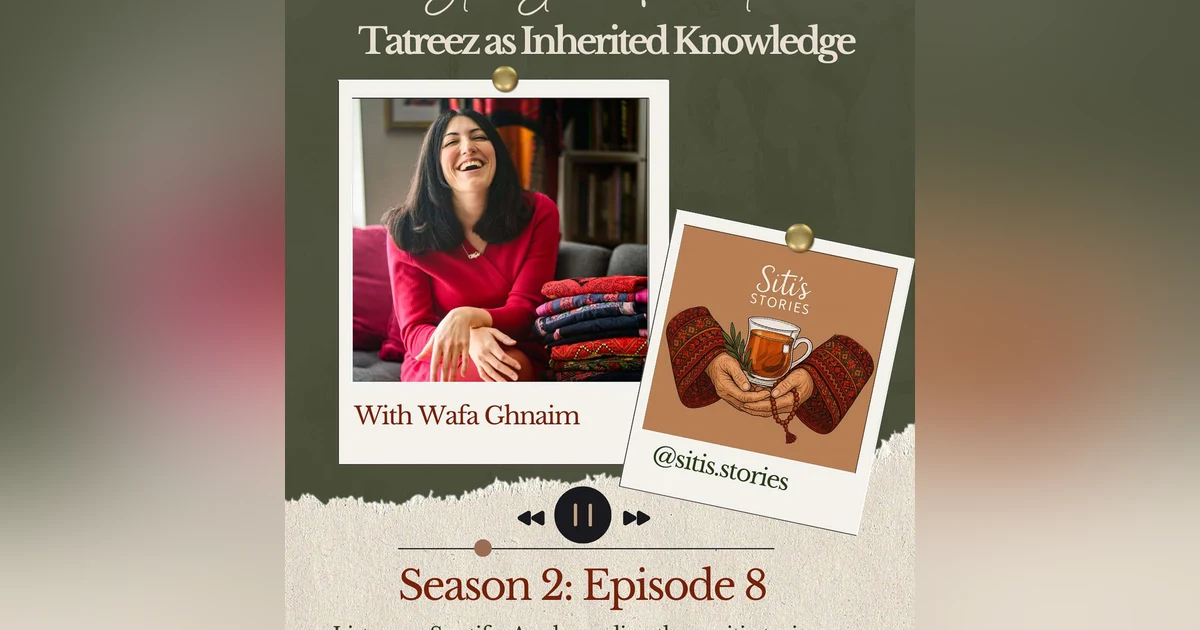


In this episode of Siti’s Stories, Laila sits with Wafa Ghnaim an art and dress historian, embroiderer, educator, and founder of the Tatreez Institute for a conversation about tatreez as inherited knowledge and preservation.
Wafa shares how tatreez entered her life as an intergenerational skill passed through the women around her, and how stitching became something she returned to again and again.
In this conversation, you’ll hear about:
- Her journey from classroom teacher to researcher and eventually becoming a historian of Palestinian dress.
- Her work with major institutions, including the Metropolitan Museum of Art, the Art Institute of Chicago, and the Victoria and Albert Museum & why museums that hold Palestinian dress have a moral and ethical responsibility to steward these collections transparently and accessibly
- How witnessing the genocide in Gaza has changed her, and how she turned to writing, archiving, and sitting with the dresses as a way to endure
- The lessons Palestinian women past and present have taught her about identity, self-expression, and being unapologetically yourself
We also settle some very important (and very serious) fashion questions… belts on thobes.
This conversation holds it all: the personal, the educational, and the lighthearted.
Additional resources mentioned in the episode:
- Wafa’s publication with the Met: Tatreez in Time
https://www.metmuseum.org/perspectives/tatreez-in-time - Traditional Palestinian Costume by Hanan Munayyer — one of Wafa’s mentors (including the hot pink thobe discussed in the episode)
https://interlinkbooks.com/traditional-palestinian-costume/
Learn more about Wafa and her mother’s work at:
🌿 tatreezandtea.com
Connect with Wafa:
📍 Instagram: @tatreezandtea
Connect with Siti’s Stories:
🎧 sitisstories.com
📸 @sitis.stories
Do you have something you always go back to when life feels heavy? Like when you need comfort or a tool to help you cope? For my guest today, that tool is Tatriz. Today I'm joined by Wife Echem, an art and dress historian, embroiderer, educator, and the founder of Tatriz Institute. In this conversation, we talk about Tatriz as an intergenerational practice, her journey from teaching into research, her relationship with Palestinian dresses, and the responsibility she feels carrying so much trust from her community. This conversation moves between the personal and the historical, the heavy and the light, including some very serious fashion debates about belts and sleeves. This is Dity Stories. I'm your host, Leila, asking you to pour yourself a cup of tea and listen in to the stories that remind us of who we are and where we come from.
SPEAKER_01Um attitude. Always had some good jokes.
SPEAKER_02Okay, that's awesome. Um a lot of your work really feels like it bridges between generations and between art and research. And I know you share a lot of personal context within your book, Tatris and Tea, so we won't really kind of get too much into that. Uh, I recommend everyone to go pick up pick up a copy. I have one downstairs on my formal like living room coffee table. Um, and everyone who like comes over, like loves flipping through it. It's so beautiful. But for those who might not know your full story, can you just kind of take us back a little bit to where you're from, what venue you're from, where did you grow up and where do you live now?
SPEAKER_01My mother is from Safad and my dad is from Jaffa. And I um grew up in Oregon and I'm currently in Washington, DC. It was a big transition and I miss living near my family, but I think a lot of the work I've been able to accomplish and kind of what I've had access to for in the museum world and and and the way that my work naturally evolved. I'm not sure that it would have been the same way had I stayed in Oregon.
SPEAKER_02Yeah, no, that makes total sense. I grew up on the East Coast. I love the DMV area. There's always like so many things to be done, and so many people go there for work. So I think that was like such a natural fit for you. We know how much our family really impacts our life, and for you specifically, it really kind of transformed what your future work would be doing. You began learning from your mother, the incredible Fidiara Basi Um, and eventually started teaching and writing books like Tatris and Tea and Thovna to guide others on their own Tatris journeys. You've really documented your family story so beautifully. And that was something that like really drew me to your work, is because I was the person in my family to kind of like, you know, ask all these questions and try to find my own ways of like documenting it and recording it. Um but what took you from wanting to document your family's story to sharing it with the world as well?
SPEAKER_01Well, like I talk about kind of in the preface of the book, T Tudis and T, is that um it's always been a discussion my mom had with me growing up was that we should write a book and that I could write a book about this one day. And so it was just to me an inevitability, and I still look at past drafts of what's now known as Tesides and T, but was titled and written in various ways throughout the years. And I think about it, and then it's like amazing to me that it's been almost 10 years since the book was published. As of 2026, it'll be 10 years, and just how far it's reached, and that I didn't ever think that it would be be spread this far. And I'm honestly always surprised when people have taken the time to read the book rather than just follow me on Instagram or on social media. I can tell when people have read the book because I left a lot of questions there in that I've been following up on for the past 10 years. And yeah, so it means a lot that that there has been such interest and my mother's history and that maybe Tatriz and T has provided a little bit of a framework for others to document their stories.
SPEAKER_02Yeah, yeah, totally. You've also went on to found the Tatriz Institute. Can you walk us through how that journey began and what inspired you to create that?
SPEAKER_01It was really natural evolution, like anybody who has asked me about my work. None of these choices were contrived in an strategic or like, you know, very particular path that I had laid out or a plan. You know, when the book was published, it became that people wanted me to travel around and talk about the book. And then as I was traveling and talking about the book, people were asking me to teach embroidery. And that's when I was realizing that other families had that broken lineage of knowledge. And that's really how I started teaching in 2017. And then when I was teaching embroidery, people were asking about the history. So I started talking about the history, and it's just it was a total natural evolution. When the pandemic hit, and I was I began teaching virtually a lot. I was teaching like eight to ten classes a week. At that time, there was only maybe a handful of people teaching in any capacity at all of Palestinian embroidery. I mean, I could count on one hand who who was doing that, and I don't even know if it would fill up my hand. So I started teaching virtually through Instagram Live for free on my porch actually. But when the lockdown ended and people weren't quarantined anymore and I could teach in person, that's when I was really tired of teaching and I really wanted to go back into researching because that when you teach for so long and for so intensely, a lot of questions come up for you in the process. And I needed to answer some of those questions and research allows me to do. So that's when I went into research, and then that's when I started collecting the dresses because that aided in my research.
SPEAKER_02Yeah. No, I I love that it was something that was totally authentic to you and who you are, and you let it grow organically. Um, something that I love about your work is how research-based it really is, because it really allows for the conversation of erasure and our cultural preservation to be at the forefront because we are backed with evidence. And so I love how you kind of are like a scientist within tetris and cultural dress. It's really impressive. And so you make Palestinian cultural feel seen as something that's like really dignified and important, and it's something that we're not really used to. So if you can kind of walk us through what does your research process look like, do you begin with a dress, a motif, a question that you want to answer? Kind of walk us through your mind.
SPEAKER_01It's really all of the above. There isn't a single research methodology that I take on. Every object has its own, dictates its own methodology. So if I have a dress or a headdress or something where I know the maker, let's just say, and I have her history, then I have a different set of questions in terms of how it was produced or how it was constructed versus if I don't know the maker of a dress, or that dress has patchwork and pieces on it that I don't recognize and that don't look authentic. So each dress, each object has its own set of questions, but it's within the art of close looking specifically, and this ability to look very closely on the details of a piece and or of a dress or headdress, whatever the object is, and in looking closely to observe all the various elements that allow us to identify it. And if those questions are unanswerable, how do we get those questions answered so that we can identify it? So for me, I mean, sometimes I start seeing a pattern emerge, you know, because I'm looking at collections all the time and exposure to collections is really important. So for anybody who is interested in research or researching or becoming a a published author or becoming a researcher, the most important fuel for that is to get in front of dresses and to physically see them and to learn how to look at them and to ask questions about them.
SPEAKER_02But where do you get access to those dresses and those pieces?
SPEAKER_01You go to the museums, you go to the collectors, you go online, you ask. And yeah, it just takes a bit of a sort of measure of courage, but you ask. And if you ask enough, the answer will eventually could be, maybe, yes. And the way that you get in front of those collections isn't just by permission, it's through funding. So a lot of the reason I've ever even sold classes was because I needed to fund my research. I needed to go on a to a certain collection, I needed to visit with a specific center that had an example of something that I had seen a pattern of. And that's sort of how the world goes around for me. So selling books, even, that's a way that I will fund some of these trips is through those, through my lectures. And that's mainly how I fund myself. That's why I don't have like I don't have a lot of like branding strategy and stuff because I don't really, I never really intended to be necessarily like a brand or a business, you know. So that's kind of how it works. And research, again, it's not really the intention of branding myself or building this brand that's about research. It's that I don't want to talk or do anything else. There's really no time in the day that I want to do other things. I just want to be with the dresses.
SPEAKER_02It's because like it's like the dress is telling a story, the pieces are telling a story. You're having like these kind of conversations like within your research. And so when you do your writing, when you take your research and you turn that into your writing, how do you balance the storytelling component with the evidence base? Like, how do you you kind of balance the emotion with the evidence?
SPEAKER_01First of all, yes, I think the dresses have their own presence. And I think that's a big part of why I'm constantly like shook when I'm around the dresses. I don't see that there needs to be a boundary between emotion and science. And maybe that's why people are interested in my work because I incorporate poetry and my response to witnessing history today as it's happening and the scientific aspects to the dresses and the analysis, the material analysis of the dresses that help guide my sort of direction. And I bring that all together because I don't view them as separate pieces. They, I think, are all harmonious together. And I really believe that the human condition allows for all of those things to coexist at once and that there's really no reason. I do have critique in academia and sort of formal ways of assessing dress in museums because often emotion is viewed as like invalid and like as a lower form of study. And it's not objective. But I think that's really a colonial way of viewing. That's a close way of close looking. The indigenous way of close looking isn't a spiritual experience, and that's what I embrace, and that's what I embody. And there's no argument I've heard that will alter my perspective, because that is one I've inherited from my elders and my mother and my ancestors. So I'm not sure anyone has the authority to stipulate its invalidity. And for that, I am a bit of a rebel there.
SPEAKER_02That's really valid because when you are indigenous to the land, there's something, like you said, it's totally a colonialism way of looking at things, of not understanding the spiritual connection and just only looking at things in such a black and white way. So I really like appreciate that insight. Which of your recent publications have been the most transformative or personal to you?
SPEAKER_01I think one that I'm really proud of recently was published by the Art Institute of Chicago. There's an exhibition there called On Lost and Absence, and it includes a Ramallah Ensemble. And I was asked by the curatorial team to study that dress and to write an essay about it. And I wrote the essay, and it opens with a poem from Mahmoud Darwish about her eyes Palestinian, her skin's Palestinian, her face Palestinian. I forgot all the things, but that was the opening, and that was kind of my like preamble. I try to open with my mother, the mother tongue of Arabic and some of my essays as a way to like establish grounding and connection with like my heritage. And then I went through history, and we didn't have like scientific analysis. So I didn't have like dye analysis done or fiber ID or any of the other kinds of things. So there wasn't anything scientifically involved with that, but it was like poetry, history, and of course some element of narration and storytelling and oral history. And then I also was able to draw patterns from the ensemble so that anyone who got a hold of the exhibition catalog could stitch in memory of the maker of the dress and the zadaye. So I feel very proud of that essay. And I even sent a copy of the book to Hanan Munayir, who peer reviews my research and I study with, and she was really proud of me. And I sent one to my mom and she was super proud of me.
SPEAKER_02So I was like, if you get those two women, then you have, you know, something really awesome on your hands. That's great.
SPEAKER_01I felt really good about it. It's funny. I know young ladies, but it still makes me feel very giddy and excited to have their support. What Henan said was, you're doing this the right way. And that felt really good because it's the age of social media where anything goes online. You could really say anything, it can go viral and people will believe it's fact and they don't check sources and and all of that. And so that particular essay feels really good. And it's on sale, so people want to support the exhibition, and they, you know, I obviously made an income from that essay and my contributions to the exhibition. They really supported me, and I just want to thank them for that. I hope people get a chance to see the exhibition.
SPEAKER_02Yeah, I'm I'm sure it's a reciprocal relationship because I'm I'm sure everyone who's, you know, viewing the exhibition and reading your work is very grateful and appreciative that someone is taking the time to do that work. That actually brings me to my next point with your work with museums and uh these institutions. So you've had a fellowship with the Met. How did you even find yourself getting involved with something like that?
SPEAKER_01I saw that they had a collection and I wanted to see it. And then I started visiting. I was fundraising my research visits for four years. I think I my first one was December 2019, my first viewing of the dress collection. I was the first on record to request viewings of these dresses. So I feel really proud of that. Wow. Um I started to methodically go through the collection with the curator who took interest in my work. And we did so for a number of years. And I actually I I earned the fellowship one year later than I had intended. I I they suggested in the Robb Testato Center where they um offer these viewing sessions as a public resource. Anybody can request viewings at the Map for like research purposes. They had said, you know, you should get funded for your research here and your contributions because you're contributing to the curator, curatorial knowledge and to the institution's knowledge. So I applied and I got it. I was really surprised.
SPEAKER_02But it takes so much guts, though, to do that, be able to be in these academic spaces or kind of these like, you know, world-renowned spaces. And so to have the confidence to just be like, I want to see these pieces. That took a lot of guts, like for you to be able to do that. How would you encourage people to kind of go about that?
SPEAKER_01I think what's just really important is to hold these institutions accountable. I mean, the point of a collection is to teach. So if they're not teaching or educating or they don't have the proper identification of the dress on on the I mean, they have an obligation, like a ethical obligation to steward their collection in a way that benefits society. That's the point of a museum. So the staff and the people at these museums, including the Met, are very much willing and able to do the right thing. They just, it's a colonial institution that they are now a part of it. So there's a bureaucracy that comes with that. And so I think there has to be compassion to them for navigating that institution on your behalf if you're coming in as an outsider. And I think that the most important thing to remember if you're going to engage with a museum or an institution that has a Palestinian dress collection is that you aren't going to be able to own the dresses. If you don't think that institution shouldn't have it, I definitely don't think you're wrong, but they have it. So legally it's in their possession and they legally own it. The next best thing to that is to make sure the attributions are correct, to make sure it's correct, to make sure you can access it as a Palestinian, to make sure these dresses are even being seen. So I think the most important thing that people should walk away with is that um like an abrasive approach to these institutions and museums, like is not going to get you very far, I think. And I'm not saying that we should pander to the tastes of colonial institutions and elites or anything like that. But if you genuinely want to engage with the collection, then I think approaching it in like good faith and knowing that the other side is doing the best probably that they can, and they're probably stirring like a hundred different countries and cultures, you know, at the same time. That I I just think that that is a really important part of doing anything in this work, in this field. Yeah.
SPEAKER_02Yeah. And then you just being at those institutions allow you to kind of reclaim our Palestinian narrative as well just by being present. What do you hope you're like the curators that like you're working with at the like at these institutions? Like, what do you hope they take away from the work that you're doing?
SPEAKER_01That there is a way to engage with Palestinian arts and culture in a way that they don't have to address maybe contemporary issues. Like they can talk about our history, and there's enough academic like citation bibliography grounding that they can simply elevate the collection in some way, improve its attributions and its archival record, and not have to feel that they have to speak to their own personal opinions about what's currently happening. Like what the genocide has has brought into the museum world is this sense that you can't touch this topic at all. And that's what I'm that's what I'm referring to. So right now, the tendency is to be silent and to not create, you know, whatever kind of contentious discussions they view will happen. I come in and I'm engaging with the dresses. I am a dress historian. So there is a way to engage in this from the field of art history, from the field of anthropology. Way that strengthens the academic grounding and continues to ethically steward the dresses, and that that's possible. Sure that um I'm sure that black fashion historians, I'm sure there is many Latin ex dress historians, like I'm sure they have to grapple with their own, the own, their the delicacies and specifics to their own community, especially right now. Um, and especially Latinx dress history and and any form of academic that even interacts with that culture and that community. While I care about what the curators take from my work, what I care more about is Palestinian what Palestinians take from my work. Because I view myself as not engaging in gigs or bookings or a job. I view this as a duty. And if I'm not bringing anything back to my community, and that's largely why I stopped, for instance, teaching. There's a lot of teachers now. I'd really like this for them to teach their classes, for them to find their footing in the in their own fields, whatever they they want to do, it's time for me to take a step back. So I retreated into writing be because I felt it was best for my community. So at this point, for me, what really matters is what I'm bringing back to my community. And it's always been that way.
SPEAKER_02You said something really interesting of like, I would hope my community knows that I like feel this way or like what they're kind of taking away from me. What you are doing with preserving our history is the only way that allows us to move forward into our future. Like, and so I think every person plays their role and every person has their strengths to a free Palestine, to a liberated Palestine. And so I I think what you're doing is extremely powerful. I know you've seen so many pieces and so many thobs, and I'm sure, like you said, you have this like deep connection with each one of them. But has there been one that really you'll never be able to kind of forget that story?
SPEAKER_01It's the story untold that's haunting me. It's the hot pink dress in Hanan Manay's book. Every time I visit her, I I asked to visit the hot pink dress. It's in her book Traditional Palestinian Costumes, Origins and Evolutions. Woman from Gaza, from the Gaza region, from the region, she wore a fully hot pink dress every day. And what year is this? It goes back to I think we agreed 1920s and 1930s.
SPEAKER_02Wow. Okay, so 1920s, she's walking out in Ghazza with a hot pink dog.
SPEAKER_01And so Hana says 1940s, but we just yesterday were I was like, I think it's 1920s and 1930s, so that's my theory. I think it's a little older. So, first of all, I'm excited about the fact that this woman had so much personality. Because I think one thing we don't really talk about in our culture are the sounds that the dresses make and the headdresses and the coins. Like, I think because we're used to seeing them on mounts, but when you put a coined headdress on, it makes sounds. Like at every single move, you have a jangle. Then on top of that, I think we don't talk much about what kind of bold fashion statements are made. Because I think generally speaking, we're like, oh, this is cultural heritage. And we have this very romantic idea of like a common village woman, you know, in her sob, like making food in the kitchen. She wore this dress every day or all the time, or most often when she was out of the house, and she was head to toe in hot pink. So I just find that to be a very bold fashion statement and an expression of her personality, and it makes me even more curious with who she might have been. I've only found two other dresses that are within this genre of neon bold art style out fashion statements from this village from this time period. So apparently there was this like sentiment. There was a sentiment that this was it. And I really love that idea and like thinking through what that means, like when you're picking out the thread and when you're picking out the fabrics, and when you're picking out, you know, how you're gonna wear it and how much embroidery, and is it your everyday dress, and all of that, and what people might say, and then how her children, and and that's where it really what it comes down to is that you know, I wrote Titsudis and T as a study of my mother and my mother's stitches. And I view the rest of my work not as anything more than that, except for that I'm honoring the stitches of other mothers. So this woman was seen by her children and by her family and by her village or her town to be the lady with the hot pink dress. And so I think that's just an interesting like thing to imagine. And and my mind kind of goes wild. But I also have the sort of paralleling scientific interest in how hot pink dyes were created and what are all the ways that you can mix dyes to produce hot pink, because hot pink pink is a light red. So how could they lighten the red and then create this vibrancy through the dyes? So then that's where I'm like, well, let's do a dye analysis and what lab will do this dye analysis will help me figure this out. And sometimes I can capture the imagination and interest of scientists, and sometimes not.
SPEAKER_02No, that's so fascinating. It leaves so much to think about. Um, because we know that thobs carry stories, they carry personalities of the people that are wearing them, and so it just leaves so much to think about. My I'm gonna my daughter would absolutely love to see that picture of a hot pink thob because she wants hot pink on everything. And Palestinian women are just so versatile and they are so many things, and we are always bold, and so it's just so empowering to kind of see that that existed even so long ago when no one else was doing it. What has been the oldest piece or thob that you have ever gotten your hands upon, and what has been that story?
SPEAKER_01Well, I thought it was an 1850s, 1860s still, but it actually ended up being 1870s, and it's in the collection of the Met. And I actually wrote about it in my essay for the Mat, Titsities and Time. It was a dress that I noticed had stitches in the chest panel that were not so stitched by the same hands that stitched the skirt. And I spent years studying that dress, but my conclusion was basically it was a young woman's like first thulb. She stitched the chest panel and her mother stitched the skirt. So I think, but I think it's around 1860s, 1870s, and I'm did a number of uh analyses while I was at the Met and afterwards with the approval, of course, and blessing of the curatorial department and everything to analyze it materially. And I'm in the process of writing an essay about that particular address because it's so old, and I think it's we need to talk about the oldest pieces, so and like on record, yeah.
SPEAKER_02Yeah, that's so interesting about how kind of it it's touched so many hands, like it went from her to her mother, and that's just what Tatriz is. It's a communal aspect to it, there's a familial aspect to it. I've read your Tetris in Time essay, but I'm very excited to read your next new work on it. You are currently a fellow with the Mellon Foundation at the Museum of the Palestinian People. How does this fellowship allow you to continue your work? And what kind of research or preservation are you currently working on?
SPEAKER_01That particular project, which is like a part-time kind of fellowship, so I have other things happening at the same time, is intended to essentially digitally map the objects in that collection for the Museum of the Palestinian People in Washington, DC, because they have like a wide array of objects, so I'm not just focused on dress and embroidery. It's a bit of a challenge because of that. I'm having to focus on objects that are to me secondary because I'm such a, yeah, I'm a dress historian, so that's what I do.
SPEAKER_02This has other pieces within the collection.
SPEAKER_01Oh, yeah. Like there's a vessel that was blown by an Armenian family in Jerusalem, you know, and there is like an iron key. Yes, I'm sort of pushing myself out of my comfort zone by um by studying these other objects. And we're really trying to use cartography in a way that is not only digital and interactive, but that allows people to understand objects as it connects to geography and as it pertains to its travel. And that maybe we we could sort of map the exile of the objects into the United States in similar ways that we might be able to understand people and those like conditions of people. And so yeah, so it's still in its early phases at the project, and we just began, um, and it looks very promising. And um, but it's a short amount of time. So we're sort of testing this approach within a limited period, within limited funding, and we'll see what we come up with. And I'm also consulting like part-time with museums. So museums just reach out to me and say, You want, you know, your you your support in this Palestinian embroidery exhibit. Or like in Baltimore, they invited me to exhibit some of the dresses from my collection. So I try to stay as like nimble and helpful and supportive as possible just to try to use and steward the knowledge I have as best I can from the United States, and especially having, you know, the support of the women before me, the dress historians before me, like Udad Grawad, Hanan Mane, and my mother, even Maha Abu Shoshi. I haven't had a chance to meet Mahaseka, but I hope so someday. Our daughter Iman. But just having the support of those that I've been able to work with, I feel even more like a duty to be as helpful as possible in as impactful ways as possible.
SPEAKER_02Yeah. Wow. So much of your work actually circles around the women who came before you, like your mother, who you've written a lot about, have been inspired by. Um, and then all those inspirations that you've just listed, who are giants and powerhouses within their own right. And then also to think about the women who make the dresses that you are researching, you know, all of those kind of take us back to our Siddhis. And so when I say Siddhi, it doesn't necessarily just mean your Siddhi. It could mean literally all these like wonderful inspirations that you have, these elders within our community, um, and our ancestors as well. And so I would love for you to care about your Siddhi. And so where she came from, um, what bench she's from. Did she have a neck bar displacement story and where she kind of ended up and things in between?
SPEAKER_01My mother's mother is from Suffod. My mother was only two or three years old in 1948 when in April 1948 when Suffod was depopulated. So my grandmother was really the one that gave me so much of the content that I wrote about our Nekbah stories and tea. Um, I'll keep it kind of general because I don't, I don't know, I I get too emotional. It's it's hard to talk about it. It's not like a casual story to tell. But but yeah, it was uh a stormy day. And actually, if you go to the Nekba archive and listen to any of the Suffolk exile stories for that day, everybody reports that it was just pouring down rain. And um yeah, they walked to Syria. They walked to the Syrian border and they took a bus and they didn't know where it was taking them, and they ended up in Syria in one of the refugee camps. So, and that was the last of it. I mean, you know, haven't been able to live or really visit. My mother hasn't been able to visit her childhood home. And my grandmother passed away over 10 years ago, unable to have ever returned. And yeah, it's it's a story that is really difficult to share because many of those that have told me the story have passed away. Oh, I'm sorry to hear that. That's the nature of kind of, you know, what an extended why this is such a painful and psychologically like overwhelming and difficult place to be in an exile is this sense of closeness, but really not being close at all and conducting ourselves in such ways to try to stay connected with the land and to try to stay connected with heritage and culture because that is at minimum the inheritance I have and what I can do from the United States.
SPEAKER_02I also find it really difficult because of the fact that it's not over yet. It's not a we're talking about the NECB experience, and then it's like, but all was well after that. We're literally still witnessing it, and so it's just it's really heavy to think about and to listen to. The reason why Sithi's stories kind of came about as a project was because I lost both of my grandmothers in the span of two years and oh my god. Um yeah, it was well, now see I'm gonna get emotional. But where where it came from was with one of them, the first one who passed away, they're both of their names are Hanima, so I can't ever specify in this story. Yeah, my paternal grandmother passed away first, and I was so distraught that I didn't record her stories, and I always asked, but I didn't like document in like prof like in a you know, in a way that can kind of provide longevity. And so, but I was like, okay, I have to get my other Siddhi's stories then because their stories are so valuable and so important for us to kind of really preserve and also share. And so I was able to record with her actually two years before she even passed. And then the genocide started, and I just didn't feel good about pursuing, I didn't feel good about putting something out. It just, I don't know, my heart wasn't in it, you know. I we were like all just distraught with what was happening. And then she passed away last year, and so I was like, oh my gosh, like thank you. But I was just like the same way that we are letting these women and these elders who experienced the NECBA, um, they're all passing away now. And they're all at that age where, you know, we're letting those stories kind of pass away with them if they were never told or preserved or shared. Yeah. And so that's kind of where that came about was I was like, I'm not the only one who, you know, has experienced this. So that's why I know as emotional and as hard of a question that it is to ask my guests, I just think it's like of such importance. But when you do think of these women in your life, um, your Siddhis or your inspirations and your mother, what are some of the lessons that they have taught you? And how does that show up in the way that you move throughout the world?
SPEAKER_01Well, first, I am so sorry to hear about your grandmother's passing, both of them. There is no loss in family and in friends that we can emerge from unscathed. They all change us in some really fundamental way. And that's why I think the scale of the genocide is so unfathomable to us at this moment that it is going to take centuries to understand the impact it has had on the people there witnessing, the people surrounding who are an immediate threat to the genocide continuing and spreading, and then to those of us forced with almost our hands tied to watch. It's a kind of torture to experience that. And I just wanted to share as well that when the genocide began, I had a really hard time selling and selling fabrics and kits and books. And this isn't at all any type of a commentary about anyone who has. And I'm so glad others have been able to pick up that thread and keep preserving our heritage through their different shops and initiatives online. So many have have done that. But for me, one of the ways that I was affected was that I was just one, I needed to write. I had to, I didn't want to cut fabric anymore. I didn't want to assemble kits anymore. I didn't want to print things anymore. It was just like there was this sense of like, I need to write and I need to look at the dresses and I want to be close to the dresses. And that that was my coping mechanism. And I know just for those that are listening, for some people that have reached out to me asking, why don't you do cool TikTok videos anymore? And why don't you, why do you not talk to me about fabric as much and or reply to all our messages? And it's like, I changed. I changed, I was changed. I I'm I'm not that person anymore. And I even look back at some of the videos I created in the reels, and I'm like, wow, I I miss her. But what we've all witnessed changed me in this way, where I just want to be with the dresses and I want to write. And maybe that's because when I was really little and helping my mom with the dresses, that's how I dealt with difficult situations. Didn't get glasses until fourth grade. And by then I was very, very impaired visually. I had spent years in elementary school being bullied and unable to see what was happening. Wow. A lot of the way I coped with it is by being with the embroidery and keeping the embroidery as close to my face as possible and the books. It was books and embroidery. And that's how I coped in my visual impairment through my childhood, and now I'm emotional. I think that's just my way of coping. And, you know, it's the what's kept me going, I guess. The lessons that I've learned from my city and my mother, and mainly like my maternal family. Um is how I think to keep my candle on a slow burn because I am holding a candle. No matter what happens, I have to keep holding this candle. Because I have this knowledge and I have these dresses, and I'm in the field that I'm in, and I want to do it all the time, and I don't have anything else I'd rather do. So to keep that going, I can't have big flames and small flames. The flame can't go out either. So I can't pinpoint lessons through words, but through experiential gleaning, I've learned strategies to allow me to keep that candle burning at a low burn and a slow burn so that I can rut as fast as I can. It's kind of like how Beyoncé talks about, and I know that that's like problematic right now, but how Beyonce learned how to sing and run at the same time. Okay. You know, to control her breath. Yeah. Control her breath. So she had to like jog on a treadmill or something, like sing her songs. Like that's what how she grew up. I had a similar kind of training where I had to run and hold a candle, but a very like symbolically that candle. Metaphorical, yeah.
SPEAKER_02I appreciate people who are passionate about the things that they love and about their crafts. You're kind of like taking it back to what Tatriz was when we look when we think about our Sitties times or when we think about our great-grandmothers. My grandmother, for example, one of them, she used the power of stitch to be able to come to America. And so she was in Falestine, she was sewing thobs for other Palestinian women and being able to kind of tell their stories through their own a thweb. But then she faced some difficulties in Fallstein and had to come to America. And so she was able to use it as a mechanism to be able to pay her way to come to a better life for her and her family. And so I think we all use different coping mechanisms, and I think we all find ways to uh overcome our struggles. And so um, what better way to do that than um a way that preserves our history and that it feels so close to you and who your family is? Um what are some of the favorite dishes that your Siddhi cooked for you?
SPEAKER_01Of course, a family favorite is always grape leaves, what at the wadi. Um and my favorite favorite in my family is melfuf. So anybody who makes melfuf is like an Yeah, favorite.
SPEAKER_02What have you learned about Palestinian womanhood through the lives of the woman around you, but also through the stories that these dresses tell?
SPEAKER_01Hmm. They've definitely helped me redefine what beauty is in my adult life. I think there was a period of time where I thought wearing black was slimming and flattering and all of that. But I lost a lot of personality and fashioning my body through just focusing on the aesthetic of beauty and not the embodiment of beauty. And so one thing that I think the dresses and my the women around me, my family reminds me of is that I can wear whatever I want, whatever color I want, any way I want. And I really love being able to put on a hot pink dress. And I really love um belt something that might not have been intended to be belted.
SPEAKER_02Okay, well, hot take, hot take. Do you think all thobs need a belt? Can you get away without wearing a belt when you wear a thob?
SPEAKER_01Yeah, yeah. Who says you have to wear a belt?
SPEAKER_02A lot of people are like, what are you doing? You need a belt. It's not a finished look if you don't wear a belt.
SPEAKER_01Well, that's a new perspective. Because when I was online, when I started my account in 2015, people didn't did not know how to wear a thulk. So people were like, Oh, how do you do that? And I didn't wear a belt. I don't always wear belt. I don't feel like it. No.
SPEAKER_02I don't always wear belts either, but then I get like comments like, did you forget your belt? And I'm like, no, this is intentional.
SPEAKER_01Yeah. Some of the dresses are fitted specifically to your body. So especially those from like the mid-20th century on, they're a little bit more like fitted into your silhouette and tailored specifically for that. So that you could definitely get away without. I think the really wide ones or the ones that are not maybe they won't map for you. So they're extra, extra wide. They were built for a different body or something like that to be baggy on another body. Those ones you do you might want a belt because then you can't see all the embroidery and and stuff like that. I think I don't who who says you can't, no. Wear like a belt, wear a contemporary belt, wear a traditional belt. It doesn't matter. Don't wear a string, wear a necklace around your waist if you want, who cares? No, we can fashion our bodies any way we want to fashion our bodies. And even women traditionally fashion their bodies in any way that they found useful. Like some would even tie a scarf around it. Like also, what belt? Like you can pick any style of belt. And I know I feel like some of that, the stuff of what's like in and out, I feel like is so new. That's why I mentioned earlier when I started my account in 2015, I saw no presence of a discussion around Palestinian embroidery online. That's why I started the account. And um, and it's just interesting to I've seen a wave of people not wear belts. And then I remember in like 2021, 2022, people started to be like, you have to wear a belt. And that's when I really like owned out because I was like, why? And then I was like, oh well, I don't know. You know, things are in and out. It's like sleeves. Sometimes they want the triangular sleeves. There are eras in the past where women thought the triangular sleeve was like it. At some point it was like the half triangular sleeve. Other eras and decades, they loved the cuffed sleeve that the narrow sleeve. So I think sleeves and belts are kind of all in the same category. Like it just depends on your personal taste and the contemporary tastes as well. Yeah.
SPEAKER_02Oh, yeah, totally. I just wanted to throw that in there. So when you look back at your journey, how much love you've accomplished so much so far. You know, you've gone through teaching and researching. What have been the moments that like have really challenged you the most?
SPEAKER_01Oh, that's hard. I have a really difficult time when the wrong information is shared online. And I've been extremely challenged by relationships on social media, like because of that. But I do really deeply feel gratitude for the trust I have in the community. And I take it so seriously sometimes when I see misinformation, I just can't, sometimes I can't sleep. So I take my role so seriously. And those are areas of growth, even for me, you know. And and I don't know if people view the people they follow online as people who need to grow, but I can tell you that just like you and just like anybody else, I I have areas that I'm working on and strengthening and growing and healing myself. I because my goal is to make this more accessible. I don't want anyone to feel alienated and that process of healing and growing is something I think we can all do together. And again, the effects of the genocide have been so horrific and just affected all of us on such a cellular level.
SPEAKER_02I think the genocide for sure has pushed people to think a little bit differently, or at least I I would hope so. On the flip side of things, what are some things that you know you experience or that you go through that kind of really feel like a a reaffirming of yes, this is exactly where I need to be. This is exactly like why I'm doing this work.
SPEAKER_01The fact that I can wake up every day and feel like a moment in the morning, that I get to to be with the dresses and I get to write about the dresses, and I get to think about the dresses, that is always a sign that I am aligned and that I am in the calling I am to be in, and that this is where where I belong. So it's just an unshakable truth. And and I think that um that deep joy and excitement and contentment that even though I struggle, I have things, I I have a lot of obstacles that I've had to overcome, and I continue to have to overcome every single day. People that, you know, are getting in my way to do something, or people who are disparaging of me, or people that they're just all these kinds of forces that come at me. I view those as signs that I'm in my light. When you're in your light and you're in your calling, it creates extreme reactions from people. The majority of those reactions are positive, but there's also the sort of subset of reactions where I found in the work I'm doing, it's this sense that because my work is in cultural heritage, that there's an entitlement to my time and my labor at all times, every hour of the day. You know, do this for me, do that for me. What's this dress? Should I buy this dress? Should I not buy this dress? All kinds, how do you mount this? It my phone makes me the most overwhelmed.
SPEAKER_02And I can't imagine on the scale of you who you are a teacher to so many. You're that expert opinion to so many.
SPEAKER_01That does for sure get so overwhelming. It is overwhelming. And I try to take it in stride because I really am trying to do the right thing. But I then also give myself silent permission to simply not reply to everything, that it's okay. I I try to prioritize students, former students, even in that qualification, I can't reply to all the students because I'm still every day getting questions from it. And that's actually the beauty of teaching and being an educator, is that because I taught so many Palestinians their first stitch, I am forever their first embroidery teacher. That is so special to me. So I always try to live up to that standard of like, let me reply to this, even if it's a month later. That constant access, I think it creates this impression that that I'm available all the time. And so that that is has been a blessing and a curse in a sense, because I love the community um and I love this work. So I love to see a challenge. Oh, what dress do you have? Let's look at it, you know. But just at the same time, I feel like I'm I'm I'm disappointing some people by not being able to be available to them.
SPEAKER_02You know what I think is so cool and kind of outweighs like if you didn't message them back quickly enough or adult or whatever, is you know, the people who you've taught how to stitch are could possibly be at an age right now, or maybe like in the upcoming years where they're teaching their kids how to stitch. And so then it creates like a whole new lineage of their family members who are now following up with Tetris and stitching their own thobs that you know, you're like in their family life. And so I think that's really, really special and really, really neat.
SPEAKER_01Um I hope so. I hope they consider me their auntie or sister or something. I hope that they feel that way. Yeah. I hope. Yeah.
SPEAKER_02And so when you think about all of the things that you have published, the essays, the books, and you know, the lectures that you've given, what story do you hope is it all kind of tells, like when you're thinking about when you're a city? What's that legacy? What's that story?
SPEAKER_01Well, I feel I'm writing my own legacy as I go. And I don't hope for anything except for that it's that I've I can be known for having moved the field forward substantially in the time that I was alive. And that I did so honoring and respecting and citing the knowledge lineage that I belong to. And that's what I I hope and I feel that I accomplished with the essay for the Met, the cities in time. I used my bibliography as a space of activism. I privileged Palestinian sources. I cited Palestinian women, and I even in my gratitude line, I only thanked women, Palestinian women. In that way, I uplifted everyone with me. And I know they felt that way. Those that I cited and those that I thanked in my essay reached out to me and felt that that I not only did I move forward in my career, I brought them with me. Yeah. That that's really, really meaningful because I am not here alone. Like you're hearing my voice coming out of my mouth in my body at this moment talking to you. But I, in every word and in every discussion around our history and dress, have been informed through the words and the lives and the bodies and the mouths of my own elders and my own ancestral. And this is a compilation of that. Yeah, I've inserted my own conclusions and I've found a way to communicate it in English. And I have my own opinions, like my own theories and things like that. I'm otherwise informed through this great knowledge lineage that I really hope continues to carry with me into the future and until, and then I hope then for my students when one day they're writing or they're doing something, that they carry the knowledge lineage that brought them there as well. We're all stronger together, actually. And this is something that Mene talks about all the time is she she would always say, like, I don't really understand people who don't cite their sources. You're so much stronger when you have others saying the same thing as you.
SPEAKER_02Backing you up, yeah. We're not all here alone. All of the work that you have been able to do has been throughout the inspiration and throughout the teachings and wisdom of all these women before you. Yeah, that's so special.
SPEAKER_01And bibliography is the community. That's where you can thank your community of people that informed you, Palestinian or not, but it shows who you are. So if most of your bibliography is colonial sources, that tells a lot about who you are, whether or not you like it. Crack, who do you prioritize? Whose voices do you prioritize? And that goes for every scholar, I think. Me in particular, I always try to represent my community in that bibliography. And I view that as a very meaningful space. So I hope that that is one way that I can influence. That's talk about the reluctant influencer, but I want to be an influencer on bibliography.
SPEAKER_02That's fantastic. So we always end every episode with a reflection back at the woman who kind of began our stories, our cities or your mom or your elders in your life. If your city were here with us today, kind of drinking her shay, listening in, serving her attitude, what do you think she would be most proud of?
SPEAKER_01I think she would be the most proud of how close we all are in my family, how much we respect our culture, and that no matter where we've been placed geographically, there's still a closeness to the homeland, to our home and homeland, but to also our family and our family's legacy through this cultural inheritance we're keeping alive. And I know that my grandmother was so deeply in love with Safad and being able to look out her window and see Tabarille, you know, the Lake Tiberias, and being near the water. I hope that this romantic side of her would also appreciate that like poetry and oral history and that her wisdom and that of my grandfather too. It it moves us all together in the afterlife and in life. Like we're all connected and I see them and I feel them every day.
SPEAKER_02Yeah, yeah, that's so special. I'm sure that you're making your ancestors very proud with the work that you're doing. And thank you so much for sharing your wisdom, your care, and your dedication to our cultural survival and bringing that into Sitti's stories. I really appreciate it.
SPEAKER_01Thank you so much for having me.
SPEAKER_02What I personally took away from my conversation with Wafat is just how intentional she is with everything she does and the care that she has for the woman who came before her, and for the dresses she studies and for the trust she holds within our community. It's very present in all of her work. You can check out WiFat's preservation work at the Tries and Tea both on Instagram and on her website. I'll link everything in the episode description below. And as always, you can find us at cities.stories on Instagram and at citystories.com. Thank you for listening to Sith these stories. Until next time, ma's a salama.


