
Growing up in Gaza with Najla Khass
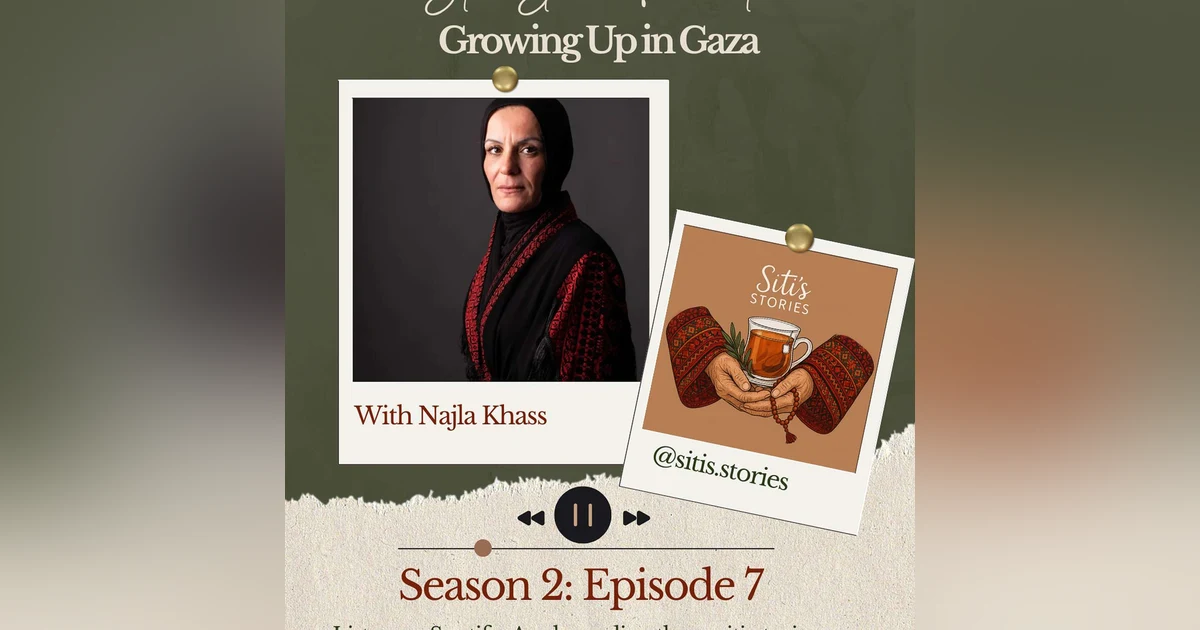


In this episode, I sit down with Najla Khass, a Palestinian-American activist and refugee resettlement manager. Born in Gaza, Najla fled with her family at eight years old during the First Intifada, part of a long history of displacement that traces back to the 1948 Nakba.
In this episode, we talk about:
- Growing up in Gaza with fear and restriction but also so much love and the ways her parents tried to protect shield her living under occupation.
- Soldiers as a childhood boogeyman and the constant presence of unknown
- Arriving in the U.S. as a traumatized child and experiencing so many levels of culture shock
- She shares stories of her grandmothers whose humor, courage, and resistance shaped her understanding of strength and resilience.
- How Najla uses her lived experience to support refugees with deep empathy and awareness
- Building community and advocacy through House of Hope, a home and network created to support Gazan refugees with dignity
This conversation was recorded before the most recent ceasefire, at a time when emotions were already heavy. Listening now, Najla’s story feels even more urgent and even more grounding in its reminder of how lived experience can be transformed into helping others.
Connect with Najla: Follow Najla: @lady_najla80
Learn more about House of Hope: gazahouseofhope.org
Connect with Siti’s Stories:
Follow Siti’s Stories: @sitis.stories
Visit: sitisstories.com
Growing up, Najla thought her life was normal, that the limits, the fear, the constant presence of soldiers were just part of everyday life. It wasn't until much later that she understood how much her parents had tried to protect her and how her life was not everyone's normal. Today I'm joined by Najla Khas, a Palestinian activist and refugee resettlement manager, born in Khazzah, who left at 8 years old during the first of the Fada. She carries with her memories of a childhood shaped by occupation, moments of fear, but like all Palestinians, the strength and resilience of her family. In today's episode, Najla speaks about the realities of growing up under occupation and having soldiers as boogeymen, not being able to play freely outside, or even walk to her grandmother's home. But we also talk about what happens after a displacement and how Nejala's childhood continues to shape the advocacy work she does today and the future she's building. This is Siddy Stories. I'm your host, Leila, inviting you to pour yourself a cup of tea and listen in to the stories that remind us of who we are and where we come from. Thank you for having me, alhamdulillah. Before we deep dive into the work that you do, we love asking a Siddhi-inspired question. If we were sitting with your Siddhi today in her living room right now, what's the first thing that she would offer us?
SPEAKER_01Not tea, not coffee. It would be fresh fruits and vegetables. I love that, yeah. Yeah. Um it's a little awkward, but I definitely, that's one thing I remember when I was a little kid. Um, and I always mention it to people. I'm like, uh when I was a child, I used to eat raw eggplants. She would definitely offer you a plate of fruits and vegetables. Straight from her garden? Yeah, straight from the garden, free, straight from the best in Assan uh you know, market. You know, it was always a story to it.
SPEAKER_00I love it. I think we're such an agricultural like community and people. So I love that that would be like the first offering. So let's take it back to the beginning and get to know you a little bit more. You know, what Bella is your family from, uh, where do you live now, and kind of everything that happened in between.
SPEAKER_01I live in New York. I am originally from um Chiaya, from Wazel. I yeah, I fled here to the States during the first Intifada. And I've been here since October of 1988. Uh I came here with my siblings and my parents. Back in the day, people were able to receive working visas, and that's the opportunity my dad was able to do. Um, he ran a sterling server company um in Tel Aviv, and um he was able to bring it here to the States, and we were able to come and live a life that we weren't given the opportunity to live in Palestine. I was born in Shiva Hospital. I lived in Shijaya until I was eight years old, and then when we came here to America during the first intifada.
SPEAKER_00And that's what pushed your family to come, was the first centifada?
SPEAKER_01Uh my dad always had the opportunity to work outside um of Reza. Um we really didn't see him much. He was always, you know, in and out, working an Entel Aviv majority of the time, and come visit us during Aid, during Ramadan, special occasions, birthdays. Majority of all dads that live in Falestine are separated from their families due to the fact that there was no opportunity where they are. So they had to find a job or a way of living elsewhere. That makes total sense. Do you have any memories? Can you remember? You will be surprised when we sit down and talk and reminisce with our parents, the fact that they would be surprised and how much we remember. Um, I have a lot of memories. I I went back to Gaza back uh when I first got married. I knew how to guide my husband to where we lived.
SPEAKER_00Wow.
SPEAKER_01I knew where the dahela was, you know, Sut Lefras, which is in the Shijaya. Um, I knew exactly where to turn to get to my um grandmother's building. We were there one time shopping for other reasons. It was his brother's uh wedding, and I'm just like, oh, I I lived down that street. My husband's like, how do you remember? I'm like, yeah, and it it was just It's like muscle memory at a certain point. You will be surprised how much I have I've had memories of our Hakura. I have memories of Asaf, Lil Asaf Dejesh, Adiyaf. I have memories of exactly what had happened the day we were cleared to go from the bridge to Shajaya because my mom came back from America and we were able to go see her, and she was able to take us with the permission of the US Embassy and fly back to America. Like that day, we have a lot of memories. And alhamdulillah, that's something I'm very much uh grateful for because we live off what? I mean, now we have to continue talking about our memories. We have to continue talking about who and what we are because there are certain people that are out there to erase us off of this earth. So if it wasn't for our memory and if it wasn't for our stories, how are we able to tell and remember and teach? No, totally.
SPEAKER_00That's why I think projects of preservation are so important, is because it's capturing the memories before they're forgotten, forgotten by us as well, too. Right now, this generation of elder women, right? These generations of Siddhis and CDs. Unfortunately, they're passing away and we're not hearing their stories first. And I'll ask like their kids or their grandkids, and they're like, no, we never actually sat down and looked about it. And I'm like, but now we don't have it at all. Obviously, the oppressor is trying to erase your own stories, but even us as our community, we're not doing enough to preserve our own stories as well.
SPEAKER_01I mean, we have someone like you that is definitely this is an amazing uh project that you're doing. It's just a fact of capturing our memories, my generation, because my mom and my parents really don't talk much. It is a sign of it's trauma. Like you don't talk about it. And when they do talk about it, it's like being brushed off, like, oh, it's a laughing matter. It to us, we you know, we know that this is not a laughing matter, but it's just like, oh, what's the big deal? But what's that far from? Oh, the Yehud, you know.
SPEAKER_00Well, because they're not trying to get too into it, because if they get too into it, then it's like it floods all the emotions. But we have to, yeah, yeah. I'm so glad that you were able to have memories though of your time in Fallstein. I lived in Felestine for like the first five years of my life, and with my Siddhi, that's why I was so close with her. When I just passed away, no, that one was in America, but the my paternal grandmother passed away two to three years ago, like almost three years ago. Um, and and so yeah, so I lived with her in the bed, and uh I cannot remember a single thing, a single thing. Like literally, like the only thing I remember is the shade of the door of her front door was that green that like was that door, yeah, you know that door, yeah. Wow, yeah, yeah. And so it's but when I went back in 2017 with my husband, again, I don't remember anything, I don't remember any memories, but I knew how to get to my city's house. I knew how to guide him to that house. It was the oddest thing.
SPEAKER_01But you were the guide for your grandmother when you were taking like walks from one place to the other where she we because my majority and our grandmothers are like you know, hold on.
SPEAKER_00I was only like four at the time, and I mean like she was like 40, like she was like a very like young yeah, she like guided me, and yeah, but so like literally like yesterday I was at a picnic for my Ballad, and um I had this like old lady who came from the Blad, like my city's ages. She came to visit her son, and I've no recollection of this lady whatsoever. And she came up to me and she was like, You're later bent to Sama, and I was like, Yeah, and she was like, Oh my god, I remember you running around the Hara with your city. I was your city's neighbor, you used to always come. And I just wish so badly I could like remember those memories, but um I think like you know, when you're young at a certain age, like you can't just can't remember those memories. But yeah, I so I love that you're able to like have those memories. Can you share with us a little bit more what your life was? Do you look at your life like in chapters of it being like my life in Ghaza, my life after I moved out of Gaza? Can you share with us like what was your life in Ghaza?
SPEAKER_01My life in Ghaza was I thought it was a normal life. It just consists of, you know, living as a child, but in ways where it was like survival mode. Like we weren't able to go to the hakura in the backyard at certain times. To us, it was like stay in the house, khaliquum, but in reality, when I come to think about it now, which because at that given time it was men at the journey, no one was allowed outside.
SPEAKER_00Yeah, but your parents like were able to kind of shield you from that. No, no, no.
SPEAKER_01No, they used to remember my grandmother would always tell me, is it like and I would not go outside in the Hakura because it was just fihayabara. And that was the only thing that my grandmother would always tell us. Like my mom's mom was um lived in one hour in Afulaimara, and then my dad's mom would, it was just a couple of steps, and then she would live there. We weren't even allowed to go in hand la hand. And if we did, it was against the wall to my other grandmother and Matamalouch thought. Like, don't make noise because it's like we're we're in trouble. You know, I have an older, one-year-old brother than me, and we would walk to school and he would walk with his arm around me, and we would walk up the dahala because there was shish. At that given time, there was shish in every corner with their huge um, you know, rifle and their huge green hat. That's my boogeyman, and it's huge antenna walking. Back in the day, it was, you know, for for satellite or whatever, it was just like a huge antenna. And it it was it was fear of the invasions in the house. They would come and they would line us up all uh, you know, outside and asking us where the boy was. I was Sati, you know, halimah, sitti subhab, we they were always together. Um, I do believe I shared a picture uh with you. It was always in the hakurah, they're always together, always doing things together. So our haqkurah was open to the main street where the jama was. So if there was a young man that threw a rock or is running away from the jipsh, he would go through where? Through our backyard. So Sitin, Allah, they would always like and they would cover them over their, you know, their shashiyyah or their skirt. And then Adin biqbizo. Or I didn't be na' dokhiyyah. Oh my god. So it was it was that, like that was our memory. Um I do remember one time it did happen, and it was me, my older brother, and my other sister. Um, we were sitting there eating some. We would like it was like a sandwich of filfil, like red shatta, filfil, and that was what we would eat. That was one of our sandwiches. It wasn't a cheese sandwich, or nor was it peanut butter and jelly sandwich. Shut up. It was shutta, filfil. And I remember we it was at like two two steps, and we were just sitting there, and they ran through me and my brother trying to get to the main street to get away. And my grandmother wasn't able to catch him and to hide him. Uh, but they, you know, the jayish would come through and he was interrogating my grandmother. I'm going from being sad to laughing because she offered him a bitin jan that day. The jayish. She's like, Bid dak bitin jan. So when you asked me that question, it was just like, ruh mishminha. It didn't go through here. What do you want from him? To us that was just like, okay. And it was memories of of fear, memories of uh um what's to come and Allahu Alam. There's good memories and there's bad memories.
SPEAKER_00It's just like overall like instability. Your parents did the best that they could to kind of like shield you from this and create a childhood for you. But the circumstances that you guys are in, it's it's hard to shield. You could try so hard to shield your kids from that, but if it's in their everyday life, how do you shield? And it's just sad that kids and kids are still experiencing the same exact thing.
SPEAKER_01Still experiencing 100%. Um I went to an Orthodox uh school, Dirlatin. It's not standing. That was my school, Dirlatin. Um, Muslims and Christians uh attended the school. I do remember that it was Christmas, and my teacher handed us a gift, and I have that picture with me. It was my mom, my teacher, and me holding on to my gift, so excited. I mean, it's it's Christmas for them, but she gifted me that gift. And you have my sister and my cousin, they're facing this way, looking at what? Looking at the Debaba. That's not far from us.
SPEAKER_00So that was, you know, and like you try to like live your life, but there's still that looming oppressor there. Yeah, yes, 100%. So something that's like kind of coming up is you're, you know, through your memories, like you're talking about these places like El Shifa Hospital and your school that like, you know, we see on the news like right now that are either completely demolished or you know, have been completely disrupted. What is that like for you, like having to view that?
SPEAKER_01Heartbreaking. It's definitely it it's heartbreaking, but at the same time, you gotta understand there's so many times that Gazda has been hit and attacked and then rebuilt again. It's not the first time. It's the first time to this extent, but plenty of times where they've hit and we were built. Um, so we have that hope. Also, at the same time, and this is written by Makir, Allahu Alam. What's the come of this? Allahu Alam.
SPEAKER_00Yeah, I just can't help but imagine that you feel like you're kind of living in two worlds at the same time. I feel like you're physically in New York, but then yeah, Falustin is like all of our homes, but this was your home there, like you grew up there. I just can't help but imagine that. It's just like an outer body experience for you.
SPEAKER_01Alhamdulillah. This is, you know, Rabna is giving me the strength. Wallahi wallahi at the end of the day, it's Rabna and Imanwin al-Dabna.
SPEAKER_00Yeah.
SPEAKER_01He's giving me power. He's getting not just me, like my parents on a daily basis. They're siblings. I mean, my grandmother passed away because of high cholesterol. She wasn't able to get to get taken care of. So it's just the simplest things that the Palestinians, not just in Ghazza, Palestine in itself. It's happening the same in the West Bank also. You know, in Janine, we make dua, we continue doing what we're doing, you know, we continue to talk about Palestine, we talk about our family, our ancestors, who and what we are, continue educating. I mean, I always bring light to the fact that I really didn't talk much about myself. And sad to say till recently. Yes, everybody know that I was from Palestine and it's from Gaza, but deep down, personal stories. I always thought, like, oh, dahamid can adora, they'll never believe what I will say. You know what I mean? They'll never believe what I went through. I've always said I've lived three lives. It was the life that I lived in Palestine as a child. Then it was the life that I lived when I came to America, it was a totally different life. I could go to the backyard and play as I please. Wow, subhanAllah, something that simple. I could, I could ride my bike. It's okay. To us, it was just like, oh wow. And then it was like, oh, the plane up there. To me as an eight-year-old, it was just like cringing, like we would run inside the house or the fire the fire department, or the ambulance, or the fire alarm in school. It was all these triggers for you. I was just, it's just it was just too much. That was my second life. Then my third life, it was just like my marriage, my children, wanting to let them know who and what we are. Because Anna Jose Man Ghazza or Anam in Ghazza. So it was me always instilling the love for Falas Sin and letting them know who they are. They have to continue talking about Falas Sin and they have to continue being being able to utilize their voice because Ahlnah, Ahl Baba, and Ahl Mama are still in Ghaza. Like we're not gonna forget about them. I always had that relationship with them. So we have to continue going to your best ability to never forget and to always continue and to encourage our parents because I'm sure they have more memories than me, but they block.
SPEAKER_00Yeah. Well, hopefully them seeing you open up and share and talk about these things will give them a space to feel like they can do so as well for them. I just really appreciate you sharing kind of like the earlier parts of your childhood. Just because I feel like when you set that tone of your childhood, it really shows uh what kind of path you were able to take in the future. And your childhood really led you to the path that you're on today. I would love for you to talk to us a little bit about how you became a refugee resettlement manager uh with ICNA and if you could tell us a little bit more about your work.
SPEAKER_01I didn't know what I wanted to do after I got married and I had my children. I I just it was just like a passion. It was a volunteer type of thing. Um, I had a passion to help. And then came the refugees that I that came from Syria about almost 15 years ago. It grasped me to wanting to be able to help them. It kind of reminded me of, oh my god, these moms are here with their children. I wonder what they're going through. I wonder how their school day is. I wonder how they're making friends. It took me back to me. Yes, yeah. The eight-year-old Neshla. I wonder how when they're in the schoolyard, I wonder what they're doing or what they're going through. Or they're playing or they're in a corner. I wonder how their mom dresses them. Are they I wonder what their lunch box looks like. Is it zetulzata with the pita bread? I wonder if they're being made fun of. I wonder how their teacher is treating them. That kind of opened my heart. I went out and I I reached out to, you know, the these families and I just made sure that their children knew that I was there. It was my therapy. Does that make sense?
SPEAKER_00Yeah. Did it open up unhealed wounds for you that maybe you didn't deal with?
SPEAKER_01It was wounds, it was memories, it was heartbreaking stories that kind of the older Najla, you know, said it's it's it's okay. You know, you you are who you are now because of what had happened.
SPEAKER_00Yeah.
SPEAKER_01You know what I mean? I I made sure that when I first came to America, just one random night, one random night to us, there's a doubt knock on the door, and it was a bunny and Spider-Man and other other people that were just wearing weird stuff. And trick or treat, mezla was like candy, grabbed candy from her bucket, thank you, and closed the door.
unknownOh my god.
SPEAKER_01Imagine how my day was the next day as a third grader.
SPEAKER_00No, yeah, I'm sure that same girl came up to you and was like, you stole my candy. That's that's such a unique experience. And then it but I'm I'm so happy that you were able to use your experiences of such a rough transition to help other kids, and you have just such a good insight on like what it means to be that child, but then also like from your mom, and now you're a mother, what it means to then be in a mothering position as well. So exactly, exactly 100%.
SPEAKER_01I use those stories, I use those incidents, I use that as an example. I let them know that it's okay, it's okay to be you. You do come from a different country, you do come from a different world. My experiences in school with the you know, the fire drill, let them know. And I would explain to the child, you're gonna have a fire drill. This is what it means. The things that I experience, yeah, and I would let them know, and I would also let the parents know, you have to understand that this is a journey for your child, also. It's just not just yours. You have to understand where you live, you have to understand. I'm not saying to forget your identity and you know, become someone else. No, I'm saying to merge both together.
SPEAKER_00What I think is really cool that you do is that the parents are receiving help finding housing and helping them set up their finances and and their jobs and things, but you are really thinking about the children and kind of all these small nuances that they're going to experience. Hearing you talk was reminding me of a funny story. So I came to America like a month before kindergarten started, and I spoke not a lit of English. Not even yes, not even no, nothing. Um, they put me into kindergarten and the teachers told my parents something that nowadays in education we would never tell parents. They told them, do not speak to her a word in Arabic. She will flip all of her Arabic to English if you do not speak to her in Arabic. Um and it'll it'll happen really quickly. She'll get it really quickly, and this way we won't have to like have her like be held behind. I started kindergarten and I didn't I knew nothing. And um you know, everything in the bed is so community-based. Like nothing is yours, everything is everyone's. We started art and the teacher was like, Everyone go get your art aprons. Uh-huh. I had no idea what was going on. I just followed what I saw everyone else doing. And so I saw them all get up and I saw them all go get this thing. So I just saw one that I liked and I was like, oh, okay, I'll wear this one for today. And this girl got so upset at me, and she started crying, and it was this whole thing. And again, I have no idea what's happening. I just like the teacher's trying to talk to me, the student, the other student is like crying, and I have no idea what's going on. But I mean, long story short, everyone had a their own apron. I did not know that. I thought it was just like community-based. You just go, you pick it, and you wear it for hers. Yeah, and I wore hers, and it was like the end of the world. And I just never forget that feeling of feeling so like I did something wrong, but I have no idea what I did wrong. Unless if you're in that position, will you understand those small things? And so I just find that incredible that you're able to be there for those children to help them navigate those small nuances. Something also inspiring is that um I read that after October 7th, you actually opened up your own home to refugees from Gaza. Can you tell us a little bit about that experience?
SPEAKER_01I mean, after October 7th happened, a lot of the people in Gaza that were green car holders, had family here, were able to leave um and come to America. One of the people that did come here didn't have anybody. So I just from being out there and and people knowing that I am from Gaza and from Palestine, uh, I'm able to help in some way, shape, or form due to the fact that I did resettle refugees prior. Um Afghanistan or from Syria or, you know, any type of refugee that came along, I was able to help. Just a word of mouth that someone had asked, are you able to help her? I said that of course. I was able to bring her into my home, get her situated. The community helped from her to other people uh that came here to get their children taken care of medically through organizations. Yes, they are here on a mission. And yes, they are here to get whatever it is that they need to get done and to go back. But there's one thing that people do need. They need one-on-one communication, conversation, that he's saying no, we are here for you. It's not just through money, not to materialistic things, it's time. So that's what I provided. The reason why my home was opened was not because I was able to collect money for them and provide essentials for them and a home for them. I was able to welcome them in my home and provide that sense of security that's anyone that came into my home, that's what I provided. It was just like I had them sit down in my home on our dinner table with my children and let them know that I'm just I'm not just here because you need something specific. I'm here if you want to chat. I'm here if you have a simple question, or, you know, just to have a simple conversation. That's where it all started. And then I've come to realize that what's going on in Gaza is not short term. I need to think about the future. My home is, of course, open anytime to anyone, but I needed to give them a stable home here in the States. I need for them to be able to call it a home where they're not in someone else's home. It's theirs. Yeah, and like not a guest in someone else's. And then that's when House of Hope came upon. It's a house that currently holds about four families that are here on different journeys. But one thing that they they are together on the same journey is the journey of finding themselves, finding themselves in a different country, but at the same time knowing that what's going on in Gaza is long term, but they are here for each other. And then also for me, being part of it, but also at the same time taking care of my life, my personal life, my children, my family in Gaza, but being part of theirs at the same time. It is a way of opening my home, but in a different home, if that makes sense.
SPEAKER_00Yeah, like opening up yourself and your family as a support system for them, but they have their own home that they could feel a little bit more comfortable in. Right.
SPEAKER_01There is no one asking them who, what, where, why, and how. Um, I mean, for God's sake, they left that in Gaza because they were not able to go anywhere unless they're questioned. They're not able to leave um, you know, their hometown to go in a different uh uh country or whatever unless they're quite they're questioned, not by, you know, their family or their community, but questioned by the occupiers.
SPEAKER_00You know what I mean? So, how were you guys able to acquire the home for House of Hope? It's in New York, right? It's in New York, yes.
SPEAKER_01Um, I always say House of Hope really is not owned by a specific organization, nor is it owned by a specific person. It is owned by the community. Um, it is owned by us. This is a project that is owned and ran by community members. You have Gazans, you have Gazazwa here in America in your own neck of the woods, provide for them, help them. You're able to meet one-on-one with them and understand what it is that they need. So it's a community-based uh project. It's being taken care of the community. Um, I'm referring to materialistic-wise, financially, um, emotionally. You're going to have some hope and you're able to have a cup of coffee with the families that are there. Making them feel that they do have someone that's going to knock on their door and be like, hi, how are you? I'm here just to have a cup of coffee or a cup of tea. Yala, let's go. Um, we're going to Juma'a prayer, we're going to a specific park. You want to come, I'll take your child with me. Making them feel like they have a home, away from home.
SPEAKER_00Yeah, I'm so happy to hear that you were able to help the community organize such a community effort. Hearing you speak about the hospitality that you have really makes me think of our siddis who taught us to be really generous with our time, like not just with our money, but with our time. Um, and it sounds like you really carry that spirit of hospitality and generosity forward with all the work that you do. I would love to hear a little bit more about your sitdis.
SPEAKER_01100%. I wouldn't be able to choose one over the other. So I'm gonna mention always together.
SPEAKER_00Well, uh Sitti Halima. Still think is crazy that you have a Sitti Harima. Both of my sddis are named Harima, which I always thought was crazy that both of my sddis were named Harima. Aside from my family, I never knew other Siddhi Harimas. The amount of Siddhi Harimas after I started Siddhi stories, I'm like, is everyone just have a grandma named Harima? I have a baby. I'm upset with myself that I didn't name her Harima because we could have kept it going, but I have my sister's names Kharima, all my cousins are named Harimah.
SPEAKER_01So it's Halima Mindalma Pur, and then there's Sitis Sabham Daratamawi. Both originally are not from Shija'iya, but they were displaced in the Shija'iyyah after they left Beatima back in 1948. That's where we uh we are originally from. Um both very I mean, Palestinian city is not strong-willed woman. And I'm pretty sure with all the city interviews that you have done, that's one word that we describe our grandmother.
SPEAKER_00Yeah, it's a commenter. Everyone is just insanely strong-willed, resilient. We were born to be that.
SPEAKER_01Like we were forced to be that. It's instilled in us, and we were born to be that. That word. Yeah. Are we uh, you know, strong-willed, but at the same time, I bet you we could all say, under all that, it's that mushi loves Ben Hanoona, and after all that, you know, there's layers you have to dig deep. But I uh, you know, Sita Halimala at Hamad, she passed away while I was still young. Middle school sister Sabha, I I was able to alhamdulillah take my two children, my two girls. My eldest, she was five years old at the time, and my other daughter, she was a give or take uh less than a year old. So I was able to take them and they met her. She didn't believe that I had gone down to see her. It's just a a wonderful memory of her. A lot of memories that I do have with both my grandmothers, they were always together, was just always in the kura, n'hbbuz uh khbuz. You know, it's like a huge saw chicken, they would flip it. Another thing that I do remember, and I am a pro at it till this day, and they we used to always make the bread in the khakura, you know, and with the big sage. But at the same time, when there were so many of us and we have to make khbubs for the week, we would always like yellow khudul khab, would you khabas to the to the you know for to the bakery. And the bakery was really was wasn't that far away from us. So sitti can't take shriita and she would wrap it around my head, she'd place it, and she'd be like, Yalla Najla, khudi. And she'd place the sunniya for Rasi and Yallah, go. I would walk in with uh with the sunniya over my head to the khabaz, yhbazdiya home, and then he would cover them, and I would walk back to my grandmother's house.
SPEAKER_00So you you had your Siddhi in training. There are there lessons that your Siddhis taught you that still guide you to through today?
SPEAKER_01Just being strong. Even like when the Yahud used to come into the backyard, I used to always run behind Siddhi.
SPEAKER_00Yeah. Abandoning you you said the story of the Jesh is coming and she's like, Do you want Abandon Jan? They were just so fearless. Like, remember, like, be strong.
SPEAKER_01Had this woman. You know what I mean? The day my mom came back, my Amrika, and she went to Shijaya. My mother left us in the bridge to go to America. So when she came back, they let my khati know that to come and to take to see my mom. And you only leave your home with uh a specific document or isn't. So they they they let know from one checkpoint to the other and know fi had um and the day that that happened, well I said that yesah, I'm gonna go to the house. We went up to the dababa and he came out of the little loophole, came out, and he gave us an isin, and he said, to Shija'iya. Ijri. Me, my siblings in Khalti. And Anna Imaji Hamla Arusa Abuya can my dad gave it to me when he came to one uh visiting us one time in Tel Aviv. He he would he would give us toys, my siblings in Khhalti were running through the fields. I recall it was fields of oranges. My grandmother, Jibi Humuyallah. Tabaan Eh, when we got close to the house, we were a bunch of ninjas. You know how like ninjas they walk against the wall and look and chat fa'esh, and people in their windows, like fishy and right. It was just like being guided by other grandmothers. And when we ran into, you know, my grandmother's and she was like laughing about it.
SPEAKER_00I'm like sitti and they have this sense of like tawakul, but also this intuition and this pattern recognition that they've been able to just develop. Like it's just a wisdom, a strength, intuition. Wow, that story gave me like goosebumps.
SPEAKER_01We got to my mom's house, guess what?
SPEAKER_00No. Your grandmother was probably so mad. If only you listened to me. What ended up happening?
SPEAKER_01I remember the next day, um we all got dressed up and we left Akura. I was gonna ask, what was that like leaving your grandmothers behind? I was a child. What I cared for was I'm going to Amrike to see Abuya. Yeah. Yeah. We were all wearing like different outfits, cool outfits. All my cousins came and I I have a picture of it. My mom was holding onto this picture like the deer life, and I don't she's holding like I'm like, she's like, La, Surana. I'm like, mom, just give it to me. I want to make a copy of it. And I don't blame her.
SPEAKER_00Yeah, that's all she has of that life. I don't blame her at all.
SPEAKER_01Yeah. But yeah, that was the last time I saw my grandmother. Um my mom's mom. Site im Abuya. I went back to Ghazar and I saw her in Amalifetta. She played with she played with my kids and she was taking me, Wallahi. She was taking me around, and she's like, and I'm like, so back in the day when I when I went back, the wedges were in style. So she insisted that Anna Albus her shipship and she would wear my wedges. So this settlement I had a picture of it too. She wore my wedges.
SPEAKER_00She wanted to show you off. I mean, she wanted to show everyone, look, my my granddaughter from America. And she was still able to walk with them. That's adorable. Um, I'm so glad that you were able to, you know, have that memory with your city of going back and seeing her and having her meet your kids as well. Um, mashallah, a great grandchild, like a great grandmother. Were there any traditions that she passed on to you or like things that you remember her doing that you've carried on? And how do you continue to, you know, carry that on with your children?
SPEAKER_01One thing that I do carry, and it it's it's the most powerful thing, but the most simplest thing is il uwa. Like it's always like, oh, well, both, not just one of them. So I think my you know, il uwa lifiyya, it came from them.
SPEAKER_00Yeah, I can see that. That makes sense.
SPEAKER_01You know, the personality. So that's that's one thing, you know, the power that I that is instilled in me, it it it came from them. The memories that I have of them reminds me of like, well, this is how I this is why I am who I am and what I am and how I do things. You know, I think that's so special.
SPEAKER_00Were there favorite dishes that you had that you know you loved when your suttis would make them?
SPEAKER_01I didn't know how to say it back in the day. So we used to always call it sukkamiya. What were you trying to say? Summaya. It's uh it's a traditional dish. It's made on special occasions, but I do remember Sitti um would uh would definitely make some ma'iyya. Do you make the dish yourself? Yeah, it's a very special dish, 100%. All ghazaswah. You ask anyone, you know, like how from your specific town where you're from, there's a specific there's a special dish. There's a lot of dishes. There's, you know, summayah, there's hard there's ru'idra, uh, salwahadas. Those are the dishes that um we make. I gotta ask my sister-in-law, she's from Khaza, I gotta ask her about all these dishes. There's a you know, Umbarad Alhamdulillah, you know, Qazim was able to open up his branch in Egypt. So my children, when they went this past summer to visit our family on both Antsma, they were able to evacuate Qaza Alhamdulillah, they were able to go and they were able to have a little piece of like gazza with them.
SPEAKER_00I think that's something so special that you can pass on to your kids. I think food is something that is just so easily like translatable throughout generations. Your city's clearly live through you with their legacies and big legacies come hard moments. What have been some of the toughest challenges in opening your home and with House of Hope and just doing the refugee work in general? How did you push through those moments?
SPEAKER_01When you have a passion, it comes easy. When you're doing something and you're so passionate about it and you love doing it, you find yourself doing it and doing other things along with it, not realizing that it's being done because it's coming from within. In the So to me, I don't call it challenges. Nothing is easy. There might be where, you know, when I'm welcoming them, welcoming them in my home, at the same time, you kind of forget you have your own family. Yeah. When you're taking care of other children and you're taking care of other family's children, you tend to see that you're drifting away, not taking care of things of your own. Yeah, that's very valid. Yeah. I kind of didn't see that I was, you know, m'asra with my own. But Wallahi Rabna subhanahu wa ta'ala knows my intentions and knows my motive, that he was taking care of my own children. And I realized that after the outcome of how my children react to things, how they are acting, specifically being in the Western world, specifically being in the society that we are in. So those were the challenges that I faced, but I noticed them after. Does that make sense? I noticed. There were challenges that I, that we as a family were going through. Sub Ramana Wa Ta'ala was solving them without me going through the agony and the pain and seeing it after aftermath, not during. And always reminding yourself there's far more worse things.
SPEAKER_00Yeah, that's a good perspective to have, honestly. I don't think a lot of people have that perspective, but it's very much a needed one.
SPEAKER_01Yeah, and it's there's certain things, but drahbifiya, you're like, hello salah, more power. Yeah, this is nothing. Bring it on. Bring it on, you know. In other words, and there's certain things that are like, okay, let's manage it and take care of it respectfully. Because again, there's far more worse things.
SPEAKER_00On the other side of things, what have been some of the most rewarding moments? A moment that made you feel like, yeah, this is exactly where I'm supposed to be doing this work.
SPEAKER_01The love that I have for my community. We were at an event the other day, and um this volunteer just came from a different state. I was like, Oh my god, Sarah, hi, how are you? He's like, Well, why? Because I saw Sister Nash's name on this flyer. I came. Isn't that rewarding? Yeah. The trust. Yeah. That's rewarding. The love. I could go on talking about so many stories, but the love and the respect that I have for my community. And I noticed that and acknowledged that was the day my daughter did her katbittab.
SPEAKER_00Well, now it's not it's not a work thing, it's not a volunteer thing. This is a personal thing to you. And people wanted, yeah. Oh, yeah.
SPEAKER_01Just the love that my community has and respect that my community has for me and my children and my family. That to me worth every struggle and every hurdle and every thing that came at me.
SPEAKER_00Yeah. But I think that all comes from the hard work that you've put in already and showing that you're not just someone who's just speaking the words, you're doing the actions, you're showing up with empathy, you're showing up with love. I think you receive a lot of love if you give a lot of love. Yes. You get you, you get what you give. Touching upon community, how has the community responded to House of Hope? And of course, within our own community, but the larger community of San Island and New York.
SPEAKER_01I mean, when regarding the refugee, sadly it has come to a pause. Yeah. Inshallah. A pause. I'm not gonna say end, pause, but it came uh January 1st. January 1st, papers were being signed, things were being halted, stopped, paused, and then so in regarding the refugees, I've shifted it where I'm not receiving refugees from um resettlement agencies. Um, I I'm dealing with refugees that are already here and working and dedicating my time to them.
SPEAKER_00I know the community um that you're working with in the Arab community, the Muslim community, the Palestinian community. I'm sure they're very receptive and very supportive. But I'm curious to know kind of like outside of that community. So your Staten Island community or your New York community, the East Coast is a very Zionist place. So I'm just curious to see what's the response been. And have have you been able to find allies in new places that you never thought? Yes, a hundred percent.
SPEAKER_01Genocide, sadly, has opened up a lot of eyes. Has opened up a lot of hearts, has people questioning and wanting to learn more and wanting to hear. Years ago, I would say if I tell my story, no one will believed. If I sat there and I told them about my experiences with the Jeesh, my experiences with being in front of the debate. Baba with my teeth asking them for permission. When you talk about it to your neighbors when they did find out that we were from Philostine, Minreza, they were willing to hear. I was I was attacked, yes, in Staten Island.
SPEAKER_00Oh my God.
SPEAKER_01But I do believe it was just lack of education. A youngster lack of education saw me, didn't like my flag. Um, I experienced that. But at the same time, I brushed it off. Um, I was not gonna have him stop me in any way, shape, or form. I was very cautious moving forward, but I do have a experience, a good experience more than bad. I'm dealing with very much open-minded. Maybe it's because I put myself in an atmosphere where I'm I'm wanted to be heard. Do you understand what I mean? Yeah.
SPEAKER_00What's something that you wish everyone knew about refugees, especially Palestinian refugees?
SPEAKER_01They wouldn't be here if their home was left alone. When you are a refugee, you are forced to be where you are. I am forced to be here because I am a refugee. I seeked refuge from my own country. I was not, I'm not here because I want to be here. I am here because I am seeking refuge. That's what a lot of people do not understand. When refugees come from their country, they're coming from a war zone. There's a lot of things that are is behind the word refugee. They are not allowed to go back to that country for a good while. So a lot of people need to understand that they're humans. You are not any better than them, or nor they are better than you. So people need to understand, have some empathy.
SPEAKER_00What would you say to someone listening who doesn't know where to get started and how they can help?
SPEAKER_01When you hear about a project, when you hear about an organization, it's good to do your homework and to read about that specific project with that specific organization. You're able to be a part of it by inquiring and asking and volunteering and and giving in some way, shape, or form. You're a volunteer and your time is very much needed. Everybody thinks that it's all about the money.
SPEAKER_00No, time, time is just as important and it's it's just as an important way of giving your generosity. I always say that. My CD, Allah Yarhamohi, was extremely generous financially, but that was always something that like always stuck out to me with him was that he like put a huge emphasis on like being generous in like every aspect of his life as well. Being generous in your time that you spend in Salah, being generous in the way that you know you spend your time volunteering. And what's next for you? Like, what are some projects that are coming up on the horizons?
SPEAKER_01I mean, my my biggest project right now is definitely uh making sure that the House of Hope is very much taken care of, that it's there for any fellow scene, I mean Gaza specifically, that that they have a home. When when we get together and we speak and we talk about stories and we talk about our home, oh Ardna, or you know, specific street, specific place, specific clothing store, specific Mataham specific, Gaza is not that big. So for me to make sure that this home is stays open is for so many purposes.
SPEAKER_00How can our listeners follow along with your journey?
SPEAKER_01Majority of my posts and regarding House of Hope is on my Instagram. Um, and it's also linked to my Facebook. But I do welcome people to come and visit privately. I know every single person that has my ad the address to the House of Hope. Um so you're if you want to reach out and want to come and visit or or or send something during the aid or Ramadan is coming, and it's just making it feel home.
SPEAKER_00You guys should definitely do like a mailing program where you know, set up like a PO box where people can send, you know, gifts to the kids who are living in the home or the moms who are living in the homes or the dads, whoever, the family members who are living in the home. And so I'm sure a lot of people would love to send some stuff over. We always like to end our conversation with kind of the way we started with our sitties and keeping them in mind. If your sitti was here with us today, drinking their tea and their coffee, listening to our conversation, what do you think they would be most proud of?
SPEAKER_01Il-uwa strength. I think one thing that they would say, I bintamaui. Yeah. Because that's one thing my uncle always uh texts me. Like when he's displaced numerous times, or if he's sick and something happened, or he would always send me videos of his grandkids, and he would say, uh, bint'awiyya, zayikasiami. He he mentioned to me, he's like, you know, Sitti kehadkun fakurafiakyami. So I think it's the uwa.
SPEAKER_00You've definitely have gotten that strength from your sithis. And it's very clear and evident, and it's amazing to see how we can use our strength that we had to have because of the things that have happened to us, but we can really use it for a way forward and for a better life for yourself and for other people. Neza, thank you so much for sharing your heart and your story with us today. What you're doing, making a home and offering refuge and keeping memory alive is really powerful. It's been an honor to talk to you today.
SPEAKER_01Thank you. Thank you so much, Rukilaila. I appreciate your your idea of utilizing our voices. And I do hope that our mothers are willing to come and talk to you about their stories. I think it would be we would be intrigued on what they have to say.
SPEAKER_00What I personally took away from this conversation with Najina is how she carries her story forward through action. She didn't just survive what she lived through. She paid attention to it and she uses that awareness and empathy to show up for others. The work she does now, supporting refugees, building community, and opening doors for people who are starting over. It all comes from lived experience. If this episode sparked something in you, I really encourage you to learn more about House of Hope, a community created to support Khazdin refugees with dignity and intention. You can also follow Najida on Instagram to keep up and connect with her. All of the links are down below in the show notes. And as always, you can find us at cities.stories on Instagram and at citiestories.com. Thank you for being here, for listening, and for making room for stories that remind us we're never carrying things alone. Until next time, ma salama.


