Passing Down Palestinian Identity Through Generations with Amanda Najib
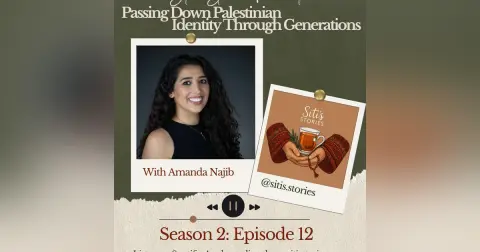


Our identity is shaped by so much more than where we come from, it’s shaped by the people who teach us what it means to belong there.
In this episode of Siti’s Stories, Laila sits down with Palestinian-American educator, PhD scholar and author of the children’s book Lana Makes Purple Pizza, Amanda Najib.
Amanda shares how growing up deeply proud of her Palestinian identity and especially the influence of her Siti has shaped nearly every part of the person she is today: her writing, scholarship, teaching, activism, and the way she raises the next generation.
From spending her college summers teaching English in refugee camps around the world to now teaching future educators how to honor the cultures, identities, and stories their students bring into the classroom, Amanda has built much of her work around the belief that our stories and where we come from matter.
At the center of her own story is her Siti and the village of Hizma, Palestine. Amanda reflects on living with her grandmother in Hizma at 19; cooking together, picking zaytoon, and learning from a woman she remembers as both deeply gentle and incredibly strong.
We talk about Palestinian identity and representation, education, writing, Palestinian feminism, motherhood, village life, grandmothers, and what it means to carry what they gave us forward.
Stay tuned until the end to hear the updates happening at Siti's Stories!
🔗 Connect with Amanda:
@amandanajib_writes on Instagram
🔗 Connect with Siti’s Stories:
Instagram: @sitis.stories
Website: sitisstories.com
I think a lot about where our sense of pride and who we are actually comes from. Because for most of us, there was probably someone who made sure we knew who we are. Someone who talked about home, told us the stories, took us back, or walked in their identity in a way that made us want to carry it too. For Amanda Najib, that person was her city. Amanda is a Palestinian American educator, PhD student, teacher, and the author of the children's book, Lana Makes Purple Pizza. Her Palestinian identity shows up in so many different parts of her life and work. From the stories she writes to the educator she teaches, to the way she thinks about representation and what it means for our stories to have a place in the world. But in this conversation, we also go back to where so much of that began. We talk about growing up in the Palestinian diaspora and being fiercely proud of it. Spending her college summers teaching English in the refugee camps around the Middle East. And what it was like to move to her family's village of Hezma at 19 years old and live with her Siddhi. This is Siddi's Stories. I'm your host, Leila, inviting you to grab a cup of tea and listen in to the stories that remind us of who we are and where we come from. So if we were sitting with your sitti right now at her house, what would be the first thing that she would serve us?
SPEAKER_01My gosh, okay. Can I have two parts? Because I have my sitto and then I have my tita, and they would both do great things. They made everything so great. I think my sitto and serve you guys all mashy. So she would make you kusa and doadi, and that would be her dish. Um, and then my tita from Nables would serve. Well, I'm thinking like she would maybe make uh leaven for everybody. She was just so good at it. It was one of my favorites, so she'd make it a lot.
SPEAKER_00Yeah, those are all really great choices, honestly. Food is just such a way to kind of connect us back to our roots and to our family. So if you could kind of take us back to kind of your beginning of just a little bit about your background, where you're from, what belad you're from, where you grew up, where you live now. Yeah.
SPEAKER_01Um, so I'm from Hezma originally, right outside of Jerusalem. Um, my sittas from there, my sitas from there, and then on my mom's side, my mom was born in Armen, but my teta um is from Nables and was very proud of that. So she would say and I'm in Javan law um the whole time I was growing up. Um, but I like root very much in Hezma. So I'm Hezmawiya, I'm very proud of it. Um, falaha, and I'm just like very proud of being from my village. I was born and raised in New Jersey. I'm also very proud of that fact because Palestine, like if you have to be stuck in a diaspora, North New Jersey is the diaspora to be stuck in.
SPEAKER_00So Patterson is literally like Palestine. So you're you're good, you're set to go.
SPEAKER_01And I'm really proud of New Jersey in that way. Like we are rooted in Palestine, being from New Jersey too. Um, so I never grew up like confused about that. I was like, I am definitely Palestinian. My sitto has always made it very clear that I belonged. And it's always like a thing that um meant a lot. So when I was 19, I moved back to Hezna to do a semester in Bierzit. And I felt like it was home genuinely. Didn't struggle, even when I couldn't fully communicate and say everything I needed to say. Like my sitto made sure she's like, this is your house, this is your land, like this is where you're supposed to be. I never had the discomfort of like, am I enough? Like I've always felt enough and I really didn't fit my sitto.
SPEAKER_00Oh, that's so special. That's so sweet. I can't wait to hear the ways that she was really able to kind of root your identity. That's so special to have that. And I do have to kind of start off the jump, letting you know that my mom actually got your book, Hannah Makes Purple Pizza, as a gift to my daughters last year, I think at Massicna. And my daughters are very picky eaters, especially my oldest one, and never ever really cares to eat Audobee food, unfortunately. My my seven-year-old, she has a very American diet of pizza, cheeseburgers, and chicken nuggets. And so she read your book after my mom gifted it to her and was for the first time actually excited to try Imsachtan. And she was like, I'm gonna try purple pizza. And she was like, it's so important for Falestine. Like she really, yeah. And so it was so sweet and so special. And so I just kind of wanted you to know right off the bat how much of an impact it really is making on little Palestinian kids. I would love to kind of talk to you a little bit more about that journey. So, did you kind of always imagine yourself as becoming an author? How did that kind of unfold for you?
SPEAKER_01Yeah, um it's funny. I don't know if author is a title. I I obviously hold it before called myself that. I definitely feel like a writer because I write a lot of things. Like feel like a writer. It's like an identity I feel and hold deeply. I had Lana, and I think again, being from being who I am and being from New Jersey, I never struggled with if I was Palestinian. I grew up in an all-American, nearly all white town. Um, and there was a lot of drama around Palestine all the time, and I was very vocal about it, and my parents supported how vocal I was about it. Um, so I never really thought of the ways that I was missing. Um, and like to some extent I was. I know I would like gravitate towards children's books that had children of color as the main characters, but I never thought it was possible to have a book that had a Palestinian in it. So I never thought through wanting it. But when I had my daughter, I realized like not everybody's gonna have this demeanor. Not everyone's gonna have this like, I'm here and I'm gonna take up space and I'm gonna tell you I'm Palestinian. Um, and I think I didn't realize it's embarrassing enough, but like I didn't realize that for 28 years.
SPEAKER_00I don't think that I don't think that's embarrassing. I think you were so strong in who you were. I think it's actually a very admirable quality to have. I don't think people realize how Zionist the East Coast is. I think if you don't live in that space, I don't think they fully realize how truly Zionist it is. It's still so embedded within the communities, within the schools. And so when you're constantly faced with that narrative that you have to kind of right off the bat say, hey, this is who I am, and you kind of have to stick up your for yourself before anyone even starts throwing things at you. It really does make a very confident, like rooted kid. And so I don't think that's embarrassing. I think it really is relative to your experience.
SPEAKER_01Yeah, yeah, it is. The East Coast is heavily Zionist. I mean, settlements in Palestine literally note that they are based off of New Jersey, that they're like, we added this place where we wanted this Jersey feel we knew. And actually makes me more proud that I'm like New Jersey, like we're in the diaspora of New Jersey. It's not just because we're there's a lot of us here. It's because we have to hold down such a strong force here because our there's so much Zionism embedded in the East Coast. There's so much power that we don't have here on the East Coast. I was fine being in elementary and middle and high school and needing to know UN resolutions and needing to know international law and needing to know our history in and out to never get caught. And I was young, right? I remember being in second grade, being like, no, under international law, people have a right to defend themselves. What like I'm like, I'm seven. So my parents were proud and they're still proud, and it makes me who I am today. But I kind of had my daughter, and I was like, I want you to know everything about us. I do, but I don't want you to be on edge like I was all the time. I don't want you to just know the parts that we struggle. I don't want you to just know our struggle. Our struggle is important, but it you also need to know how beautiful our culture is. And you also have to know that, like, it's okay if you're a quiet Palestinian. Like, it's okay if you don't want to take every fight. One, your mother will take every fight for you. Luckily, my daughter has grown up a couple years and she's gonna take every fight. So I guess technically I didn't have to have the worries I had when I made this book. Um, but I'm still so glad I made it. The picture's my daughter. Like, I like it's a running joke that like we could just like put that picture up for her, and it'll just it'll it'll just be the same. Like it is a curly hair Palestinian child with her olive skin. And I really am happy she sees herself, but I also really wrote it as a teacher. So I wrote it so intentionally, and it's why more than anything, whenever I get like a nice email or message, it's almost always from educators, but it's almost always from teachers being like, this was so great to teach. And I'm like, Yeah, yeah, it's why I made it the way I did. So how are they using it in their in their classrooms? Yeah, so people will tease me sometimes and they're like, Amanda, why did you use the word aroma? And I'm like, Oh, because I'm a teacher and aroma has a one-to-one definition that we can just transpose, right? If you say aroma and your kid says, What is that? You could say smell, and now they know a word. You could describe it in one word, and it helps with their vocabulary. I also intentionally put historical moments, obviously for Palestine, but also for like, oh, we can pause and do a turn and talk and talk about what the neckba is. We can look the illustrations are so intentionally done. My illustrator, who's a dear friend of mine, Lauren, is so talented. And while she's not Palestinian, she taught with me. We were co-teachers together in New York City. And she knows her culture so deeply and worked with me um through every single page. We were through a page. I have the worst drawings ever. I don't have an artistic bone in my body. So I don't know how she could decipher what I was drawing, being like, Can you make this on the page? But like nicely. Not only did she like bring my vision to life, she like brought my vision to life and enhanced it tenfold.
SPEAKER_00She is it came out so beautiful. Um, you speak about how you wanted Lena to really love where she came from and let a child be a child first and just fall in love with their culture and their identity and the place that they come from first. How did you feel when you were writing the book that you had to kind of balance the weight of our history as Palestinians, but then also the blending of the humor and the lightness of just it being a child's book?
SPEAKER_01What a great question. Um, it took me a couple decades to learn something I didn't know when I was younger, right? When I was younger, I had a chip on my shoulder, and when I was younger, I was defensive. Um, and the idea of like holding on to multiple things that are true was hard for me. Um and then I had my kid, and it just became easier. It became so much easier and more realistic to hold multiple truths at once. And the book kind of came alive in that way of like, hey, we can learn all about what happens to us and we should and also all the beautiful parts of us. So I didn't want to take away from what our story is. Our story is so important, and my daughter has to include in all of our kids have to include in. That's kind of like our life as Palestinians, right? Like we sit at a dinner table and we talk about everything. We talk about the genocide in Gaza and we talk about what attacks we're going through, but we're also laughing and enjoying each other's company and telling jokes. Um, and that's kind of how this book is, right? Lana the child in the book has the sassiest personality. It's both funny and tells a real life story and embeds the reality for us, which is we have gone through multiple iterations of a genocide. We are continuing a genocide, but also that our history is so rich and so beautiful. And it interlings all the things that are important to us: our history, storytelling, family, um, our relationships with our moms. Can you tell us how you got into education? So in college, I used to spend my summers going to refugee camps to teach refugees English. So I've been to Libnan and taught at Burjikarajna. I've been to Turkey and taught um the border of Turkey and Syria. And then I've also been to Palestine and taught uh displaced refugees in the Dafit too. And I did that all college. So I'd spent every summer doing that and I loved it so much. And I still never felt like an educator. And like, you should be a teacher. And I'm like, no, you don't you don't know me. Like, that's that's not me. Um it's like weird because like year after year, it seems like you should be a teacher. And I'm like, no, like I was doing human resource management and labor studies, um, and I was looking at diversity in the workplace for undergrad. So I did that for maybe two years, and I was like, I hate it. I feel like the worst person ever. Um, they made me fire people, and I like would go home cracking it.
SPEAKER_02I don't really know what I thought I was gonna do.
SPEAKER_01I'm gonna make the workplace better and for everybody, and I'm gonna implement policies. I implemented nothing. I was hiring and firing people and doing payroll, and I was like, I hate every minute of this. Do you know how awkward it was? And I'm like, I'm crying with the person that I have. And I'm like, this is not, and like my boss would be like, you can't do it like this. And I'm like, I can't do it at all. Like, this is not for me. While I was in that job, I decided to apply for masters of education like programs around my parents did throw it back on my feet, but they told me so. And I was like, Yeah, that definitely feels better. So I did my master's and I taught in New York City public schools, and then I moved to Chicago and taught Chicago public schools. Um, but while I was doing my master's, uh I have a very dear professor to me, and she was looking at our final projects. We had to meet with her, and when I did, she was like, So when you come back for a PhD, and I was like, When I what? Like I'm a teacher and I'm gonna die being a teacher. She's like, No, no, like you need to come back and do a PhD. And the more I was in the field and teaching, I was like, it would be really nice to teach teachers, like it would be really nice to show other teachers how to embed other people's histories in their lessons, how to um bring in like different perspectives so we can give our students like a window to their lives. And that's what I did. So I moved back and started my PhD. Um, and I currently teach pre-service teachers and I teach them social studies for the most part. But I also, my PhD research does not look at teachers, it actually looks at institutions. One hat that I proudly hold and not lightly is that of an activist. And I look at student activism for my PhD and how institutions respond specifically to Palestinian student activism. Um, I'm not done with my research, but not well is the primary reason.
SPEAKER_00So you said how the main purpose is for you to teach educators how to teach about different cultures and different heritages. What is the biggest takeaway that you want for the teachers to take away from the work that you're doing?
SPEAKER_01Yeah. Honestly, that your students' stories matter and that you don't have to get everything perfect or know everything for you to embed their history and culture in it. Nobody can know everything. And doing right by your students really is just trying to make things relevant and important to them.
SPEAKER_00Mm-hmm. And on the flip side, what what would you want a student in the classroom to take away?
SPEAKER_01That they matter, that the knowledge they hold and the stories they have really matter and is education that it's it's a two-way street. Your teachers aren't just feeding you edge knowledge, like you have such knowledge in yourself, through your families, through your history that you that's important to the class. So hard, right? Because like part of me and the Arab mom part wants to like shake them and be like, be proud. Um in the ways are um, but like the educator side knows that like saying something to a student is not really gonna move it, right? So I think it's just like a gentle thing of like reminding your students that they should be proud and that like it can it can be slow, it can be slow. While I believe and like want every student to and child to just like wake up proud of who they are, it's not the reality we live in, right? The reality we live in is that there's so much influence on media, literally on the news, um, that is trying to dehumanize a lot of us, not just Palestinians, but trying to dehumanize so many of us here in America. Um, so it's a slow process to undo a lot of the work that policy in media and education tries to do.
SPEAKER_00Yeah, and I'm sure the current state of the world, unfortunately, is probably making your life a lot harder, um, especially within the PhD that you're doing. How has that been navigating your PhD program?
SPEAKER_01Hard. Yeah, I bet. Yeah. Um, yeah. So when it comes to my re my research, yes, there is no shortage of data. Quite the opposite. I am drowning in data. Um my God.
SPEAKER_00That's such a bummer. Like it's that's so depressing. I mean, I'm happy that you have like, you know, data points to study, but just the fact that I'm sure there's so much of it is just shows just how much injustice there really has been.
SPEAKER_01Yes. And like so much, it's just wild. And like, I think people normally want to be swimming in data. You know, when I started my PhD, I didn't know I was gonna do this just yet, but I wanted to be swimming in data. And now I'm like, you know, there's something as too much data. Like, there's just too much to look at, there's just too much happening. But we keep moving forward and having to respond and answer um and look through it. Um, I think the institutions, especially mine, I'm at NYU, um, didn't respond well, is the biggest understatement. They have dehumanized and vilified Palestinians and anybody working towards Palestinian liberation every step of the way. I'm lucky to be just supported with the people who are on my committee and my advisors and mentors that are really great when it comes to Palestinian liberation and my research. But that's like few and far between, unfortunately. The university is not just the donors and our president. It's a lot of people. It's a lot of people complicit in the system. But our student activists are so great. Um, and their oppression is so strong that they really keep pushing through in any way that they know how.
SPEAKER_00I know we have to wait for your research to be done, but is there an interesting um fact that you have found throughout your research that even took you by surprise? Yeah.
SPEAKER_01One, um, I also look at the historic continuum of student activism. I have looked at student activism through the free speech movement, the black campus movement, third world strikes into Palestinian liberation movements here. And it it is comforting to see that like a lot of the strategies the university implements are longtime strategies that they've had. When it comes to arrests, when it comes to how violent they are, it's not, it's not a one-off, right? Like it is not that this is super exceptional. They have responded in ways since the encampments, I would say, in like most universities are so unwilling to negotiate or move the needle, and the repression has been very intense. But I do think that seeing it on a historic continuum has been a little bit reassuring that it's that like we're in a long legacy of student activists. Um one that traces a hundred years plus, and that's been nice. And then aside research, not to like end my research anytime soon, but um, I also look at research to name a Palestinian critical race theory, um, and just name tenants of what that looks like. And the most, I would say like the first sentence is that anti-Palestinian racism is embedded in US society, that it's not separate, exceptional. It's that like from US law and policy and how the media responds and you and Western ideology, that racism towards us is the status quo. And it's actually not something we're gonna necessarily get rid of, right? Like a law change, a policy change is not something that's gonna get rid of it. So we have to learn ways to maneuver in this country and be in this country just with that knowledge, with knowing that like this is stacked against us, we should still fight, but like having the like realization that that's our real and how do you think people can use real ways of navigating through that?
SPEAKER_00Great question.
SPEAKER_01Honestly, I look to black liberation movements, but um interconnected struggle is so real, and we can learn so much from other movements, and we have learned so much. A lot of the things we know as Palestinians come from black folk in America. A lot of the theories I read and the people I cite and people who people's work who mean so much to me are black and indigenous indigenous researchers here. So I think that I think like remembering like it's not just us against the world, right? There is there's a there's a solid Front, a group of us, and it affects all of us. And I think Palestinians have been screaming that for a really long time, but like we've especially been screaming it for two years, right? We're like, it's not just our problem, it's not just our issue. We weren't speaking in euphemism when we said no one is free until Palestine's free. Like we mean that, and it's not a threat, it's that we see we see what's happening. And the common expression of like Palestinians are the canary in the coal mine is so accurate. We were warning you, we were warning you what's to come. And again, none of us are gonna get free. All of us are free. And right now, one big step is what's happening at Hazet. Yeah.
SPEAKER_00Yeah, it's a bittersweet realization to know that we're all in this together because we kind of all have the same larger oppressor within our world. And but then it's also, yeah, it's it's not a club that we really want to be a part of. And we're learning and we're growing together. What really strikes me is how dedicated and unrelenting and strong you really are about the things that really mean so much to you. It really takes me back to our Siddhis, who were very unrelenting and steadfast and strong within who they were, and really wanted to convey that to everyone else. I would love to kind of hear a little bit more about your Siddhis.
SPEAKER_01Yeah, so my Sitto was via um was born, raised, and Aliyah Ramha passed away in Hezma. She was born before 1948. Um, witnessed the Nekbah. Um, and Hezmah, we stayed. So they stayed. They were displaced for a little bit and moved back, but they stayed in Hezmah her entire life.
SPEAKER_00And how old was she at the time of the Nekbah?
SPEAKER_01We have never gotten my grandma's age correct.
SPEAKER_00Okay. She was probably 12. Oh wow. So she would have been old enough to remember.
SPEAKER_01Yeah.
SPEAKER_00Um my sister was probably around 10, 12 years old. Yeah.
SPEAKER_01Did she share stories with you guys about the NECBA? She would. She would share um brief stories. We didn't get, unfortunately, like the most detailed because it's traumatic. Um we did get stories about, you know, armed dinus men coming through the village. Um because Hezma is located right near Jerusalem, um, it's surrounded by four settlements and a checkpoint. So her stories of the Nekba have been long overshadowed by my grandfather's arrest, every single one of her sons being arrested, a ton of my cousins being arrested. Nearly every male in my family has spent time in Israeli prisons. Yeah. So I think that the Nekbah stories unfortunately have been overshadowed with just how much um oppression the people of Hezma do go through often.
SPEAKER_00Yeah. There was just so much life, and unfortunately, just so much oppression that has happened from now until then. Yeah.
SPEAKER_01Um, and just like memories, we would walk around Hezma, um, and there's a lot of our olive trees are confiscated.
SPEAKER_02Um, so we can't actually access them.
SPEAKER_01Um, but we can see them. So we're like looking at them with like a fake imaginary border that the state of Israel has implemented. Um, but she loved our olive trees and she would have like these beautiful memories. We would go to Ayn Farah, she would go to Aynfara, and then of course I like mimic the path that they would walk, just like trying to walk in my sitzo's footsteps when I lived there. She was so Palestinian. We woke up and wore a thaw every day. She's Metajba, but she would put her hair in two braids um every single morning. And I just I loved how she moved in this world. We just moved in such an intentional way. I always say, I've never met anyone like my sitzo because a lot of us walk around with this shell, right? Like we're tough and we're Palestinian, and like my Sitso was the softest woman you would ever meet. I had never heard her raise her voice. My dad has zero memory. He's like, my mother never raised her voice at us. Um, my sitzo is just so kind and soft all the time. Yeah.
SPEAKER_00But I think there's so much strength in that. You don't always need to be the loudest person in the room to be the strongest person in the room. So much strength in it.
SPEAKER_01Um, yeah, because she took up this presence and never wanted it. She she is she's one of the best people I've ever known in my life.
SPEAKER_00Oh, that's so sweet. Do you feel like there's ways that she shaped your identity as a Palestinian?
SPEAKER_01Yes, my sitto has shaped every aspect of my identity as a Palestinian. Um, I didn't know it, in all honesty, um, until I had moved there, how much I was influenced by Hisma and my village, right? But I didn't understand because we went when I was three, four, and then I had not gone back since until I was 1920.
SPEAKER_02Wow.
SPEAKER_01So when I went, I was definitely like, sure, I belonged here, this is my home, and I'm gonna go, and I live here now. But it was when I got back that like I didn't realize how much of the conversations I would have that they all affected. My sitto affected, my family affected, my politics, my beliefs. Hearing them talk like when I finally moved there and just seeing how they move around to the world was so important and so eye-opening.
SPEAKER_00Um was your city still alive when you moved to uh Palestine for that time?
SPEAKER_01Yes, my sitto was alive. So nice. Yes, so I got to spend time with her. It was just so nice being so embedded in the culture of Palestine. So doing things like pickling Zaytun with her, picking fruit off the trees with her, cooking with her was so beautiful. And then just like seeing the ways she wanted to protect me as a grandma. A lot of times the Israeli um army would come through the village and she'd be like, You have to get away from the windows if they see you looking like they'll you. So, like big important things like that. But then like little things, like we would be doing the Kusa together and I would like poke a hole in it, and she she would wait until all the coosa got on the table and then find all the ones that I had poked holes in and put them on her plate because she like didn't want people to see how badly I missed. She didn't want to embarrass you. That was so sweet. Or like, you know, she would call me. I still remember this. So I moved to Hezna, but I was living in Bierzit, so I got an apartment there, and my whole family told me not to. They're like, Don't don't just live here. I'm like, I can't come out from Hezna to Bierzit. And they're like, no, just come live here. And I was like, no, no, I'm gonna live in this apartment. It was miserable. I stayed for one week in that apartment. Oh my god. In that week, my grandma called. She's like, you have to come back. I have lived in this apartment for like two days, and I'm like, and she was like, just come, it's an emergency. And I'm like, I got on a bus. It took me an hour and a half to get back to Hesnah from Briazet at night. I get back on this bus. I'm like, what happened? She's like, I bought you pajamas. I'm like, I had to come back from school. That's such a sithy thing to say. It's the most like sitto thing ever. And I loved it. I had been living here a week and a half. And I'm like, oh, like what a sweet moment between us. Like, what sweet moment that I rushed back to get my bright well, I still remember these pajamas. These bright yellow matching pajamas that you thought I needed to have. And I said his ma obviously I'm not gonna track back to being a sick. I slept with those pajamas that night. I slept in those pajamas most nights when I lived in.
SPEAKER_00Yeah, I can there's there's definitely something so special about Sutti's kind of love. What would you say was your Sitti's love language? You know, they didn't know about love language, they didn't classify it in that way. But how would you say your Sitti showed her love?
SPEAKER_01Yeah, so in the love languages, my sitto was definitely an act of service. Um kind of sitto. Um, even little things. I just like to remember all the sweet things she did for me. She used to hide the gummy candies if I like hadn't gotten to eat them yet. And she said, we have to save some for Amanda, and she would like put them in the pockets of her coke, and she'd be like guarding them with her life because she's like, I know I'm into like the specific gummy candy, and I need to make sure it's here for when she comes back home today. She was such an acts of service person. Um, and just the way she like moved and functioned, she loved spending time with us. Genuinely, I hadn't spent a couple hours in the day sitting next to her. She didn't even need me to talk as long as like I sat next to her too. She really just wanted to spend time with us. When I would sit next to her, she would say, She was like, just come back and live here. Like, what do you need with this place? She was like, just yeah. Um, and I was all about it.
SPEAKER_00I was like, you're right, you call your son. We should all totally. My grandma felt the same exact way. And I was like, I'm with you, Sati. I'll come back tomorrow. It's it's a different, I can't explain.
SPEAKER_01Nothing will ever be being back home. Nothing. Like the air is different, the water is different, the just everything. You just like get everything tastes fresher. Yeah. It's crazy to say, but like I every time I go back home, I can breathe lighter. And it sounds crazy because we are so occupied, but it's the only place I feel free. Like it's the place that I'm like, like this is home. I feel free here. Walking through these awful checkpoints, having to see Israeli military and settlers, I'm still just like, but it's mine. Like it is mine here. And that was just always important. And my sitto always made sure like I knew, right? Like we would go to land, and she'd be like, These are your olive trees. She was not wavering. I was never been to America ever in my family. Never a thing. When it came to Hezmat, they're like, You're Hesmawiya. Like they never wanted to make jokes. My family and Hezma has never made fun of my Arabic, even. They are so, so they're so adamant. They're like, that one's Palestinian. This one is ours.
SPEAKER_00Um, I love that. Was there something when when you spent your time in Falstein with your city? Was there something new that you learned about her?
SPEAKER_01Yeah. My dad was born in Ayanfada in a cave. And he I gave birth in a hospital with an epidural, and that was so hard. You gave birth. First of all, you walk to Ayanfada is not next to Hismap, but it was spring, and they go to Ayan Fada, and they have to have like the Hanam, like, you know, move and migrate and eat grass. Uh, she gave birth to my father, um, in her handfada. And when she had told me that, I literally was stunned. I'm like, you're so strong, you're so strong.
SPEAKER_00And it was like nothing. Did she see it that way? Yeah, I was gonna say she probably didn't even see it that way. She was like, ah, and then he was born.
SPEAKER_02I'm like, wait, we skipped over something.
SPEAKER_00She's like, and everyone does it.
SPEAKER_01What do you mean? He's so strong and just just her will about everything, right? Because a few of the arrests in my family were terrifying arrests, but also we didn't know how terrifying they were till days, a week, weeks later. And we have a renam and they would go have the renam go out to feed. Um, and one of my uncles or cousins would be out in the fields. One of my uncles, literally a helicopter came, and then like paratroopers came down to arrest him. Nobody saw it because it feels so far from us. So then it's just like days of like, what happened? Like, where is he?
SPEAKER_00Oh my god.
SPEAKER_01And it's just like having to live through that for every single one of your sons, having to live through that through nearly every single one of your grandsons, having to live your husband repeatedly is so hard. I like I can't tell them how strong our sitto's hearts are that like to keep living this. When I was pregnant with Lana, my two cousins got arrested. They were six and eight. And my god. It's rocks, like they always yeah, like they always claim. They arrested my six and eight-year-old cousins. Oh we couldn't tell Sito, right? Like Sito has lived through a lot, but we were like, there's babies, there are babies. Um, they were released the same day, thank God. But she knew, I guess she had like seen, and I wasn't there at the time I was here. Um, but I was of course getting phone calls and like trying to figure out what was going on. But my sitto knew. Um and I just like think about that strength, right? Because like I like it's so sad for us and our people.
SPEAKER_00Yeah, I don't think people talk about enough of like when we see on the news, we see our men getting imprisoned, like taken hostage essentially, and even extending to like our teenage boys or even our children. That's what we see on the news, right? But we don't see the women who have to stay home and hold down the fort while all of that is happening. We don't see the women who now have to like go and work for their family because their husbands or their sons are away. And I don't feel like people talk enough about the strength that those women have to embody and how they birth the resistance, but by them being the people that they are and keeping the family together and keeping the family going is what allows these men to go out and be those freedom fighters. Um, and so I don't think people talk enough about how much of a role these older women really do play within the resistance. And it's shown like with your grandmother time and time again.
SPEAKER_01Time and time again, not only holding it down, uh I'm also a pal uh part of the Palestinian Feminist Collaborative. It is uh it's a special group. And sometimes before protests are things, sometimes we'll say the name of someone who's important to us. Um to my dear friend Dahlia, because she tends to be the one who like says this. And I own my grandmother every single time. I literally name my Dow Speeha because she has impacted every aspect of my life, and I mean every. She's impacted my identity, my scholarship, my writing, uh, and my activism. You know, a lot of times when I talked, I attribute it to Hezmet, and I will always do that. But like when I think of Hezma, I think of her. When I think of his her and her house, and it's a running joke with my cousins in Hezmet, right? They're like, you always call this Sitto's house. And I'm like, it is Sitto's house. And they're like, we call it Sito's house. And I'm like, you're wrong. Like, I don't want to tell you. She's like, every single one of the cousins calls it Sito's house. And I was like, it's my Sito's house. It'll always be my Sito's house. Um so sweet. And obviously it's the same house. And obviously they were married. Um, but it's just like the association, right? Like I moved there, Ali and Hamel, my father wasn't alive anymore. Um, but I don't even think that's what it is. It was just like that house, every aspect of that house is my grandmother. Like the ways the grape vines are in front of our driveway, the way they lay out reminds me of my grandmother. I had gone to the open Shahada Street protest when I lived there. Um, and it's a pretty intense protest. There's, you know, always fires and paramedics and a ton of tear gas um and bullets. I thought about it before I went and I was like, I can't tell her where I'm going. So she had called like 500 times. My uncles have called. I'm getting text messages being like, we know where you're you you are at home now. And I'm like, I'm stuck in Khalil. Like, I there's no way I'm getting home. All the roads are closed. Like, I'm stuck in falil. I have tear gas on one side and fire on the other. Like, we're here in the middle of this. And um, when I got home, my jeans are ripped. I'm a mess. I can't breathe. And my sister looked at me and she's like about to say something, and she just asked me how studying was. And I just started laughing. I was like, so real. Like I looked just like studying what? And she's just like, and you could tell, she was like, Do I say something to this girl? And she just didn't. Holy girl. And she was like, I was studying.
SPEAKER_00She's like, I see you, you see me, keep doing what you're doing.
SPEAKER_01Yeah. There's a running joke that they would have to call back to America if something happened to me. The day I came to Palestine. My uncle came to get me from a man and we went through the Jisid together. And, you know, they assumed I would be at the Jissid for two hours. I don't know what on earth gave them that assumption. Awful assumption. So we get to the Jissid super early. It just opens. My uncle comes to our man. We leave together. We're at the Jisid. Long story short, like 13 hours and four interrogations later, I finally get in. My uncle's phone dies. I obviously don't have a phone. This is like before you can actually connect at the Jissid to anything that resembles Wi-Fi. So they can't call us. So they're like, we're supposed to see Amanda at 10 in the morning in Hezma, 11 p.m. I'm rolling through.
SPEAKER_00My God.
SPEAKER_01They had made your grandma was probably so terrified. They were everybody was calling everybody. Nobody knew what to do. My grandma was calling my dad. My dad was like, What am I supposed to do? Like, I'm in America. So everyone was freaking out. My my my sister had made men saf and everybody had teased her, like, why are you making men saf for breakfast? And she's like, Amanda's gonna be here. And so, like, when I finally got there, they were like, At least it's men saf at a more appropriate time. And I was like, 13 hours at the gist and that's not including the travel time back and forth, that I'm like, I don't know how to speak Arabic right now. Like, I could barely speak English at that moment. I was just like staring at everybody and I'm like, I don't know where I am. I'm so tired. Like, I need to get to bed. And of course, that wasn't an option. My sister's like, you're gonna sit and you're gonna eat this men sap. So I'm like sitting and eating mentap, and I'm just looking around and I'm like, what did we all? And I think we were all doing it for a minute. I was like, what did we all get into right now? Like, what is um and then I woke up like I'm back home and I feel better and you're never gonna get what you want, right? Like they're not gonna get they they do it to deter you, like don't come back.
SPEAKER_00Yeah, no, totally. We've heard so many stories about your city, and we like got in so many of her characteristics and kind of things that she held so importantly to her. How do you feel like you are going to pass on those traditions and lessons to your daughter, Nena? So I talk about my grandma's lot to my daughter.
SPEAKER_01I really deeply um believe in your maternal lineage. My other, my tita, my other Sito, used to always talk about it. My uh my mom's mom had 10 kids and five daughters.
SPEAKER_00Wow, mashallah.
SPEAKER_01Yeah, but from her five daughters, I'm the only granddaughter. So everybody else had boys. Her sons- No way. Wow, that's wild. Wild. Um, her sons had girls. So like I do have girl cousins, but none of her daughters had a daughter except me. Um, and I'm my mom's last one, and a surprise. I came along and it was something she would tell me all the time. It was something she had repeated since I was a child. She loves all of us. But she's like, You're our lineage. She's like, because when you back, like, who's my mom? Who's her mom? She's like, the only way somebody gets to me is gonna be through you and your daughter. She's like, when we keep trace. My grandma was so conscious of it. So she was very big on like the only way they're getting to me is through you. Like you are here. And I was like, Oh, yes. And it like, it was a heavy weight. Like, I was like, Oh, like and it was definitely like a point of pride. I've definitely shoved it in my cousin's faces.
SPEAKER_02Sometimes not the I can be the only one who gets to tit that. Looks just so proud. When I had my daughter, I was like, yes, like I just line it.
SPEAKER_01Like, you'll trace back to my grandparents and my great-grandparents, and like the maternal lineage is so important. Um, I always talk about Palestinian feminism as being something very different than Western and colonial feminism. Um and it's part of it, it's part of why it's so special. Our sittos, our grandparents. I think the ways I teach Nana about us and about our sitto and our culture is really just through our family, it's a huge part of it. I talk about my grandparents all the time. Their pictures are in my house. Grandmothers are so important to me, they just shape so much of who I am. And my daughter has a special relationship with both of her grandmothers. My mom and my mother-in-law are just so important to my daughter. And it's really in ways that I'm very aware that whatever her grandparents give her are things I can't actually give her myself. That relationship's special and unique. Um, and sometimes stepping out of the way for them to get their moments is maybe the best thing I can actually do for her when it comes to like learning about who we are.
SPEAKER_00Yeah, no, that's such a good insight. Is like here we are talking about our grandmothers, but our kids have like their own set of grandmothers. And so we can only hope that our kids learn, you know, just as much or more from their grandmother grandmothers and have those special of our relationships as well. Yeah, I think it's just so beautiful that when I talk to people on Sitsy Stories and we're chatting about our grandmothers, they're like, Oh, I didn't realize that like I got that characteristic from my grandmother until right now as we're like speaking, and I'm like, Yeah, because yeah, your mom raised you, but who raised your mom was her mom. And so it's just all getting carried on. I just think it's something like so special to think about, even when we have like our own kids as well.
SPEAKER_01You just like letting us carry on these stories and make these connections, right? As much as I talk about my sittoa, I've never sat and talked for an hour about my sittoa.
SPEAKER_00Yeah, I don't think people do it enough. So I was like, why the? I think we can learn so much about them and not in a way to like romanticize them because every person is flawed. And I think the things that they have gone through taught them so many life lessons. When you talk about generational trauma, we could really kind of unpack that. When we look at them as a person and who they were and what their story was. And I just think it's so important to kind of like carry us forward within that. So when we do look forward, uh, what is next for you? I know you're working on so many different things at kind of all different times. What is next for you? What's what are some things that are on the horizon for you?
SPEAKER_01Yeah, um, great question. Um, a lot of research. So while you will not catch another children's book in the near future, I do have a lot of my academic um articles out and coming out. Um, a couple of book chapters, a couple articles. All about Palestine. Uh, so Palestine is awesome. But those are out and coming out. So there's a lot of writing, it's just looking a little different than Lana makes purple pizza. And then give me a couple more years, and then hopefully a PhD will be done.
SPEAKER_00Inshallah, that's a huge undertaking. Honestly, it's so impressive that you're able to um, you know, focus on that while also being a mom and also kind of focusing on other things as well. So it's a huge undertaking, and we're so excited to kind of see how it all unfolds. The work that you're doing is so impactful. I don't think people really realize how important research and academia is because it's it's quiet work, but we need the people like you who are kind of doing all that quiet work to really back us up with evidence. That's the way that we can make our argument stronger, that's the way that we could make you know our our future stronger as well. I love that you're able to do that because not everyone has that skill. Where can people follow along with your journey?
SPEAKER_01I have a public Instagram, um, and they can follow along there. I'm a Google Scholar too. A lot of my articles will be out there. Um yeah, I think Instagram is gonna be good.
SPEAKER_00Okay, great. Yeah, that's like live updates for us to kind of follow along and get to know when your publications are going to be out and when your writing is gonna be out. So that's gonna be so helpful. Seriously, thank you so much for coming on and for sharing your story and your Sidney stories and really sharing her heart with us. We do have one last City inspired question to kind of end us off of how we started. But if your Siddhi, Sofia, was sitting here with us today, kind of joining in with our conversation, what do you think she would be the most proud of you for?
SPEAKER_01I think she'd be the most proud of me for being a yeah, um, it was so important to her and she was the best mother. Um and I think my outside personality um doesn't always tend to be her soft demeanor, her soft but strong demeanor. My mothering is so much like her. It is soft and quiet and um and I channel her every day. I mother.
SPEAKER_00Um I love that. That's so sweet. That was so special. I'm sure she's very proud of you. And Nena's already doing an awesome job being a little activist herself. Thank you so much for being here and for taking the time out of your day to chat with me.
SPEAKER_01Thank you, Leela. I love chatting with you. This is so special for us.
SPEAKER_00I kept thinking about this conversation about how much of who we are really starts with the people who came before us. Amanda talks about how her city shaped her identity, her scholarship, her writing, and her activism. And I think what struck me is just how far those things can travel. Something her city gave her in Hezma all those years ago didn't just stay there. Amanda carried it with her into her classrooms, into her work, into the stories she writes. And now into what she passed on to her own daughter and to so many other Palestinian children. And I think that's just such a beautiful reminder of carrying our culture forward. Who taught you to be proud of where you come from? And how are you passing it on today? And actually, don't just think about it, write it down, ask the questions, document the stories, have a little fun with it. That's exactly what I've been creating with the Sisty Stories Mail Club. Starting this November, I'll be sending a little piece of home to your mailbox each month, filled with stories, arts, prompts, activities, and little surprises designed to help you slow down, create, remember, and document the people, places, traditions, and everyday things that connect us to home. This is my way to get the podcast offline and for everyone to be able to join in with me. I wanted to create something that makes documenting our stories feel less like this big project we keep saying we'll get to one day, and more like something we can actually enjoy doing little by little. You can head to the City Stories website to join the list and be the first to hear more about our first edition coming out in November. And speaking about the people who came before us, we have just one episode left this season. For our season finale, we will finally be hearing from our Cities and Sidos. And I really can't think of a better way to close out the season. Thank you so much to Amanda for sharing her story, her city, and a little piece of hezma with us. And thank you as always for listening and for continuing to make spaces for these stories. I'll meet you back here for our season finale. Until then, this is City Stories, Masonama.


