
Sewing Our Stories with Bayan Fares
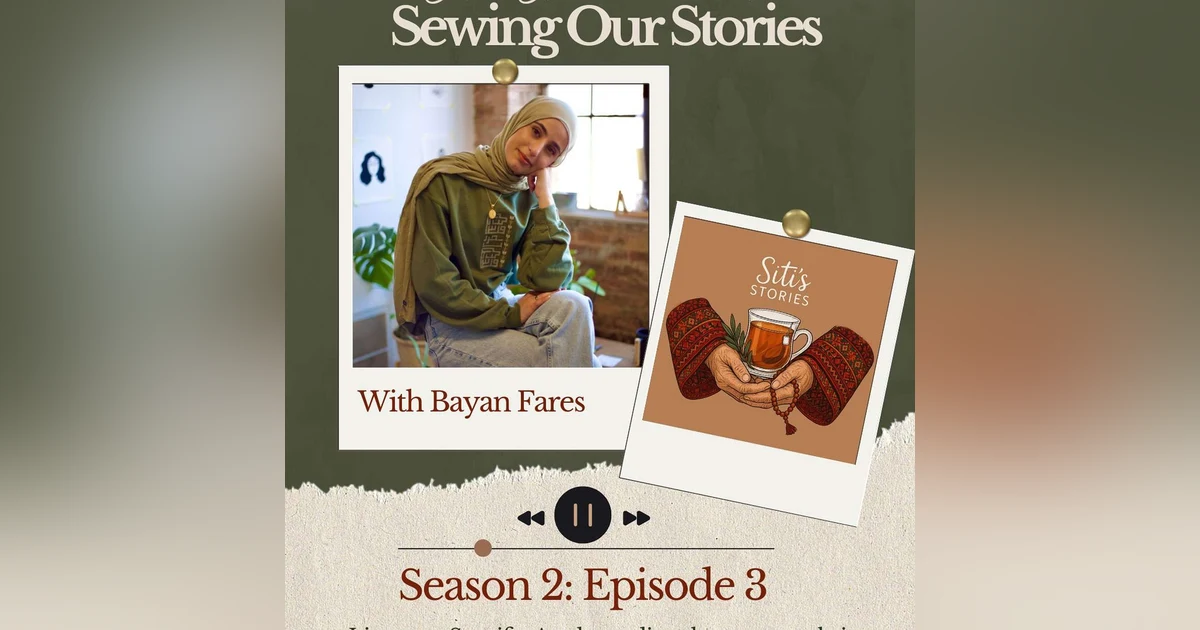


What does it mean to stitch memory into fabric and to turn thread into a language of home, resistance, and love? ✨
In this week’s episode of Siti’s Stories, I sit with Bayan the founder of Badan Collective a design house and learning space dedicated to preserving Palestinian embroidery, memory, and storytelling. She is also a writer, poet, and a social worker.
In this episode, you’ll hear:
• The meaning and legacy of tatreez and its role in preserving Palestinian identity
• How joy and grief are intertwined threads of Palestinian life
• The power of intergenerational womanhood and ancestral memory
• How slow, human-centered fashion becomes an act of cultural resistance
• Why our generation is stepping into its role as cycle breakers and storykeepers
💌 Subscribe to The Olive Press, Siti’s Stories’ weekly newsletter, for exclusive reflections, heritage resources, and behind-the-scenes letters from each episode.
Connect with Bayan: badancollective.com | @badancollective
Connect with Siti’s Stories: sitisstories.com | @sitis.stories
Have you ever felt your hands remember something your heart always knew? There's a language to memory. It's a quiet one, spoken through the palms of our 50s and 60 does. And it's the way every stitch carries a story, the way your 50 needed dough without a recipe, and the way your seats will walk to the state unit knowing exactly which offers are ready. Our hands hold a memory in a language of their own. In this episode, I sit with Faye and founder of Beth Collective, It's Base Design and Education House. She's also a writer, a poet, and a social worker. Together we talk about growing up between homelands, the braid of joy and grief and Palestine identity, and the ancestral knowledge of our hands hold, even when they tried to make us break it. Welcome to City Stories. I'm your host, Leila, inviting you to pour a cup of tea and listen to the stories that remind us of who we are and where we come from.
SPEAKER_00Thank you so much for having me, Layla.
SPEAKER_02I'm doing good, alhamdulillah. How are you? Doing good, doing good, trying to lift my spirits up. It's a very intentional effort. And I find that on days that I am recording with people, it's just been really nice to kind of connect uh and talk about things that are close to our heart in a like nice afflective way. It's just um it's just been nice to like be able to connect with other people.
SPEAKER_00Yeah, just to talk in community. What specifically is like having your spirits down just like you know, obviously what we've been seeing for. Yeah, obviously.
SPEAKER_02Exactly. When all that you see of Fallestine is what we've been seeing the last two or so years, um, it kind of can feel like that's the only identity associated with Fallistine. So it's great to be able to have these reflective conversations where we talk about what traditions we have and people in our line of ancestors that bring us closer to our heritage and our identity, not in that only one space and that in what in that one way, if that makes sense.
SPEAKER_00We just did the launch earlier this week, and one of the pieces that really talking about this, like it's it's called the piece is called The Lover's Tale, because it's supposed to talk about Palestinian love, and usually Palestinian love is like so entangled with grief, and you almost feel guilty when you as a Palestinian are like having celebration or having joy or having some form of human connection without it being always attributed to like, oh my god, they're so resilient, or oh my god, they're having joy despite the grief. And it's always like this enmeshment, this entanglement of joy and grief. And I was feeling guilty when I was designing that piece for not putting anything to do with grief inside of its story. I was like, no, Palestinians deserve joy and celebration and love outside of that, and that's not to negate the reality that we're currently living or to like deny things that are happening or to be aloof or to um further um the dissociation or the dystopian feel that sometimes people have, like when they ignore it. But it's just this idea that we are allowed to dream of more for ourselves. So I was thinking about that all this past week, and so I definitely feel you.
SPEAKER_02Yeah, I would really love to talk to you about that a little bit deeper. But before we dive into your journey, I always start with a Sithi-inspired question. So if your sitti were sitting with us here today, what's the first thing that she would serve you?
SPEAKER_00So my my grandma, I think she would 100% be either doing wada'ana, 1000% the wadi. She's so particular about it, or she would be baking some sort of um IG9. That's her specialty. So she would definitely be doing that. She's also very particular about how she does her dough. So it would either be some form of dough or dawali. I love that.
SPEAKER_02Those are like so like intensive labor things, and it's just a way for her to show her love to people. So it's so special. So let's take it back to the beginning. Um, I would love for you to kind of share a little bit about your background and what your family is from. Where did you grow up? Where do you live now?
SPEAKER_00Yeah, so my family from um Palestine is from Selwad, so it's next. And I always have to emphasize that T because it's not Selwan. Selwan is next to Jerusalem, Selwed, is next. So that's where we're from on both sides. 100% very proud, Palestinian and also specifically from Silwad. Any sort of like Palestinian traditions that we usually practiced have always been influenced by what they do in Silwad, and also the specific extension of that in the US, in the diaspora. But I had a little bit of time where I grew up in Jordan. So I do very feel like when we were growing up, I got a very bicultural experience of like firsthand, not just, you know, my parents used to do this, but no, like we used to do this. So I grew up a little bit in Jordan and then it came back to the US. So I pretty much have like a diaspora Palestinian experience.
SPEAKER_02Even though Jordan is made up of many Palestinians, it's still Palestinians living in the diaspora, like both here in America and in Jordan. What was that experience for you in Jordan?
SPEAKER_00I always say that I love Jordan for the experience that it gave me, especially when it comes to experiencing the culture, learning Arabic, which when I came back I found was not the common thing amongst like diaspora um Palestinians or Arabs in general. Um so I loved it, especially in its relation to like the Quran. I love the things that it gave me. I would always go back there. I did go back and visit a few times, so I still love it. It was just rough as a transition going there as a small kid from an American school system to their school system, which is wildly different in terms of its standards.
SPEAKER_02So that's what I will say. Yeah, my husband grew up going back and forth between Chicago and Jordan, and for a couple years he lived there, and him and his brother still have nightmares about the school system. They could not wait to come back to America just for how tough the school was. Um I built character, so 7% for sure. Yeah, Bill's character and I have funny stories or interesting stories to kind of tell. But um, Wishella, you are a renaissance woman. You are a poet, a writer, a social worker, a businesswoman. You wear many different titles. How do you navigate all those titles into your identity?
SPEAKER_00How do I navigate all of those titles into my identity? Is such an interesting and deep question. So I used to really compartmentalize these arts because I grew up with them. It got to a point where I started intentionally pursuing it, but poetry and pathities have always been a part of my life since I was about 10. I practiced them consistently throughout my life till I myself. There's not a lot of people that do that. I find as I, you know, talk to people about like how do you mesh these things together? People just let things be. And for me, I would always have a split. I always had to split, like, especially even when I started sharing things on social media, I would um, you know, people would come up to me and I'd be like, Well, do you know me from the poetry or from the dis? And they're like both, and my brain would just like go haywire. Like I couldn't comprehend that you could see both because they were both so separate in my life. And then subhanAllah, as but then continued to grow, and then as my poetry continued to grow, I just think I needed to allow for them to bleed into each other, especially I think the past few years in the poetry world where I started pulling on the Tatri's imagery in my poetry. Because even in my poetry, I wouldn't allow myself to write too much about Palestine. I was always very cognizant of the idea that I didn't want to be a Palestinian poet that only wrote about Palestine. I think we get thrown into that bucket so much. And it's just like what we were talking about earlier. Palestinians are allowed to exist beyond their grief. And I wanted to write about the human experience outside of the context of the political landscape of Palestine. And again, that's not to diminish anything. It's just we get compartmentalized into that bucket very so often, especially in our community when there's like an open mic or some sort of poetry event. You always only ever get invited to speak about or to recite a poem on Palestine. I was just very adamant that I wanted to explore art outside of the context of cultural art because Satriz is a very cultural art. Like, and I really dig into that aspect of the cultural art. I actually don't deny pursuing the culture and the Palestinian context in that. That I just jumped straight in. But with poetry, I needed a second before I could allow it to bleed into it because I'd always ran poems about Palestine, but I never emphasized, I never pursued writing about that. And then specifically these past two years, I've been pulling on what's been happening in Palestine into my poetry. I've been pulling on my work with tatriz into my poetry, and then I said, okay, if I'm gonna allow that to happen here, then I need to be okay with maybe pulling some of my poetry into my tatriz as well. And so I've been pulling it into that world, especially with the pieces that we design. I like to write short stories for each piece and really just infuse it with meaning. So that's where it gets pulled into the tatriz world. And so I now am kind of allowing myself to really explore that identity as like a whole 100% of my tatriz, my poetry, and then my personal life. Those were like always the three buckets. But yeah, you yeah, you can do that for forever. Like your brain doesn't comprehend segmenting your identity off like that. You're always one person.
SPEAKER_02Yeah, and I think at the core you are a very creative person, and at its core, you're an artist. What I love is that you were really able to kind of take Tetris as a hobby and something that you like you love doing into a business. Can you walk us through how you learned Tetris and where your journey started and then move forward to how that transformed into Bedan? Yeah.
SPEAKER_00Uh I learned Tatris from my mom when I when we had that period where we were living in Amman. I mean, it was very one of those organic experiences where you just go to the bookstore and you pick up a few. Um they used to call them Kenabath. Um, and they had like little images on them. It wasn't even tatriz like with Palestinian motifs. It was just basically what we would know was like cross stitch. We picked that up, that's how my mom taught me. And then I, you know, back then, back in the day, I'm not that old, but we were able to watch were rerun. You didn't have like the newest hit shows. And even though we were living there, we still really wanted to watch our English shows. There's not much to do. It was before uh I even got access to a phone. This is back in those days, okay? So you don't really have much to do. So I just really started focusing on the threes. And so I really just focused on stitching so many pieces while I was there. And then when we came back to the US, I ended up um continuing it every single summer. I would stitch about three or four pieces. So, anyways, I practiced it consistently for that amount of time. I ended up going to the University of Chicago. I got my master's social service administration, which is essentially social work, but the community organizing part, not the therapy part, which I know people sometimes get confused. Um, between the two. So I I truly believe when we as a collective are moving in a certain direction, humanity-wise, things will bubble up in the air and you don't really know why. But it's just because we are generally moving towards that direction. This is before the Sheikh Shatter happened, but right before it. I started pulling out my old tatries, I went to my aunt's house, I learned more about traditional forms of embroidery, so how to stitch Palestinian garments. Um, and then eventually I just continued stitching my own items. And then throughout those coming two years, just more things kept bubbling up. I kept trying to push it down. I was like, I'm not gonna pursue this, it's not the time for it. I even remember having this conversation, and I to this day think this phone call was a godsend. We got this DM and this random phone call from a friend's sister, and it was out of the blue. Like, literally, I'm telling you, I've never met this girl in person. We got on the phone call and she was like, you need to do this now. And I'm not kidding. That was truthfully the thing that made me say, you know what, maybe this can't wait until next winter, maybe this needs to happen now. And so I ended up just thinking about it. I just allowed myself to think about it. And then December rolled around because by the way, at this point I had started teaching, but but then it didn't exist because I hadn't decided before that phone call to make it an official thing. So and then I started thinking about making it an official thing, and I I started with just an Instagram account that was like me being so naive. I was like, let me just come up with a name, let me just share my workshops there, and that'll be it. And then I did end up starting the Instagram page, and then for whatever reason, everybody got really excited, and I was like, wait, wait, wait, wait, not for whatever reason, you're really talented. So I I know, but that Instagram page, I hadn't done anything yet. This is like just imagine I only have a name and I've only taught one, like I put one workshop on that Instagram page.
SPEAKER_02Yeah. I think people were yearning for that. You know what I mean? People were really waiting for that to happen.
SPEAKER_00I I think that's definitely where the excitement came from. It was definitely new, especially here in the in the diaspora. We didn't really have anything like this. Teaching Tataris, pursuing Tatriz was so new. At that time when I created it, I think there was only three other girls who had their Instagram accounts in the Tatris community sharing online. It was very new, very, very new. Um, I started just, you know, building collection after collection, and it just kept blowing up. And then as we all know, October 7th happened, and that absolutely blew everything up in terms of teaching, in terms of how many workshops I was doing, really just building spaces for the community to come together, to feel like they could have a safe space, teaching the Palestinian cause to non-Palestinians through Tataris. And so I was doing that for a a good year. And then we're now here. We are just finding our footing as a dan or in the aftermath and existing in this world now as an art a business that's focused on creativity, but also what does that mean when again it's this idea of pursuing creativity for what it is, for the dreaming of it, for the the romanticization of it without its entanglement with grief? But then this very real reality of Bata Triz is an art that is a gateway to the Palestinian cause, and how can we use that to further the Palestinian cause? So it is a constant balance, and I'm not even so sure if I have found that balance yet. There's so many decisions that I constantly make behind the scenes that I'm like, is this the right one? Am I not emphasizing Palestine enough right now? It's just this constant balance that you have to constantly go back and forth between.
SPEAKER_02Yeah, I think that's what's really interesting about Baden and you specifically is that you are very intentional with the way that things are told and the storytelling component of Baden. I think that is a way that you can help work out the business versus the cultural aspect of things, is making sure that the storytelling is always there and that it's really a way of preserving your culture. How do you weave storytelling into your designs and how do you use your pieces to tell those stories?
SPEAKER_00Yeah, this is such a good question. Also, thank you for noticing the intentionality. That's always a nice to hear because you don't really see it when you're on the inside. But for my pieces, I think I am an intentional person. And so I'm very adamant, even in my workshops, that you don't only practice tatriz. Whether you're Palestinian or non-Palestinian in my class, I always want you to know what it is that you're doing. Sometimes that's why I I try so much to emphasize that students show up on time. Because if they come late, then they're getting the tatriz part, but they're not getting the history part. How can you practice the two when you only learned one? When you only learn the mechanics of it, but you haven't learned the history of it. We want to practice it with intention. We want to wear our tatriz with intention. Most Palestinian women know what tatriz is. If they don't know it blatantly, they learn it for sure before at like some henna party or some wedding. I want to really emphasize the knowledge component of this and being intentional. And so that's when I teach. So for sure it will bleed into my my designs as well. You add in not only my teaching component, but then my my poetry and short story component that I like to bleed in there as well. When I create a tatriz piece, you know, especially now when there's been a growth of Tatris businesses and a sort of revival of it, you can nowadays go and purchase a Tatris piece from almost anywhere now. But what makes it different at Badan is that this is a piece of art and a story that is you are meant to preserve over time. Um we are creating this these pieces to last within the design itself. It's really the story that I build. I will take the the Palestinian designs and I will um, you know, take concepts from history. We try to pull inspiration from historical dresses. So there's always a historical component that is in there. There's always some sort of land component, whether that's just like inspiration of colors, there's inspiration from the the names of the motifs themselves that I pull on. And then all of that really is within a collection. What story am I trying to tell with the collection? Then what story am I trying to tell with each piece? Then I build out a story for every single piece in a way that is meaningful. And so when you look at the design, it's meant to tell you a story. And I want to get back to that component of what does this piece tell you? Because pre-1948, pieces of Tatris, they were able to tell you a story. Even the chest panel that I'm wearing right now, the story of this is that it originated and Gaza, sometimes even specifically the village of Astud, which is uh north of Gaza. They were able to tell where a woman was from almost instantly by what she was wearing. So post-1948, we have this world where it has impacted Tatris, you know, modern Tatris, machine stitched Tatris. You can't tell what the story is of these pieces. And I want to get back to that. I really want to embody that.
SPEAKER_02I love that you're taking it back there and congratulations on your new collection. Absolutely stunning. Thank you. Yeah, mashallah. It's really, really beautiful, and it shows how much thought, heart, and soul you really put into it. The collection consists of three embroidered shawls, each telling their own stories. Can you walk us through what inspired each one of those stories and what you hope people to take away from that?
SPEAKER_00Each story, by the way, is built out on a website and has a video that is attached to it that will tell you more. So there's three names. One of them is called An Everlasting Resistance, uh, a lover's tale, and then a Palestinian Harvest. And when you watch the Palestinian Harvest video, you will see that I talk about it being created on the 60th day of the genocide. I really need people to remember that we are well beyond that time. I actually have lost count. I think it's been over two years at this point. And so 60th day is about two months in. These pieces were created a while ago. As you know, like hand embroidery takes a minute, and so that's some of what caused the delay, um, etc. But that is really the context in what they were born in. And we were engulfed in this level of grief that I think none of us were prepared to handle. I mean, October, November, December, I just remember being so utterly distraught, so utterly burnt out. I was so utterly burnt out by just witnessing what was happening. And we were getting a lot of requests for workshops, and I was just about to launch a spring tour, but it was the dead of winter, and you just feel utterly helpless. What is there to do? Truly. You this this is after after we've been to a bunch of protests, this is after we we did the protests in in DC. This is after we've called all of our congressmen, they've rejected us in our faces. This is after we we fundraised. What do you do? You know what I can do today? If I can just do one thing, just one thing, to pursue or to help the Palestinian cause, I'll do that. And to me, that was just creating a design, just creating this collection. I remember it's literally on my kitchen counter. I just drew it up. And this is what where that collection was born from. I mean, a Palestinian Palestinian harvest is almost like a celebration, you know, of the land, that we are rightful owners of the land, that we are separate now, but when we get back to being in a Palestine and a free Palestine, our diet diasporic experiences will only enrich that Palestinian experience. A lover's tale is really exploring what love would be like outside of its entanglement with grief. How can Palestinians love and be celebrated and have an understanding that they deserve love and they deserve joy and they deserve celebration outside of grief? Outside of someone getting engaged and then their fiance being martyred. How are we allowed to feel that? What world can we imagine where grief and love is entangled is not normalized. That is what that piece represents to me. And then of course you have an everlasting resistance is named in a specific way where you are in this new world of a free Palestine and it's no longer just a resistance. We don't have to resist anymore, but we understand that our resistance movement got us to this place, which is a free Palestine. And it will be everlasting with us, but we don't we don't have to fight anymore. We can just build. That is what that piece represents. And so it's just this world that's constructed around what a free Palestine would look like. And each piece then goes further into that story, and it's what influences the designs, it's what influences the colors, it's what influences everything. And so when someone puts this piece on, they understand this is what I'm fighting for. I'm not giving up that hope. I'm not. So it's really just taking people through that world. Yeah.
SPEAKER_02No, and I honestly like feel your passion when you're speaking. I I love that you used our history and unfortunately our current present to really put our history and our present into pieces that we can hold and carry forward to the future. Um, I think that's so powerful. It's a way for us to not get stuck in our current present. But then also another thing that you brought up was the fact of what can you do today? You were feeling a moment of helplessness, hopelessness that we've all felt. And what can you do today? That's been a conversation I've been having with a lot of people recently, even myself within this podcast. I'm like, is this pointless? What am I doing, especially when it comes to social media? How am I on the same feed? I'm seeing these children and it has that, and then I'm gonna host about my podcast. It just doesn't compute with me. And then I really have to take it back to is what I'm doing the way that can help anything? Is this what I'm capable of doing for the cause? And so really taking it back and reminding yourself that and reminding people around you when you look at it as like what can I do as like a whole, it can get really overwhelming and daunting. But when you strip it back to what can you do as a person, as an individual, I feel like it can be more of a feasible like route to take. Um, so I just like I really appreciated you touching upon that. I know for this collection, you worked with Palestinian artisans in Palestine. How do you go about that? And how do you use it as a way to preserve and sustain our culture?
SPEAKER_00So from the beginning of Bedan, we have always worked with Palestinian artisans, specifically like one of our head seamstresses out there, who most of everything that we have in the shop, she has at least touched in some capacity. So we've always worked with artisans in um some shops in Palestine. Um to we I always wanted to emphasize that there was a connection back home. I can't be like an extension and talk about being in a free Palestine when there is a disconnection in my own business. There needs to be a connection there and and a real connection as well. There are things too that happened behind the scenes that we don't talk about because they're very minuscule in comparison to what's happening. Even even certain things like shipments getting delayed because Israel decided to, you know, close the roads or certain things you know that happen in the personal lives of these embroiderers that we don't share publicly that prevents them. We always want to emphasize deal with your family first. This is literally secondary. There's things that happen behind the scenes that is a constant reminder of what the reality is like. And as a Palestinian living under occupation, that will always come secondary to our art. So that's already embedded in there. Um, and so we we have this level of realism that's kind of baked in. Um, but we do work with artisans and Palestine. For example, our pouches or our belts are really sourced and created there by our headseams. Just but when it comes to the hand embroidered pieces, they are all embroidered in Palestine. And I'm very proud to say that that is where they are created from. And because of the access to that is is very limited. We really rely on our headseams just to kind of do that communication because I can't be there in person. And our embroiderers are all across, Ramallah. They embroider our pieces for us, and we intentionally make sure that they are also getting paid well in a way that helps uplift them. And uh, they're all women artisans that are doing this embroidery, and so it's just sort of baked in. Our pieces are so selective at Baden that it's not a huge amount of pieces that need to be limped out. This is very slow fashion. This is very much based on this Hazel couldn't get through it because she had X, Y, and Z going on in her day, so it took her two extra weeks to do this piece. Like, that's fine. Like, there's a human element to this that we really do take our time. And so that really goes into like when you get these pieces, everything is really thought out from the story, from the design to the story, to the intentional process of like working with these um these gatos and these these mothers and our seamstresses that are out there. And you know, by the time that we get this piece, it's ready to be presented to everyone. It is a piece that has been through so many hands that it's really truthfully a piece of Palestine.
SPEAKER_02Yeah, I love that you are making sure it's as authentic as it comes. And I'm I'm sure when people have that piece, they really truly feel that. Hearing you talk about Titris, it really reminds me of our Siddhis, because they were the original keepers of these traditions. And when I say Siddhi, it doesn't necessarily have to mean your actual Siddhi. I know you referenced your aunt before, and so um I would love to hear a little bit more about your Siddhis and kind of where they come from and where did they end up and like all the things that happen in between.
SPEAKER_00Yeah, I mean for sure. I think people who have influenced my Duty's journey the most are definitely my mom, my aunts, and my grandma, for sure. But for my grandma, I mean she's definitely the OG, like she still wears her throws, she still has those like skinny belts that she wears. She's a grandma to the mask.
SPEAKER_02That's so nostalgic. I love those. Those are my favorite.
SPEAKER_00I know. I wanted to wear one of those one time, and my mom was like, those are reserved for grandmas. And I'm like, I wanna wear one, I wanna be a grandma. Can we be Sutis in training? Right. That's actually one of the things that's written on our Katrin's kit that literally says Seth in training because literally we we are the future Deta's. Like we need to prepare for that. But my grandma um and my grandpa, these are this is on my maternal side, they're all from Sinhua. My understanding is that they are originally from Sinhua. My grandma was born in 19 roughly, roughly, they don't have exact birthdays, but roughly in 1943. So she was about five years old during the Nakaba, my great grandfather. His work, they ended up going to Haifa. So they were in Haifa for those five years. Again, my understanding. Was she born in Sinwad? Was she born in Haifa? But the point is they were in Haifa when she was around five years old, and she well, she I I don't know, it's crazy because she's five, right? Like, what do you remember when you're five? But she exactly. But this so so exactly. So this will speak to the level of what kind of traumatic man this was. But she will tell us, like, every time I go over to her house, like she'll somehow end up repeating this story. She'll just be like, Well, I still remember the day where like my dad just picked me up and he put me on the wagon and we had to just leave. She still remembers that. That's the only downbite that she'll give me from that time, but she vividly remembers it. But I can't imagine what it must be like in her head when she tells me that for her firsthand experience to have that and to still be able to recall that at she's about 8081. So the fact that she can still remember that is insane. So they went from Haifa to Silwad, which if you don't know the Palestinian map, that's like across. It's on the other side. And so she has that story, she has so many other stories. My grandma didn't live that easy of a life. Her mom died when she was like nine. She's the eldest daughter to the core. Um, and so I do think for our grandma's generation, as much as we value and love them and they're so endearing to us, there's so this element of trauma. And it's not just the state violence from Israel, because state violence is such a collective phenomenon that is real for a lot of our parents, even not just our grandparents. But it's this uh level of what was happening in the state and what was happening at those times for them. What do you do when your mom dies at nine and you're taking care of your three younger siblings and you don't go to school because you're from the village? Till this day, I couldn't believe like the fact that like grandma still doesn't know how to read and write. Like she can't read. Um, and so this is like such a very real reality. And then she ended up getting married, I believe, at 17. Um, so married very young, has 10 kids. And so again, we love them. They're so endearing, they're they're like this caricature almost that we've built.
SPEAKER_02They've had their own life, they've had their own traumas.
SPEAKER_00Exactly. And so, and so when we how do we reckon with that in our generation? Because we we often like attribute this to our parents, right? I think everybody has a different experience depending on who your parents are. I really believe that. But there's a lot of us that exist in in sphere where there's certain expectations of you as a woman or as a man, right? We attribute that to our parents, but we don't go further back to say, well, our grandparents really had this kind of life. And then our parents had this life because of our grandparents. And so now we are having this experience because of that. And when we talk about generational cycle breakers, our our generation as a whole is a cycle breaker. We are reinventing what it is to be Palestinian, what it is to be Muslim, what it is to be a woman in modern times. We get to redefine that. And so we have to always go back to understand where we are. And now that that I'm saying this out loud, it makes sense to me that I do that with Baden as well. We have to go back to understand where our future is gonna be for Palestine. So I think that's such a great point, actually, to make.
SPEAKER_02It's a panel, just these are things that I reflect upon so often. And when I became a mother, that was kind of where it first hit me, right? So I become a mom and I'm like, wow, I have this newfound appreciation and gratefulness for my mom, like my own parents. And then I'm thinking about my grandmothers did this as well, and then they did it in these certain conditions and they did it with these certain traumas, and I'm just like, oh my gosh. Like, and you feel that collective strength. I know that sounds so corny and so cliche, but you really do feel it on the flip side. You also start thinking about now that I'm a parent, I would have kind of done that differently. You know what I mean? You also don't you don't romanticize them either. You kind of really see it for who they are because you're like, I would have done this differently, but then it takes that reflection to be like, well, I turned out a certain way because my parents were raising me, and then they turned out a certain way because their parents were raising them. And it was just like, what are those circumstances around those people make them who they are? So it's just crazy that you've said that because I feel like that's literally something that I think so much about. And uh and it really is something that I love getting to have these conversations with people to understand their grandparents or like their lineage a little bit more.
SPEAKER_00Alhamdulillah, like my my maternal grandma, may Allah protect her and preserve her in a long life. She is the closest thing that I have to like that uh ancestral sort of generational first-hand experience that I get to engage with her. What's her name? Uh, Mariam. She's so cute. It's so weird for me to call her that. I'm like, what is she just there that?
SPEAKER_02My daughter had to do a family tree yesterday and I had to tell her her grandmother's names and her grandfather's name. And she had no idea what her grandfather's name was. She was like, wait, his name is not Junto. I'm like, no.
SPEAKER_00You know, honestly, I'm not even embarrassed to say, but at my grown age, I also don't even think I know all their like first and lesson guys is because they're just teta and sido to you for so long. So I don't blame her, okay?
SPEAKER_02Yeah. So for Daita Miriam, is there a lesson that she shared with you that still helps you till this day?
SPEAKER_00So many. But I will say the one that I immediately think about is her recipe for her dough. Because I did one time go and do that with her, and she immediately she was like, You're gonna take this from me. This is my tip. Um and that's literally the one thing that I will remember that she's actually given me, like personally, is how to create really good dough, the way that she did. We really just talk about her story um and the things that she's experienced way beyond what happened in Hypha. She's been through so much. So then I will just kind of extrapolate my own lessons from what she says. She's not relaying the message to me. She's really she's relaying her story.
SPEAKER_02Yeah, and I don't think that generation like really did that. Like they didn't like sit down and be like, this is like what I'm gonna teach you. But I think there's just like so much that we can like take from just even like hearing like their life stories and like hearing things that they've had to like go through and how they handled it. I find that everyone has like their own form of like storytelling. For example, one of my grandmothers, she loved cooking. That was her way of connecting with others, that was her way of sharing her stories and her life with other people. And my other grandma did that with the threes and sewing. And so I feel every person has their own form of that. Is there something that you can relate to your grandmother?
SPEAKER_00Yeah, for sure. I think it's cooking for her. Even earlier when I was mentioning the diwali and the dough with the zaat, like that's what I remember her for. And I think that's also because that is her love language. I do think that that's really how she shows that she cares about people. She will always make sure that you've eaten. I go to my grandma's house and you feel like this is like another piece of home. So for her, I definitely think it's cooking for sure.
SPEAKER_02Yeah, and uh, do you see parts in her life that kind of are similar with how you approach your own life?
SPEAKER_00In terms of like kindness and generosity, I always see that in my grandma and in my mom for sure. Yeah. Um, and I think that that's something that has been like embedded in our family. I wouldn't just say for me, but like all my sisters. I think they've always encouraged us to like give and make sure that, you know, you give something well. You know, if you're gonna give, give something well done. Um, and so I definitely see that in her. I definitely see it in my mom, and I think that's been passed down to all of us. I think that's so special.
SPEAKER_02Like you don't automatically think of these things, but when you have time to reflect and be like, oh, what are some characteristic traits that have been passed on? Yeah, I think those are really special ones to have. So we take some of our these characteristics, our our mother's characteristics, and we're able to look at them through how we move through life, especially through facing rewarding moments or challenges. Um, and what have been the toughest moments of your journey with bedin?
SPEAKER_00Do I would one value in person say what the aftermath of October 7th? I think that was probably the most burnt out I'd ever been. I think it was just a recovery from last year. Uh, because last year, 2024, was just astronomically insane. We had already done a tour in the summer of 2023. So this is pre-October 7th, which was already um just tiresome. But then there's no recovery period because by the time fall rolled around, something happened. And so that's more burnout. And then we had our spring tour all across from the end of January to the beginning of March, right before Ramadan, where we did like around 22 to 23 workshops in that span of a month and a half, which is all across the country, so you can imagine basically gone every weekend. And then Amadan comes, which is its own thing, and then we had another round of workshops. We launched like our thobe guide for independent learners, which is a resource that doesn't really exist to teach stitchers how to create their own thobe from scratch, especially with the garment making, which you know, if you know tatriz, the tatriz part is the easy part, right? But the garment making of a thob, that's what you need help on. And so that whole summer was just going back and forth with the pattern makers and making sure that we can get it right, and then creating something that you can just access in your own house. So that whole summer was just also just so packed and dense. So by the time December came of 2024, I was just so burnt out. And so it makes sense that earlier this year was a little slow for us. So I think, yeah, I think that was probably the biggest hump that we will get through. And I mean, hopefully things and Palestine stabilize and stabilize in a way where obviously the genocide ends and like we we end up getting where we want to go, which is a free Palestine. So I mean, we're I think it's you know, we came across this conundrum of dealing with creativity and resistance. The balance that we were talking about earlier, it's good that we came across that in our early days in Badan because I really do anticipate our generation having to reckon with that balance quite a bit. So I think we we have found maybe our footing, but it's something that you always have to just figure out as you go. Um so I mean that's definitely the the biggest thing that we've ever had to deal with. I don't what I what can compare to that, you know? Yeah.
SPEAKER_02Everything else just pales in comparison. But on the flip side, what have been the most rewarding moments in your journey?
SPEAKER_00I will say, especially since this is Siddhis stories, the most endearing thing that I think anyone could ever come up and say to me is after a class, especially if they're Palestinian, and they will say, I never got to learn fataris from my grandma, and I should have because then she passed away, and I don't have a connection with her anymore. And my mom also doesn't know fataris, but I've come to your workshop and now I can continue what my grandma didn't get to pass down to me. And that to me is always what I've wanted to do with Bedan, which is to reignite our generation, is sort of like the the outlet, and the 1948 generation, which is our grandparents' generation, is the plug. And once we connect those two again, they it reignites us being able to continue these practices for generations to come. And that is something so endearing to me that I can that my classes can make up for that disconnection, especially being in the diaspora. We are already disconnected in our own way. Our parents' generation, I think when they came over, had their own bucket of things that they were dealing with in terms of like just making it in this country, you know, that they were not the generation that was equipped to pass down these traditions, that they were the generation that was equipped to survive, continue the survival of what their parents had gone through. And we're the generation that will preserve this. Even back in the day, you know, mothers used to teach daughters, right? Bedan exists as a workshop. Learning in a workshop is not necessarily the most organic thing you can do as a Palestinian. It's it's a necessity of what our generation does. But once our generation has this practice under lock and key, we now revert back to mother, daughter, mother, daughter, grandmother, granddaughter. We now revert back to that tradition. And so this is going to take generations to fix, and we are at that precipice of that, and we're not gonna see the fruit of that. And it gives me chill. We're not gonna see the fruit of that until our grand baby, basically. When they come to us and they're like, Can you help me do tatis? Exactly. And the fruit of that, the the fruits of that, we won't even really understand until way after we're gone. Our generation, I really think is again at the precipice. We're at a really important point in time for Palestine's history, whether it is at you know, the Palestinian land, the homeland, or it's just Palestinian traditions thriving and and being revived. So I mean, for sure, that is that is something that if I can do that through Beda, and that is the one thing I I will like have achieved my goal.
SPEAKER_02Yeah, no, I think that was so beautifully said and very well fitting for it being Sitzi's stories. Exactly. Before we wrap up, what is next for you and where can people follow along with your journey?
SPEAKER_00Yeah, so we have so much coming up. I always say I think and I hope because again, we work with artisans in Palestine, so every single thing is always unpredictable, every single thing is is never guaranteed. But in terms of what we are planning, there's so much coming up. We've just begun hand-embroidered items. This is like the first of many collections, inshallah. Um, there's so many, many collections that we have planned. So you can keep up to date on bedancollective.com. You can, it's bedan collective on Instagram, bedancollective on TikTok. Um, and also one thing that I always encourage everyone to do is to join our community of stitchers, which is called the Bedan Village. You can find that on the website, and it is a community of stitchers. We meet monthly in Chicago. Um, but also there's so many people from across the world in that group chat and across the country, and it's just a way for us to practice the projects together and share our progress and ask questions, and it's this outlet, this community that you wouldn't have find naturally find anywhere else. But we just launched the Baden village design specifically made for that group. Um, and it's really uh it's it's the data of that group, it's the makeup of that group. So every motif kind of represents who's from where in Palestine. And if they're non Palestinian, have their own motif. And so I made a chest panel. The the idea came up also like collectively. It took a few months to like go back and forth in the group chat to see where everyone is from. So we did that. You can grab it from the website. Anybody can stitch it. But if you join that group chat everybody is going to be doing their own colors and their own projects. You know you can do a shirt like this chest panel. You can stitch a chest panel to hang up. Uh I personally will probably be making it into a stove. Some people are making it into a pillow. Some people if they're a beginner they're making it on Ida cloth. So that community there's so much to offer there. So I would definitely join that if you're looking for a community of stitchers. It's completely free. There's nothing that's paid just that's strictly for the community. That's aside from our online shop and from our workshops. And then our workshops of course you can find upcoming classes on the website. So there's so much to offer the website is the best place to find all of that. But yeah I hope whoever's listening that eventually one day someone will come up to me and say my God I heard you and Lega talking about this and this, you know?
SPEAKER_02No, that's so awesome. I'll link everything as well in the episode description. Our last question that I always ask is it kind of takes us back to the beginning with our Siddhis. So if your Siddhi was here with us today, um, you know, sipping her shea and serving us her food, what would be the thing that she would be most proud of proud of?
SPEAKER_01Well first of all she would never say it okay that's the thing she would never verbally say it.
SPEAKER_00I do find that I've gotten some credit with her. She will whenever she sees me she will just come up to me she'll grab your arm she's like you, you, you come sit next to me, say intimidating has that she's like, you're you're from us. You're from our own the fabric that the same fabric that we're cut from so she she kind of like claims me which is really great because I think the more that she sees that I practice or the more that I ask her about her story the more that I ask her about um tatries and show her some of my tatries work. Again they will never say it this is the same case with my mom and my aunt they will never really verbally say it but there is always this like glimmer in their eye like aha like I got you know that you can tell they're proud of you you can tell that they are proud that the next generation is excited and interested in this and wants to preserve it. And so that's for sure what she will say. And so that's why I always encourage everyone if you have anyone available in your family whether it's your grandmas or your aunts or even your mom if she's also alive just you need to ask you to ask you need to preserve their story. You need to have an understanding not just of what they went through but how their life shaped yours. It's just it's so important.
SPEAKER_02Totally yeah that's exactly what Sithi Stories is about. So we love to hear and I love that you know you've been able to take full advantage of that um and really kind of preserve your own Sidhi stories and I'm sure she's so proud of you especially with the work that you're doing with Eden. You really are creating like such a connection to home in such a beautiful way and thank you so much for being on this episode. We really appreciate it.
SPEAKER_00Of course thank you so much and this work that you're doing is so amazing. So I'm so glad that you are also out there asking these questions.
SPEAKER_02So thank you so much for having meane's story reminds us that our culture isn't something we look back on but yet actively work towards if her words moved you share this episode explore her work with Bedan Collective or even pick up a needle and thread and carry a piece of that heritage forward yourself. You can find Mayan at Bed Thancollective.com and on Instagram at Beth and Collective.stories and subscribe to theOlivepress at 60stories.com for reflections, recipes and behind the scenes letters from each episode. This is Sitties Stories where we honor the ones who came before us and carry their voices forward. Until next time Mass Lemma


