
Rooted in Identity, Rising in Education with Abeer Ramadan-Shinnawi
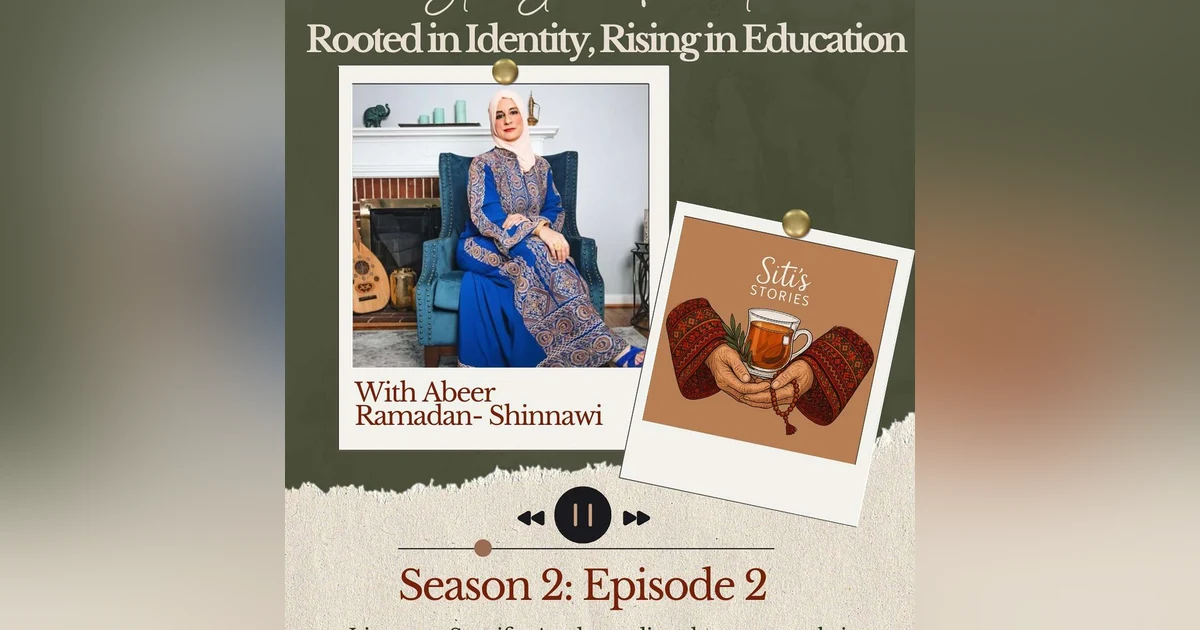


What happens when a teacher brings her whole self- her culture, her story, her heritage into the classroom?
In this week’s episode of Siti’s Stories, I sit with Abeer Ramadan-Shinnawi, an educator, consultant, and advocate with over 20 years of experience supporting Arab and Muslim youth.
Abeer shares her journey from growing up between America and Palestine to founding Altair Consulting, where she helps schools celebrate identity instead of silencing it.
We talk about what it means to teach with heart, to find strength in dual identity, and to infuse joy, faith, and heritage into the spaces we lead.
In this episode, you’ll hear:
• How Abeer’s Palestinian-American upbringing shaped her voice and purpose
• The story behind founding Altair Consulting and her mission to uplift Arab and Muslim youth
• What culturally competent classrooms look and feel like and why they matter
• How joy and storytelling can serve as everyday resistance
• The lessons she carries from her grandmother
💌 Subscribe to The Olive Press newsletter at sitisstories.com for exclusive reflections, recipes, and letters from each episode.
Connect with us: @sitisstories | sitisstories.com
Connect with Abeer: @altairedconsult | altairedconsulting.com
Have you ever sat in a classroom and realized your story was the one missing from the lesson plan? For Abid Umadon Chinawi, that realization became a calling to reimagine education as a space of belonging, representation, and joy. As an educator and founder of Alteir Consulting, Abid helps schools honor the cultural identities of Arab and Muslim youth while creating spaces rooted in compassion and connection. Together we talk about the beauty of dual identity, the power of education, and the resilience we inherit from our cities. Welcome to Cities Stories. I'm your host, Leila, inviting you to pour a cup of tea and listen to the stories that remind us of who we are and where we come from. Thank you very much. And I love the title of your show. Oh, thanks. Yeah, and that's why we actually usually start with uh a city's inspired icebreaker. So before we dive into your story, what is something that kind of like brings you back home? So if you were sitting at your cities table right now, what would she be serving you?
SPEAKER_01So my Sutyal Hamha, she was very known, well known for making her maftoul. But unfortunately, I don't like maftoul. But uh, I used to love watching her make it. Pulling up her taub, and you see, you know, the layers under her taw, and then she's sitting there and she's difted as they say. If she was around, that was what she was famous for making, was her maftoul.
SPEAKER_04That's such like a therapeutic like process to like even if you don't enjoy eating it, you could always get around the table and like have everyone roll the walls together. Yeah.
SPEAKER_01Yeah. I mean, if you think of our foods panel, I think majority of it is communal and therapeutic. Totally. You know? Yeah. There we make things in huge batches, and there's no way that one person can do it on their own.
SPEAKER_04Well, thank you. Yeah, food and memory always takes us back to our earliest moments. Um, and it kind of really is the thing that can always draw us back to where we come from. Can you start off by sharing a little bit about your background, where you grew up, what bed you're from, and where you lived in or out of America?
SPEAKER_01So one piece of information that people don't really know about me is I was actually born in Richmond, Virginia. Uh, that's where I started out my life until about third grade. Had a really great childhood, typical Falcine family like Amati and Amami, and huge extended family that lived. Um, and then we had a very a big tragedy that happened in our family. Khalil was um murdered in our house. And so that's like the turning point in our life because that created a crossroads for us. And so after that, the option was either go to Chicago. I'm an 80s child, and this was like 1983. Um, so for all those youngins, yes, I was born in the 1900s, as they say. So in 1983, it was this very big revival that my parents' generation kind of shipped all of their wives and their kids to the bled so they can learn more about the culture. So in 83 we were shipped off to live in the Daffe. Now, mind you, when I was younger, we would go on back, but I had no memories, and our life was basically uprooted, and we lived in uh the Daffe for three years. So my dad is from a small Korea, Birnabalam. You know, it's very close to Ilkutz, it's next to Ram. You have like Rom, Shafat, and Bithanina. My mom is the refugee. She, her her parents are the 48 refugees. They're originally from Dirtarif, so they're Taraifya, and they are Sukan of Bira. So it's that long-winded answer that I give people. It's like, oh, you know, my dad is from here, but then my mom is my muhajin. And when I was younger, I never understood it, but now I understand why we say it. So we lived, of course, in my dad's ballad in Birnabale for the three years we were there. Um, and I think that was probably the big best thing that happened to me. I can't speak for the rest of my siblings, but for me. Um, I went to the Friends Girls School at the time.
SPEAKER_04Oh, fun.
SPEAKER_01Yeah. It was fun. It was a very interesting experience because I tell people, all my American-speaking teachers, and majority of our teachers were what you would call expat hippies at the time. So because it's a Quaker school. Quakers are very um pacifists. So that was a really great experience for me culturally. Um, and then the first Suntifada broke out, and by then my mom was like, I can't, I have six kids, I can't do this on my own. And then we resettled in Chicago on the South Side. And so I really call Chicago home. I say, you know, Virginia gave birth to me, but Chicago is really what raised me. I grew up on the south side of Chicago when we were younger. We were in the Marquette Park area and then the Gage Park area, and then like all the other Arabs, we ended up moving to the South Suburbs. And we bounced around quite a lot until we finally settled in Oaklawn, where my my mom and my dad live. I have three siblings who still live in Chicago and my parents do. And I I travel often. I also like to because I want my own children to experience that. It's a very different than where I live now. So I tell people, Chicago raised me, but Baltimore County, Maryland houses me. And so now I've been on the East Coast uh for over 20 years. Aaron Powell We switched spots.
SPEAKER_04I came to the Midwest, you went to the East Coast. Correct. So Subhanallah, you mentioned how your Khari's death was kind of like the impetus of you guys moving to the Bland. Do you think that would have happened if it wasn't for the tragedy that your family endured?
SPEAKER_01I I think about it a lot, and I can't say either or what I would think would have happened was I don't think we would have stayed in Virginia. I think we would have eventually moved to Chicago, but would we have eventually moved to the bed? I don't know. That's a really good question. But I I think about his death a lot, subhanAllah, and how that was really a turning point. Because I look at my life in chapters. Um, and so that's one of the chapters that kind of led to one of the turning points in my life. Yeah, Allahu Alam, I don't know. I mean, maybe uh we would have gone to the bed, or maybe we would have just been the typical family that went every summer. Because we did travel a lot when we were younger.
SPEAKER_04How do you feel living in the bed shaped um your Palestinian identity? And then when you came back to America, how was that readjusting? Did you feel like you were kind of in that place of not being Palestinian enough and then not being American enough? If you could walk us through that and how you were nine years old? About nine, yeah. Yeah. So like that's a really pivotal point for a child. And and then you come back and you're kind of already in that preteen weird phase of your life. Right.
SPEAKER_01Right. I don't think I've ever gotten out of the weird phase, but yeah. Um, even as an adult right now, and I think a lot of children of immigrants experience the straddling of more than one world. For me, it's not just two worlds, it's like three or four worlds sometimes. So no matter where I go, I don't think I'm ever enough for what the expectations is, and I put that in quotation marks. It was a big mind shift moving to the bled, you know, culturally, linguistically, everything. So it took a lot of adapting. And mind you, we're coming out of a tragedy. So it's like we didn't have time to mourn and we didn't have time to reflect, and everything happened really fast. Literally, we had the deaf name, we did this, that, and all of a sudden we're, you know, I wake up and I remember this clearly. I was at Siti's house at Hamha and um in the in the beau. And I wake up and I'm sitting outside, and it was a very sunny day, and it was beautiful. And I'm just like, who are all these people? You f I felt like I was transpotted into a totally different world. I I I give a lot of credit to my mom, who was very savvy in the sense that I'm one of six kids, I'm second eldest. And my mom was very savvy at knowing that if she had put my sister and myself in what we would call like a public school or the Hadabe school, the Beled, they would hold us back because our Hadabi wasn't that good. She didn't want us to lose out any education. So she really fought hard to put us in the friend's school. You know, it's a private school, we don't have, you know, much money or m any means. We end up going to the friend school. And I think going to the friend's school also was a part of my identity that I was able to keep in a sense that I didn't have to totally let go of my American side. Yeah. Right. Or my the other side of me. But there were, like I said, such a large number of students, even within our bellad, of kids who had the same experience that I did. Now, not the same tragedy, but at the same token, shifted, moved, plotted down into another environment. Growing up, you know, I I was very aware of what was going on politically. I came from a family that they weren't necessarily super politically active, but I knew what was going on, you know, the civil war in Lugnan was going on. The news was always on. Always. Everyone was always yelling at the TV. So I was aware, and I knew I was Palestinian, but not in depth. And then so going to Palestine really shaped that for me. Being there, living there. And but at the same token, I still missed a lot of stupid little American things. I missed my cereal, you know, our cartoons, uh, where we can go shopping, little things like that. But what I learned and loved about being in the Bled, especially at the Friends School, is the depth of the diaspora. I met students at the Friends School from Bermuda and Aruba and Puerto Rico and all these places. And I'm like, we are everywhere. Places that I never have heard of or places that I never thought that we traveled. So another part of the identity shaping for me was seeing how deep the diaspora was.
SPEAKER_04That's so bittersweet to like that's a bittersweet realization to be like, wow, we're everywhere. And then it's like, wait, why are we everywhere?
SPEAKER_01But I didn't make that connection at the time. And I just thought, oh, you know, the nekbe to me, not until I got older and did a little bit more of the history did I understand, you know, the ramifications and the long-term effects of the nekbe. At the time I just thought, you know, we have all these people and we're from all these different areas of the world. And the one thing I had a lot of adjusting to was, again, when I'm there and in the school, there was a big contrast of Arabic speaking and, you know, English speaking. And so there was that division among some of the students. So you tend to realize of that that shift as well. Um, and the one thing that I loved about living in Nibled and going to the French school is learning about the Armenians who lived there, especially in Ramallah. It was so cool. I was like, Armenians, this is really cool. So it opened my eyes to Falcine and not being one-dimensional and for our culture to be we had so many people from all over the world who were living and teaching there. So living there, you're either too American or you're not enough of this. And then when we moved to Chicago, I think that was more difficult than moving to the Bled for a number of reasons. Number one, the Midwest is very different than what I knew growing up in Virginia. You know, Virginia is still considered a southern state. Things were different. We had a different lifestyle in Virginia, you know, very middle class. So the adjustment Chicago was I had to keep up.
SPEAKER_04Was it like the rough and tough?
SPEAKER_01Yeah. It's like, you know, I go in and I'm like, this is a big city, and we're not in the suburbs yet. We're still on the south side. And we got back and our means financially were very tough. So that was, you know, adapting to that. But I went to a couple of schools before we settled at Uxa. First school I went to was a Catholic school, and I was there for a a year, and oh my gosh. And in itself, could be like a whole chapter in my, you know, in my memoir.
SPEAKER_04Um this is also like at this point, is it like the late 80s? Mm-hmm. So we get back to Chicago in 87? But the Chicago like demographic at that point is like not like what it is today. Right now, you go to the South, yeah, you go to the South suburbs and the auto are kind of like running the whole thing. But I could imagine at the time that you came, that was still kind of like all new to the space, and people probably weren't that excited to have that many autob and wisdom in their neighborhood.
SPEAKER_01No, and the neighborhood I was living in, this was pre uh the other white flight and people moving to the suburbs, but it was still very lower middle class, Polish, Irish Catholic. So the school I went to was very Polish-Irish Catholic. And I went to Catholic school for a year, and oof, I mean, it's you know, I mean, it's a small school and it's Catholic, and I'm not Catholic, which wasn't a big issue, but it was hard to make friends. I had one friend at the time, and she was actually her mom was Vietnamese and her dad was white American, typical, her dad was in Vietnam and they met and she came back, and so I remember her. I remember her name, Kathy, but I didn't have a lot of friends because it was hard for me to to make friends. Again, Chicago is a totally different city, and coming from Virginia where I had all my cousins, it felt very isolating. And then until we slowly, you know, got acclimated to the city and then eventually going and getting accepted into Uksa. I think that was a saving grace because I don't think I would have survived public school in Chicago at that time. And knowing myself, Uksa was a very good fit.
SPEAKER_04I'm glad you found that. I'm glad that you found either way of like when you had to move to the Bled, you were able to find a school that was a safe space for you. And then also coming to Chicago, you were able to find Axa, which ended up being a safe space for you. So even through out all those hardships, your mom always had your best interests in mind. Um, our mothers and our cities are usually our first original role models. Like, I think it's always like important to hear from like every guest kind of like their beginnings and like their childhood. It really sets the tone for what's next to come in your life and how you got there. And we don't ever get there by ourselves. We always have like mentors and role models and our communities around us to help us get there. I wanted to ask you about who your role models were and the mentors who helped shape your life personally and your career to what it is now.
SPEAKER_01I I had never looked at them as role models when I was growing up. Um because there were so many complexities to their characters that there were parts of them that you would think, I don't know, would that be a really good role role model or not? And um I only knew one of my grandmothers, my dad's um mother, my matr paternal grandmother Lilhama died when he was 16, so I never got to know her. Um, so I only had um my maternal grandmother. At the time, I don't think I ever looked at her as a role model, more as um a person I drew strength from. Knowing everything that she's been through, but God was she a badass. Like she was tough. She didn't allow any of her circumstances to define her. Like Maikal Rahama was her only son. So we're talking about a lady who endured the neck bit and the lady who endured being transplanted to another town. And we know how that goes sometimes among our people, and then having to endure raising her five daughters and her and her son. And, you know, she's an entrepreneur with Sidia Alairahama. When I go through anything right now, I draw on her strength because she never let her anything. I don't think I've ever seen her cry. And not that that's something that is, you know, oh, you know, we shouldn't show our emotions. I think she just had this way of pulling in strength to continue what she was doing, right? And mashallah, she lived a long life. She lived until her, I think, late 80s. Um But I think of all the people, I think she's definitely the one, I think, just like my rock and what I keep going and thinking of as the ancestor that that pulls me in all the time. Definitely some role models. I I think the reason I became a teacher was because of my principal at the time, uh, Aqsa, who I was so conflicted, I really wanted to be a lawyer for the for like so long. Thank God I didn't. No offense to the lawyers, my brother's a lawyer. And I had done an internship in Springfield, Illinois, my the first semester of my senior year, and I hated it. And I graduated in '93. We're talking about like um late '92, and law has changed a lot. Like a the society in general has changed a lot, but that was a time where I was at a law firm and all the paralegal was this woman who was doing all the work and she was frustrated. She hated her job, and the dudes were just sitting there, and it was like an old boys' club. I'm like, I don't, I don't want this. This is not feeding my soul. So I get back and I was so conflicted. I had no idea what I wanted to do. This is a time where, especially as a child of immigrants, you need to know what you need to do. You're gonna go to college and you're gonna do this and then that. So I speak to my principal at the time, Ainia Ibrahim. She's very soft-spoken, but super articulate. She never spoke when it wasn't needed. She was one of those people that if she spoke, you listened. And we were talking, and she's like, You're very active in the community. Why don't you be a teacher? What greater legacy for a community than being a teacher? And I'm like, Oh, I never thought of that. I went into education, and the rest is history. You know?
SPEAKER_04So Well, yeah, so you did become a history teacher too, right? Specifically. Social studies. So how long were you a teacher prior to you making the shift to uh consulting with Il Teer?
SPEAKER_01I was in the classroom for about 15 years. About seven of those years I was in special education, self-contained, because my master's is in special ed, but I was really getting burnt out from that. And I went back to teaching what I call my first love, which is social studies in middle school. Um in eighth grade US history is really my sweet spot. So yeah. I've never heard anyone say that they love teaching eighth grade. Eighth grade or history. Like every time I tell people I'm a history teacher, like, oh, I hated history, I'm like, because you probably had a really bad teacher.
SPEAKER_04No, I love history, but I think it's it really depends on your teachers in those years because those pre-teen and then early teen years, those teachers really could make such a large impact on your life. How do you feel you're really able to make your students feel seen and heard for who they are and what their identity is?
SPEAKER_01A lot of my students were always very artistic. I don't consider myself artistic. I say I'm creative, but not artistic. I can't trust figures. So I would have my students complete assignments using whatever artistic endeavor they had. If they like to write poetry or if they like to draw or anything like that. But the biggest thing that I tried to implement in my classroom, because a lot of US history is very whitewashed, I would bring in little stories or pieces of history that really resonated with my students. And that would go a long way with them. And this is a really good example. The last couple years that I was in a classroom, I was teaching what they call here GT or advanced academics. And we're talking about US expansion and we're talking about California and the gold rush. And I introduced the Chinese Exclusion Act, which, if anybody knows, the Chinese Exclusion Act was the blueprint for all anti-immigration sentiment moving forward. So I talk about the Chinese Exclusion Act because of its impact on Chinese and Asian workers in California and how it resonated throughout the country. I had a student who was not Chinese, he was actually Filipino. He came up to me after class with tears in his eyes and he's like, I have never heard or knew of any Asian history my entire school career. So this is a kid from kindergarten all the way eighth grade, been in the same school system. And he told me how that really made him think of what other histories is he not knowing about. We know about Filipino movements in California and the farm workers' union and and all of that, right? So even though it was in not the best history I was I was giving, it made him feel seen. And me being Palestinian, we know a lot what it means about erasure. So that's how I would have my students feel seen is teaching them their own history and learning from them as well and what they can they have to offer to the rest of the classroom.
SPEAKER_04Yeah, I love that. I think that also like really reaffirms like their own worth, like as well. Like they're not only like being seen, but like their history is worth like telling and hearing and like learning. How do you infuse your own Palestinian identity into your work? Or do you infuse your own identity into your work?
SPEAKER_01So when I was in the classroom, it didn't come up often. I think more that came up was my religious identity. Because, you know, outwardly showing people and students knew that. And it was more of an of a connector than my Palestinian identity because I always taught in schools that were what I call had more flavor. And so I had a lot of students who's like, oh, you know, my uncle is Muslim or my aunt is Muslim or my brother became Muslim or that was more of a connection. And when I would tell kids that I'm from the South Side of Chicago, that was a bigger connector for me. My Palestinian identity didn't come up as much due to other things because 9-11 was more of the focal point at the time, as opposed to what's happening now.
SPEAKER_04But I think um you touched upon it before because of the fact that you are Palestinian and we are so used to being a community that's erased, you already go into your education spaces, having that understanding that some of these students are also facing that as well. Can you walk us through what is Iltier and kind of how that came about?
SPEAKER_01Yeah. So I I remember this clearly. I've been struggling when I was working in the classroom and the office that I was working in for social studies. I was a curriculum writer as well. And the county and district that I was um working. With at the time, there would be incidents of Muslim and Arab students, especially Muslim Muslim students complaining about curriculum or harassment from teachers or students. The powers that be would never bring me in. I was literally probably the only hijabi Muslim, Arabic speaking, like tick all the boxes that you want that make people look good, right? But what I've noticed is when it comes to Arab or Muslim or female hijabis, people, people don't care, right? It's like people don't even want to touch it. I would literally tell them, hey, just bring me in. Let me go and help and represent. Because when Muslim students see me walk in, they feel so comfortable. Nope, they didn't want that. They would actually bring in other people and have them do it. And what was their explanation? There was no explanation. Wow. A lot of times the explanation was basically have to stay in my lane, right? And I have to, you know, basically know how to, you know, play the game and and do all of that. But what's ironic about that is that that was only applied to me. Other people, when they would do things, it was it was fine, right? If anybody who knows me, I don't tend to really know A, how to keep a mouth shut and B kind of stay in my lane. I want to do my own thing.
SPEAKER_04But that's a great quality to have, honestly. Yeah, right? Like it is. It's you're you're advocating for yourself, but you're also advocating for others by making sure that you're up in the forefront to be able to do that for others.
SPEAKER_01But I but that was the battle that I was having, is the fact that all of the racism and the biases that come when they see a hijabi, they don't they cannot understand the concept of me being outspoken. Because all of the negative stereotypes that they have really messes with their head.
SPEAKER_04They only see you in that one way, and then when you don't act like that way that they want you to act, they're like it's difficult. Oh yeah, yeah.
SPEAKER_01Right. You know?
SPEAKER_04Oh, because I'm not what you thought I was supposed to be.
SPEAKER_01Yeah. Yeah. So there was an incident that happened and uh it wasn't resolved in the way that I thought it would. And I literally said this to my director at the time. One of two things is gonna happen. Number one, I'm gonna leave, and the counting district that I'm working for is gonna pay me to do work that they could have gotten for free. Or number two, eventually there are gonna be some really savvy parents and realize that their students are being mistreated and they're gonna sue. So one of those two have already happened. So what happened uh was I was literally sitting on the couch talking to my husband because my husband's the one who's always like take in on all of my ideas all the time. And he's just, you know, yes, yes. Well, I look at my mom like, to me, no, I really want to start consulting. Really think that we really have to bring this to the forefront. And I had also started an affinity group with newcomer female students at a school that I was working with, and I loved it. And I thought, what a cool concept, having an affinity group for these students. And I was very specific about them being female for a number of reasons. And I was like, why can't I do this on my own? And that's how El Ter came about. My husband and I were thinking of a name, and I didn't want to name it like, you know, Abhirumadon Shinawi consulting or anything like that. I wanted something that was meaningful, and we were going back and forth and we came up with El Ther. El ter means in Arabic, you know, to take flight or as a a bird. But figuratively, for me, is our mission is to amplify student voices, and so it really lifts up their voices. And so that's how the term alter came about, and that's how I started. I started as a side hustle, so to speak, about three years ago. I started it full-time, where that's all I do right now is consulting.
SPEAKER_04Nice. How did it fully transition from part-time to full-time? Like how were you able to make that happen? Uh, I just did it.
SPEAKER_01I just like I was at a point where I was working for a nonprofit and I was getting tired of that because as I was, as I'm getting older, um I'm realizing that if I don't bet on myself, I don't think a lot of people will. And I have to say, I do have a lot of privilege. I have a very supportive spouse, alhamdulillah, you know, financially we're stable, um, where I don't think if I we didn't have this luxury, I don't know if I would have been able to do it, right? But alhamdulillah for everything, everything happens for a reason. I just got really frustrated for doing work that either would fall on deaf ears, I was questioned all the time, and I wanted to be among the first people to be doing the work that I'm doing. We don't put enough emphasis on supporting our Arab and Muslim youth. We don't put enough emphasis on curriculum that matters, we don't put enough emphasis on making sure that school districts hear us and listen to us and implement what's important. A lot of it is very performative. And so I wanted to be among the first to do that. And alhamdulillah, I know I am.
SPEAKER_04Just to kind of give everyone a little bit more context, like what are the services and um initiatives that you do at El Tir?
SPEAKER_01So I tell people I'm a two-pronged approach. Number one, our niche is creating um spaces and also advocating for Arab and Muslim youth, and that could be anything. Students have been facing harassment since we know since October 7th happened, the bullying that's happened with that, how they can navigate and support that and creating the affinity groups for them. So schools bring me in and they create affinity groups for how to Muslim students, but I also like to focus on newcomers because unfortunately, a lot of the newcomers that come from Arab and Muslim-seeking countries, a lot of them are refugees or political asylum. So their lived experience is already, you know, very deep and they're going through so much. So the affinity group is one space that I I create. The two-pronged approach is along with the advocacy, I provide teacher development, teacher, and admin development on how to meet the needs, how to bridge that gap. That includes resources, but also how can we dig deeper and unpack and create curriculum that's reflective of our students. I can't go in and just do an affinity group, it'd be okay, and then send the students back into a toxic environment. So I have to bridge those two together. So those are the services that I do. If you follow me on social media, you'll see that the last couple of days I've been talking about the importance of students and documentation when something happens to them. Because the more I speak to students, the more I realize how much they go through and how much they get sidelined because we're invisible.
SPEAKER_04Right? They probably don't even think it's something for them to even report. They probably have it happen. They feel yucky and they're like, oh, this feels wrong, but who's gonna even do anything about it if I say something? And then it just gets pushed to the sideline, like you said.
SPEAKER_01Or, you know, we have unfortunately our communities still need to be a little bit more outspoken about this, where kids will go home and their parents are like, call us heavy, but it's okay. Yeah. You know, mashihah or go on. And, you know, the next thing that I'm working on is showing kids that there are there is due process and how you can go about doing it. And a lot of times, unfortunately, these kids are looking at the adults in the building to guide them and they're not being guided by them at all. And we we know that how outside pressure happens and that also leads to the adults in the building not servicing our students. So that's what I do, and I strongly believe that, you know, I can do both separately, but they're also interchangeable because my goal is if I want to provide the professional development and the guidance and the consulting for the adults, that's so it could filter into the students, but also to give students the the power and for them to be self-advocates themselves in order for them to get what they need.
SPEAKER_04Yeah, no, I think I think the work that you're doing is very much needed, especially in like today's world, unfortunately. What kind of has been the response to and like you trying to kind of change up the curriculum in some places?
SPEAKER_01Yeah. So what I tell people every time I have like a consultation or when people want to get to know me, especially if they don't know anything about the Arab or the Muslim world as I call it, I tell people, I'm here to help you unlearn what you've learned in order to learn what you should learn. It's all of this unpacking and the the the reaction people get are at first, they're like, well, I really never thought of it. Because again, our Arab and Muslim students are not on their radar a lot of times because our students do well in school. We do come from communities where it's it's it's something you you just do well in school. So that data piece isn't there, right? Number two, just recently, the identification for Mina has been has come up, but in the past, you check white. So how are they going to collect that data? But also number three, schools don't realize, or they sometimes do, their their biases when it comes to our kids. Totally. Yeah. And so they don't believe it's a strict reason to advocate because our school systems are very trendy, and we're still thinking of race and just black and white. We're not talking about intersectionality. And okay, if we're talking just black and white, let's use this fake scenario and it could probably even exist. You have a student who identifies as male, he's black, child of immigrants, he's Muslim, speaks more than one language, and if something happens to him, which one of those identities are we going to talk about? Is he because he's black and Muslim? Is it he because he's black Muslim and a child of immigrants? Like, these are the ideas that people aren't thinking of because we've been so ingrained in thinking of people in those just these boxes. I get mixed reactions. People are like, yeah, that's great, but we don't have the money. And oh, we don't think it's a need right now.
SPEAKER_04What I hear when they say stuff like that is it's not as important of a need. That's what it is. We are so low on their totem pull.
SPEAKER_01We have area schools in the south side of Chicago in the suburbs, 30% student population that are hut up. What do you see there? It's still pretty dominated by everything else, right?
SPEAKER_04I know. My daughter, Hanalon, my oldest is seven. We live, we're very privileged to live in an area that has an Islamic school. So we always had it in mind to put her in an Islamic school for fifth grade and up. We were like, we'll just do public school for the first couple years. We didn't think it was gonna be that big of a deal. She went to a pre- Islamic preschool. And then so when it came time for kindergarten and she started like the public school, we her class out of the 19 students, 10 of them were Arab Muslimine. Okay. None of her teachers were Arab Muslim, none of the administration were Autob or Muslim. And so she absolutely hated it. And I had no idea that my five-year-old at the time was gonna be so affected by it. But it's she just got so used to from the preschool being in a in a space that people looked like her, people, you know, understood who she was. And I remember one thing where after that I was like, Yeah, next year she's going to Islamic school. Um, after Haid, we do get the day off. And so the next day they go back to school, and all the kids in the classroom are talking, because again, most of the kids in the class are Muslim. Uh-huh. So they were talking about and what they got for Haid and exchanging gifts and things like that. And so she comes home. Again, she's my oldest, she's my first of going through everything. So I'm so excited. And I'm like, Did you talk to everyone? How was everyone's aid? I just can't wait to hear all about it. And she's like, No, we started talking about it, but then her teacher told the class that this is not the time for them to talk about it. And I was just like, So you're telling me when it's Christmas, when everyone comes back from Christmas break, that's not a conversation that all the kids are having. It's for sure a conversation the kids are having. I'm sure even the teacher indulges in that conversation. Yeah. I was so thrown off by that. And then I was thinking to myself, like, if that's one of the scenarios I heard about from my five-year-old, how many microaggressions is she feeling on a day-to-day that was making her truly hate her kindergarten experience? Like when I tell people about it, they're like so confused about how my five-year-old had such strong opinions.
SPEAKER_01And you make a good point with that because we don't listen to our kids enough. And we don't ask them the right questions either. So people should not be surprised that your child is very well versed in who she is as in identity.
SPEAKER_04Yeah. They were just like, wow, at five years old, I was so proud, honestly, that she like knew like who she was and like had such a strong hold of her identity and how she wants to like move in the world. But I was honestly even surprised. Like at five, I was like, wow, okay. I mean, and then literally she went to Islamic school the following year.
SPEAKER_01That's like that's the piece that I'm talking about is the we we want to make a classroom environment culturally competent for other students. Why is it when it comes to Arab and Muslim students, we act like that's this is what really angers me is the fact that all of a sudden schools act like they don't know what to do. They all say, Well, what do we do? I'm like, you treat them like you treat other students. If they're going through something, what would be the steps that you take for other students? Why are we otherizing the other students already? And I think that's the part is like the lack of wanting the cultural competency piece. When you have a teacher who has 10 out of 19 students who are from a particular ethnic or religious background, that's really falling on deaf and ignorant ears. And that's not so much of, oh, well, I didn't know. Yes, you did. Then you really don't, then you're not there to really get to know your students. You're not there to really teach. And if you're sitting there and you're shutting down conversations that are very rich and how students' lived experiences are, then you're not really there to teach. You're not cultivating that classroom. Yeah. As a teacher, I would take time and listen to what students said about what they did or what they where they went or or whatever, because they spend so much time with you. And if you don't understand that that's the connection they're making with you, then you're in the wrong room. You're in the wrong profession.
SPEAKER_04That's exactly how I felt. Like I said, the work that you're doing is just so important and especially to try to get it into as many spaces as possible. But was there ever a time that you felt pressure to kind of push down your identity and just buy like because of the spaces that you were in?
SPEAKER_01Um, I mean, always. I don't think there ever is a time when it's not. Again, when people see me first, the first identity that it's hard for me to suppress, but I have to work around it is me being Muslim and a hijabi. I think after that, everything else is just like, oh, just add it to the list. I've been wearing hijab since I was in eighth grade. So I've been wearing it for a long time and I've seen the transformation of people's reactions to hijab and all of that, and it's come a long way. But I think for me, it doesn't matter if I suppress my identity or not. This already throws everything off. So what I've learned is I really don't care. And I never did because I also don't look white enough. So that that confusion adds to it. So people are already othering me. So I might as well add everything else. Yeah.
SPEAKER_04So what advice would you give to younger teachers who are starting out? How do you work with your identity rather than like working against it?
SPEAKER_01It has to come from the very beginning. And this is what teachers in general should be doing is if you want to get to know your students and you want your students to be their authentic selves, you have to be your authentic self as well, right?
SPEAKER_00Yeah.
SPEAKER_01There's no way that you're going to be wearing hijab and not being a target and a representative of hijab, whether you're super practicing or not. And so for young teachers who are hijabis, this is a strength because what you're doing is you're going into a classroom and you're changing the mindsets of students about hijabis and about Muslims and about women by how you're creating a classroom of inclusivity and a welcoming environment, regardless of who you are. That's you, that's how what teachers are supposed to do. They're going to spend all that time with you. And if you are not going to show up as your authentic self, don't expect your students to for they to show up there as their authentic selves or for them to take you seriously. Period. And that's what you really need to do is if you're already wearing hijab, you wore it for a reason. So continue. And even if you're not a hijabi and you're a young Muslim teacher or young harub teacher, be your authentic self. Kids nowadays know a lot more than we think they do. Why give up the opportunity for them to learn more?
SPEAKER_04So last season I was talking to another educator who's our mutual friend, Dr. Sosan Javid. Yes. And she was actually a person who recommended you to be on this season of Siddhi Stories. Yes. And one of the reasons why is because she said she loves talking about her grandmother. She loves talking about her Siddhi. And so I know we touched upon it a little bit earlier on, but I would love for us to kind of delve a little bit more into your Sitti and caring a little bit more about where she came from, what her story was, if she had a displacement story, she came to America and what that transition was.
SPEAKER_01So I say this with a heavy heart because I the biggest and I hate to say regret, but the biggest thing I wish I could have done was record my my grandmother's stories, right? But I loved listening to her stories and some of them are kind of spicy sometimes. You know, she's one of those people. So I did I say that to say I didn't know much about her, only from like what my mom has told me and what I've heard her say. Um yeah, there is a displacement story. Again, I never talked to her about her nekba story ever. Wow. Right. And I'm just like, mmm. So again, they're from Der Tarif. What I do remember is her and Siddh al Ahmad like a love story. Like they just loved each other. Like she would always tell them, Oh Allah said the ijja'al ijro. Like every time wherever they went, you know, they were together. And I do know that they settled Filbira. Why? I'm I'm not sure. I think if you know the Tarifa, a lot of them are in the Bir and Ramallah area. And you know, we're clanish, so they follow each other. And so they settled there. They were, you know, fellahin, and they would sell vegetables in the Hespah, the one in Ramullah actually in the Hespa. Um, and she and my grandfather did it together, which I thought was so cool because, you know, you internalize a lot of the stereotypes people have about our women. When I hear my grandmother's stories, you know, she was a a businesswoman with my grandfather. She did everything with him. They raised kids together. They had their arguments because she was very traditional in a sense about her daughters. And it was my grandfather who pushed for his his daughters to get an education. You know, she did favor the boys a little bit more, which is very typical. But she did have this essence about her. She never lived here. She stayed in the bed, but she would go and come and visit. Um, and again, she was probably one of the toughest women I knew, but never allowed anything to get in her way. She would wear a tob everywhere she went. At the time, I was so embarrassed because, like, oh my God, but I love Tweb now. She loved roller coasters. She loved players. No way. Yeah, girl, she loved roller coasters. I'm like, when she would come visit us, we would go to theme parks.
SPEAKER_04Sito was here, you guys would be at six flags, Yani.
SPEAKER_01And I have a picture with her like that. And I have a picture of her and her little like the undergarment she wore under her tob in the pool. She never missed an opportunity to have fun. Oh, I love that. Yeah. Like someone had a saying about plane, about the guy who invented the plane. She's like, Mish Haramili Elichtara Al Tayara. I'm like, you know, yeah, like she loved adventure. And so I think that's where I get it from. Yeah. I miss her and Oh, you're gonna make me cry. I wish I could give you a hug. No, and and I wish she was alive to see me doing what I'm doing now because everything I do I'm doing for her. And what she's given, and I hate the fact that I didn't get to talk to her more. So and I am a crier, and you know, when I was younger, I'm like, that's not okay. You know, she was just this force that I wish she was around, you know, when I was older so I would be able to talk to her and and get more from her. But I know she's watching and I uh that energy is there. Yeah, she loved life. And again, I think that's a part of our Philistini nature that we have to bring back is we don't I don't want people to always think that we're just in the deficit. We're always in this misery where we are very loving and caring people, but we also know how to have fun and we don't let anything get in our way. And that's who she was. That's that's who she was.
SPEAKER_04So thank you for sharing that. Yeah. That's actually the last bit that you touched upon is something that I've been grappling a lot with. We are more than just our oppression, and we are more than just our struggles, and like we deserve to have joy in our life, and this thought process of joy is a form of resistance, and continuously like continuously trying to like put on a happy face and like love life is a form of resistance, and that is like something that I'm like really trying to remind myself of like the last like two years. And honestly, if our Siddhis are able to do that, right, and we should be as well. Yeah, but you said how your sitti was a Nekba survivor, and so if she was able to still take life by the horns and enjoy her roller coasters and enjoy her swimming pool, then yeah, we all have a lot to learn from that generation, and I'm sure she's extremely proud of you and all the work that you're doing today. Is there someone that you could ask about her Nekma story that would kind of have a little bit more information?
SPEAKER_01I could. I mean, I'm sure my mom might know. Yeah. But this leads me down to a path where. What I tell people now is if you do have someone in your life who is a NECBA survivor, but now it's our parents' generation who came after, like the first generation after the NECABA, we need to re we need to record these stories.
SPEAKER_02Yeah.
SPEAKER_01Um, and they're stories. And I started talking to my dad, and I have like voice notes of what he would tell me. And I think it's super important. You know, I'm a historian, but also I'm an archivist. And if we don't have these stories, who's gonna remember them and tell them? And whether they're NECPA survivors or not, I think our generation, we, you know, we should sit down with the elders, and that's who our community is. I think we've kind of fallen as you know, gone astray with that. But we need to record as many stories as we can because we need to keep this going and we need to keep that, you know, that lifeline going. So um if I can find somebody, I I will.
SPEAKER_04Yeah. I mean, that's something that I've like been encouraging a lot of people to because unfortunately, like we like the last couple years, we really have gotten to the point where the neck best survivors have unfortunately like passed on. And so now it's on to like their kids to continue those stories. And if they didn't ever really learn those stories, then it's kind of like gone, it's forgotten. Yeah. And so it is something that I'm really encouraging everyone to go do, and that's literally the whole point of this initiative. Right, right.
SPEAKER_01I love it. I love it.
SPEAKER_04But yeah, were there any traditions that you were able to kind of get passed on from your grandmother?
SPEAKER_01Um, I think the love for wearing a taup. Oh, I love that. Yeah, I think, like I said, when I was younger, I was like really embarrassed, but the the love for um yeah, totris and the in the taup. Because I was always around other women who did it when I was living in the bed. Um and again, the top for me is not only a symbol of who we are as Falcinia, but it reminds me of Siddhi.
SPEAKER_04Yeah.
SPEAKER_01That's all she wore in that pocket on the side that stuffed everything.
SPEAKER_04Right? Yeah. Yeah, I love it. I hate that they don't make them anymore now with it. Yeah. And actually, when I get a thwab now made, I always ask for it. Smart. I'm like, I need to put my keys, I need to put my tissues.
SPEAKER_01It's funny because I saw a video about how the purse industry became very popular because in in Europe they wouldn't um add pockets to dresses. And I'm thinking the thob is so functional and how forward-thinking were they that they had that pocket where in Europe they had to create a little purse because women weren't allowed to have pockets. So I think it's very interesting. But yeah, that whole it's the tawb that for me and Tatriz, that's what I'm carrying on from her legacy. Yeah. Were you able to have any of her thwab? No. Because she came from very meager means. She didn't have many, and all the ones that she had, she wore all the time. And so I would think rightfully so, um Ulat Khali probably got them because they're the ones who like lived with her and stayed with her. And she didn't have many, but I do have a picture with her in one of her tweb. And and the chirka, you know, the long that's how she would wear it.
SPEAKER_04So she wore that every day. Every day. Every day. Oh, she reminds me of my sutti. Yeah. My sutti who the one who lived in the blood. Yeah. Um, my paternal grandmother. Yeah, she was a filaha and she wore swab every day and a chirka every day, and would literally be in the middle of the field. And she just did all her work in her swab, and I just it's it's so interesting to me that now we wear it as like when we are dressing up. And they wore it in like such a functional way, subhanAllah. Um, do you have any lessons or values of your grandmother that like really stay with you day to day?
SPEAKER_01Yeah. Like I kept saying, she was tough. When I think about the trauma that she went through and experienced, the lesson for me is as much as I go through people are doxing me or people are harassing me, or if I lost a job, it's nothing compared to what she experienced. It's nothing compared to the loss that she had. And, you know, people from her generation. So my lesson from her is to never let anything really get in my way. I gotta really start practicing that more than I preach it. But yeah, she again, she did the best that she could from what she had. And and they did, mashallah. They kept going, didn't stop them. They didn't just shrivel away and and go. And so I think that's the biggest lesson for me is get out of my way. I've got stuff to do. You know, I'm not gonna let you stop me. So yeah, I've got Sityano behind me. She's she's she's got me. So I think that's what it is.
SPEAKER_04I love that. It's so important to have people in our lives who guide us like with their strength. And like even like if they're not here, like it's like the memory of them is like here, and it could like really push you through times of hardship, yeah. And even times of joy, and just being like, wow, like what would Siddhi do if she were here today? If your Siddhi was sitting with us here today, what part of your like life's work, professionally or personally, do you think she would smile the most at?
SPEAKER_01She was very traditional in in many ways. I think she would be most proud of the fact that I have raised three daughters. I think I'm a fairly decent mother, right? But also continuing to grow professionally and personally and keeping at heart who we are. Because, like I said, she never compromised, and I think she would be proud of that. The fact that, you know, grew up born and raised in the United States and still holding on that legacy. So I'm hoping that would be something she's proud of.
SPEAKER_04Yeah, I'm sure she is. How do you continue to pass on those traditions and instill that identity within your daughters?
SPEAKER_01You know, we make sure that we tell you know you're Palestinian, right? Don't forget to say that you're Palestinian. Right. Um I mean, my my work, it revolves around it, so it's hard for my daughters not to see it. But I'm also very cognizant of the fact that my daughters are now considered almost third generation. So their experience is going to be a little bit different. But attending events and doing all that is great, but we live it in our lives every day. We'll talk about it. Um, that's why it's important for me to visit Chicago as often as possible because I want my daughters to be among a larger community where they see the good, the bad, the ugly, all of it. Because it gave me a sense of who I am. And I would like that to be an extension of who they are. I'm not necessarily saying total replicate, but I would like it to be an extension of who they are and how that develops their identity as well. So just you have to live it in order for them to really to know it.
SPEAKER_04So one of the main reasons why I still like going back to New Jersey is just because then my kids really get kind of a larger sense of a family dynamic and all of us making food together, all of us going to events together, and I think that's really valuable. Like you said, it's something that you embody. Identity really grounds us, but life still throws things at us and tests us. Um, you've moved through so many roles as a teacher, a curriculum designer, and a consultant. Uh, with each you face challenges, but also triumphs. Uh, what have been some of the greatest challenges you faced and how did you overcome them?
SPEAKER_01Oh, blah, blah, blah, blah. I think the I the greatest challenges that I faced was when I didn't get the support that I needed because I was in an environment that was extremely toxic. And it was extremely debilitating emotionally and mentally because you start to question who you are. And it's like, why can't I just be like everybody else? And why can't I just, you know, play the game and do everything right? I sometimes hit rock bottom before I bring myself up, but I also learned this from a dear friend of mine, and he told me that life is like peaks and valleys. When you're in the valley, it's your time to just reflect and not rush things until you go up to the other peak and then it comes and goes. So for me, it's always been a struggle of not having certain opportunities that I know I'm worthy of, but because of what people's own biases are about me and getting over my imposter syndrome for a lot of things. It's always a work in progress. I've gotten better at it, but I'm also learning not to connect monetary items to the success of my business and the work that I'm doing. So that's those are, I think, the most important things for me.
SPEAKER_04Major facts. I'm gonna do total Gen Z thing, but like you clock that way.
SPEAKER_00I mean, where did we go from snaps to this? Like, are we going smaller? What's going on, people? Make up your mind.
SPEAKER_04That is hilarious. I never connected that they're just like snapping.
SPEAKER_01That's and that's a very capitalistic thing. And going back to the connection as full Cine, I was watching this person on Instagram and she was talking about, oh, Palestinians are so giving and they're the this and then they're the other. And I'm like, we've always been this way, people, right? We've always made something out of nothing. And we've never, you know, we've always been wealthy and we've always been well-to-do in many aspects. But why do we not deserve to have something? Well, I'm not sure. Yeah, absolutely.
SPEAKER_00But what do you think? No, no, I know you're not.
SPEAKER_01We have gotten so ingrained in thinking, you know, the monetary equals your success, but at the same token, there are some things you can't add up monetarily that are make you a successful person. And me being philosophia is probably the the biggest non-monetary thing that I can have that keeps me going and the drive that I have and making those connections with students who are marginalized because we know where that comes from. So that's what I mean. Oh, yeah, girl, I'm bougie as anything. Of course we make things. I'm not saying no things.
SPEAKER_04No, no, because sometimes I feel like in in spaces, it's like you should be so thankful that you're here. Like you should be so lucky that like we invited you to the table type thing. What I say with that, yeah.
SPEAKER_01I don't need I don't want to be invited to the table. I'm building my own table.
SPEAKER_04Exactly. Because it's like, why am I not deserving enough of getting paid the same amount that the person sitting next to me is getting paid? That's what I meant by that.
SPEAKER_01Oh no, that part's totally different. Like that's a that's another conversation. And I I agree with that. I'm just saying for me, sometimes I'm like, oh, I'm not, you know, at the point financially where I want to be or whatever. But then there are moments in my work where I'm constantly reminding myself that what I'm doing doesn't have a price to it. Like, for example, I'm speaking to a student who told me about her experience, and she literally thanked me and is so thankful you're able to talk to me about this. So those are things that I'm I'm thinking of as the lasting legacies that we we need to develop.
SPEAKER_04It's so rewarding. And like it's not a little bit sound cliche, but like it is it that's a priceless exchange to have with someone. That leads me to my next question of peaks and valleys. What are some of those peaks that you've had?
SPEAKER_01Well, I mean, a recent peak is I am going to be working with another county and district here in Maryland, which I think is exciting because not only as just a professional develop developer, but as an actual consultant, which I think is very valuable, where they can lean on me and say, hey, we have this situation. I've been saying this to myself, but also to other people, is we need to stop being reactive and be proactive. And I'm I'm heading in that right direction with what I'm doing and how I personify that. So the the definitely the peak is me being able to take what I'm experiencing and what schools are experiencing and creating something out of it and creating materials and support so people aren't scrambling of knowing where to go and what to do. And also for when you have school systems that recognize you for the work that you're doing and the importance of wanting that for their students, I think that's a big peak for me as well.
SPEAKER_04Yeah, that's awesome. Congratulations. Okay. I'm excited to follow along with your journey and see where El Ter continues to love you. Where can all of our listeners keep up with your work and follow along with your journey?
SPEAKER_01So I am on Instagram at Alter Ed Consults. They can follow me there. That's where a lot of my work and what I do lives. Or just go to my website, alteredconsulting.com.
SPEAKER_04Awesome. And we always close with kind of the way that we started out with a Siddhi-inspired question. Uh-huh. So if your Siddhi was sitting with us here today drinking her coffee or her she, what would be a piece of advice she would give you to cun this off?
SPEAKER_01I think she would tell me to not shrink. I think she would tell me, Siddhi, yalla, yalla, you know, keep going, do what you're doing. There's no reason to stop. Um so I think that's the advice she would give me is to continue what I'm doing. Of course, to take care of my family and my husband. Her story with my CD was just so beautiful. So like that's what she would want for everybody else. But I definitely think her advice to me would be, you know, there's no reason for you to stop and and be woes about this or that. You gotta continue. We we don't stop just because we have these these roadblocks. We work around them. In so many ways in her falahi arabie, you know, I'm sure how she would say it, but yeah. Yeah.
SPEAKER_04Kumi Ya Sitti. Should the high, right? Yeah. No, and I think that's what's like so important about reflecting on these stories of our siddis, is I feel like they just carry so much strength and resilience, and we just can have so much to learn from them. Yeah. Their words really do guide us like through things. And so I love that. That was like such a beautiful way to send us off. And our beauty, your story is such a testament to the power of heritage, mentorship, and resilience. Thank you for bringing your cities' wisdom, your own journey, and your commitment to our Arab and Muslim youth into this space. I really appreciate all the time that you gave me today. Yeah. The conversation that we had.
SPEAKER_01Well, thank you for having me here. And you know, I love this concept and you know, upward and onward as I say.
SPEAKER_04Abib's story teaches us that roots don't hold us back, they help us grow. Through her work and her words, she's shown us that when we bring our full selves into the classroom, we don't just teach, we transform. If this conversation moved you, share it with a teacher, a parent, or a student who carries more than one story within them. Keep the dialogue going because education at its best begins with listening. I've included how to connect with Abir and her consulting work, El Tir, in the episode description. To stay close to the stories we share, follow along on Instagram at cities.stories and subscribe to the Olive Press newsletter at cithystories.com for more reflections, recipes, and behind the scene moments. This is Cithis Stories, where we honor the ones who came before us and carry their voices forward. Until next time, ma'asalama.


