
Hastak: Siti’s Little Plates & the Stories That Feed Us with Mai Khader Kakish
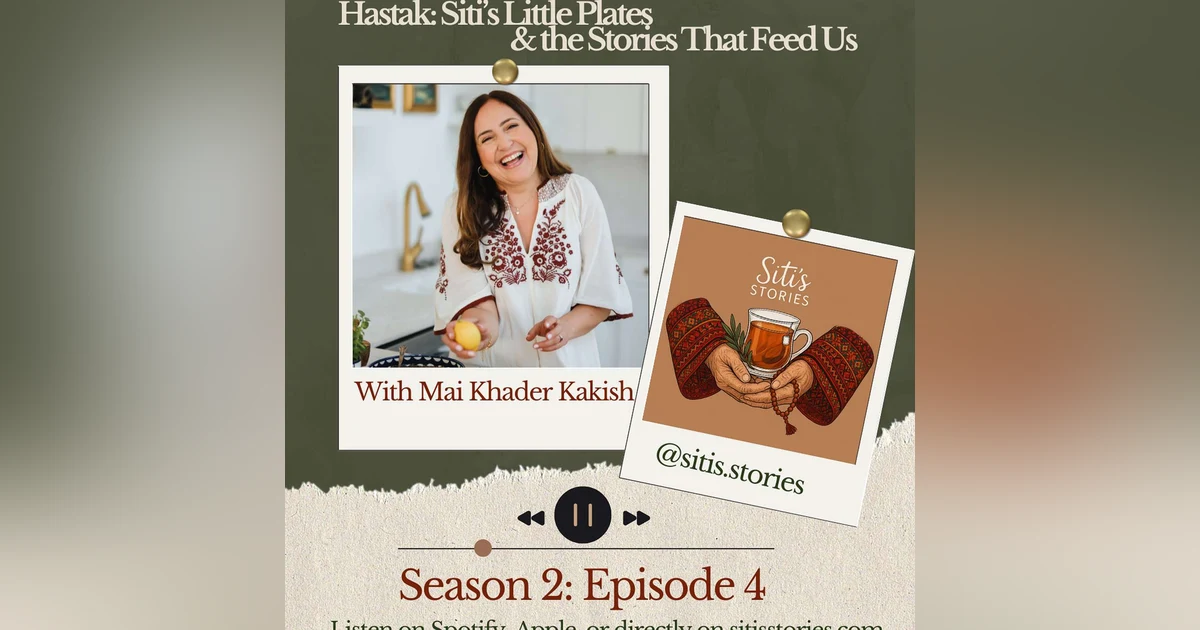


In this tender and deeply grounding episode, we sit with Mai Khader Kakish; storyteller, recipe-keeper, and the heart behind Almond & Fig. 🌿
Mai shares how Almond & Fig began as a way to feel closer to home while her family remained in Palestine; a place to preserve her teta’s recipes and document the stories, wisdom, and traditions woven into every dish. For Mai, food is not just nourishment; it is storytelling, resistance, and the inheritance of a people who survived unimaginable loss.
This episode was recorded during some of the darkest days of the ongoing genocide before any aid was allowed in and at the height of starvation and you can feel both the weight and the warmth in our conversation. We let the episode begin exactly as it unfolded: raw, unfiltered, and honest.
Together, we delve into:
• Preserving ancestral recipes and the love tucked into every little “hastak”
• Armenian–Palestinian lineage, generational survival, and carrying forward what others tried to erase
• Food as memory, identity, resistance, and inheritance
• The grief of losing our grandmothers and keeping their stories alive 🤍
• How food is being intentionally weaponized and the devastating impact of forced starvation
• The work Mai does with the Seraj Library Project
This conversation is about the women who raised us, the hands that fed us, and the ways we continue to carry them; through recipes, memory, and heritage preservation
📚For more about the Seraj Library Project and ways to support, visit serajlibraries.org
Follow Mai at @almondandfig for recipes, heritage, and storytelling.
Stay connected with us: @sitis.stories • sitisstories.com
You know that feeling when you meet someone and you instantly connect with them? That's exactly how I felt with my friendship with Mei. When we finally sat down together, we bonded immediately over our grandmothers, our shared grief, our passion for storytelling, and our deep love of the land. We recorded this conversation during one of the darkest moments of the ongoing genocide, before any aid was allowed in and forced starvation in Kaza was at its peak. We were carrying so much heaviness into that room, and yet this conversation honestly became a place of comfort and connection, a small reminder of home. When I started recording, we kind of just jumped right into it and kind of skipped over a formal introduction. So rather than giving you a cinematic or produced intro, I wanted to invite you to join us exactly where we were. Honest, unfiltered, and holding all the emotions that came with watching a genocide unfold through our screens while also still carrying the grief of remembering the woman who raised us. Welcome to Sithy's Stories. I'm your host, Leila. Grab a cup of tea and listen into the stories that remind us of who we are and where we come from.
SPEAKER_01How's everything going? Allah, it's okay. It's going okay. Yeah.
SPEAKER_00Oh, are you having a tough day today?
SPEAKER_01I'm having a tough day. Yeah. I am actually on purpose this morning. I did not touch my phone. I did not go on Instagram. I did not check the news. Uh it's just Hanjad, it's like so hard to make sense of what we do amidst what we witness. It's hard to push through. Hatha like moments, moments of joy feel guilty. Well no, what you're doing is incredible. Honestly, I do things with a lot of people. And Leila, you are so organized. It is beautiful what you're doing. Thank you. I appreciate it. I meant to tell you this offhand because I know you're always asking us for our stories, but I want to tell you what you're doing is incredible.
SPEAKER_00Thank you. I appreciate that because honestly, I say we like online. I say we because it feels weird to say I, but like it's literally just me. But a lot of people don't know. A lot of people think I have people who are editing my stuff.
SPEAKER_01It's just the way that you thought thoroughly of the process makes me it makes me so proud something to be so proud of.
SPEAKER_00You're literally gonna make me cry.
SPEAKER_01Like, no, we can't start this one. I ran into my pantry. I wanted to show you something, but then I started crying as I grabbed it, and I'm like, I'll just hold off.
SPEAKER_00It's crazy because I feel like what we are living through, and look we're not even the people who are living through it actually, but what we are witnessing and it really affects you on every granular level. Literally, you just pulling out something out of your pantry. It just makes you emotional.
SPEAKER_01To move on with our life because that's the only way to carry this story through. But uh yesterday I grabbed lunch with my daughter and she shared a photo, and I hesitated so much to reshare that photo. I haven't shared anything about me in a long, long time. And honestly, it's because I felt I have so many friends who they became online friends from Gaza. And I'm like, what would what would what if they see this? What would they think? And my parents live in Palestine, my siblings live in Palestine, but it's I but then I remembered that we Palestinians, we must carry grief and joy at the same heart. And the only that's the only way to move forward.
SPEAKER_00I did love seeing that picture because you know what? It actually gave me a moment of joy, truthfully. Like, and I don't even know you like that. But seeing you be happy, and I was like, this made me happy. It was just a nice break from my feet.
SPEAKER_01We are living our lives. We eat, we go, we have breakfast, we have lunch, we have dinner, we take walks, we are safe relatively. And you feel guilty carrying all that on your shoulders, and it's a heavy weight, and we're not, yes, and we're not starved. We're not forced to be displaced. We don't we're not forced to carry everything that belongs to us in a little bag. And once your mind goes there, it is really hard to comprehend what we're witnessing. We heard stories of Nekba growing up, and now we get to witness it firsthand on a different level.
SPEAKER_00I was saying earlier, I feel like I already know you just through our little Instagram chats and just because you come across so genuine and authentic on your platform. So I'm so excited to actually get to connect during this episode.
SPEAKER_01Thank you so much, Leila. It's an honor to be as a guest on your podcast.
SPEAKER_00Just to give people context, we are starting already with tears in our eyes, just heavy hearted with just the things that are going on. And these are spaces that we are able to create those moments of reflection and to be able to connect with other human beings who are also going through the same thing because I feel like we are moving through this world, especially us in the diaspora, of we're going to work, we're seeing our neighbors, we're dropping off our kids at school, and everyone is functioning and everyone is moving along the world, and it feels like we're not. And so it's just kind of nice to be able to chat with people who are making you not feel crazy. Before we jump into your story, uh, we love starting off with a city-inspired question. And since you are a foodie, I wanted to go into that direction. What food, when you smell it or you taste it, or when you make it at home, kind of instantly brings you back to your city or your teta.
SPEAKER_01Oh my gosh. Right before I we joined the podcast, I went to my pantry and my grandmothers, I say grandmothers because both of my grandmothers passed away in the past three years. Most people thank you, Habipti, and most people have two grandmothers. I had three grandmothers, and the third one was my sister's mother-in-law, who's not my biological grandmother, but she was a grandmother figure, and I absolutely love this woman. And I cry every time I think about that lineage of women that we lost. I left Palestine when I was uh 18 years old to go to college. So as you can imagine, coming to the US on my own as a student, my grandmothers and my mother would load my suitcases. So they didn't think they connected me to home, they just thought they would sustain me. And one of the things that Teta would always send with me or ship me during season was zapcha. And yes, that sounds like cliche, like every Palestinian has zappar. Yes, you do. And this is actually the actual last bag she ever sent me. So this is over three years old now. But I said I won't touch it, so I keep it in my freezer with her tag and the her exact packaging. So this will always smell like Tata. This is my um this is my paternal grandmother and who lived right above us. So we grew up in her wisdom. We grew up just by her kitchen, and we were so lucky to be so close to her because we got to witness life through her. So that's the one of the biggest things that remind me always of Tata. I have I wish growing up I had we had iPhones or ways to document these things, but they are in memory. And that was the reason I started writing these emotions and feelings and memories so I can keep them alive. Teta during the springtime, she will get all kinds of zatar and she'll turn her veranda into like a zatar factory, honestly. Her hands will be stained green for weeks after from plucking the zatar leaves and turning it into the ground zatar that that we we love and appreciate. She divided the zatar among all her kids and grandkids. And if we're out of the country, she would ship us the zatar. She would always call it hostak, means your portion, and she would always have, like I showed you, names and ready to be shipped wherever you are. Most people think Palestinian cuisine is heavy on meat, and yes, there's meat, obviously, but Siti love vegetarian dishes. That was one thing I inherited from her is the love for seasonal produce. And the smell always starts with zeta tuan, olive oil, um, blistering onions and the olive oil. So those are the smells that remind me of Teta.
SPEAKER_00Thank you for sharing that. You brought me back to my sitties. I feel like I resonate so much with that. We actually lost our grandmothers around the same time. I lost both of my sitties too in the last two or three years, and they were two years apart from each other. It was a big loss all at once. You're losing like you're losing just such a huge generation all at once. But funnily enough, I literally still have my sitti's semna. She made the whole things of ghee and then would chip it off. Anytime my mom or me were visiting, she would send us back with some of her stuff. And I just finished my other Siddhis. She passed away first. I just finished her Zatar. And food really is a way to connect you to your ancestors and also to your roots.
SPEAKER_01They're both so nurturing and loving, but they all have their own individuality. And my other sitti was uh Teta Amusta, we called her, and that was my maternal grandmother, and she was known for her Warak Dawadi. Every Sunday we would gather at her house, and there was always a pot of Warak Dawadi to flip for the whole entire family. And that's also the last of the Dawadi that she preserved, and this was a way that she loved preserving this. So I kept those two things just as a memory.
SPEAKER_00I love that you were able to preserve that. And I love when I meet people who were just as passionate as preserving our ancestors' stories and their traditions and their memories. That's so special. Food is really one of those things that takes us back to our roots and takes us back to our beginnings. If you could share a little bit about your own background, like what Balled your families are from, and where did you grow up?
SPEAKER_01So my paternal grandparents are from Nebles, and they both left to Jerusalem before actually my father was even probably born. Um, and C. D. was an agricultural engineer. He went to Jerusalem to pursue better, you know, better job opportunities, and he later pursued his education. He came to the States, got a, I think, a master's degree in agriculture. Wow, that's incredible. Yeah. Yeah. So he he was one of the very few agricultural engineers of his time in Palestine. So he went to Jerusalem, uh, worked there. Uh my dad was born in Jerusalem. I never knew my maternal grandfather, but I knew my my maternal great-grandfather and great-grandmother. I was actually only like 10 years old when they passed. So I was lucky to witness, to see their wisdom. And I'll tell you a little bit about that and just to show you the mass diversity of Palestinians. We're not all the same. We come from different backgrounds, different faiths. So when you talk about Palestinians, we're not one kind Palestinians, right? So my my maternal grandmother is uh from Jerusalem, grew up in Jerusalem. Her father, which is my great-grandfather, is Armenian. I come from a lineage of people who survived genocide.
SPEAKER_00Wow. When you talk about generational trauma, like that is compounded. Yeah.
SPEAKER_01So he my great-grandfather came to uh Jerusalem as an orphan because he witnessed uh his parents uh killed uh in the Armenian genocide. So he ended up being at a monastery in Jerusalem. When he was like 18 years old, he met my great-grandmother, who was Lebanese, who also was in Palestine because of the war. She was an orphan uh because of the war and they um they lived in Jerusalem. So most of my life I spent it in the city of Jerusalem. I spent my high high school years in Ramallah. Um, and then I came to the US to study.
SPEAKER_00Wow. Um, you know what I think is really interesting is that Falestine was a place actually for other people to seek refuge, like Lebanese, Armenian, and a lot of people don't know that. Uh it's really important to like highlight that there is like a whole Armenian quarter that still lives there, and it really was a place of refuge. We really were people who were so welcoming to other groups, and it's wild to me how history has changed that we are now seeking refuge from other places. But it is just a really interesting topic to touch upon because there is such a place that has a lot of diversity that people don't really know about. So you now live in Chicago.
SPEAKER_01Yes. I have three daughters and have been here since college. So my husband and I met in Chicago. The typical story. We thought we would be here to pay our school loans and then just go home, and then we had our girls, and then life goes on. My parents are still in Palestine, my siblings except one, are still in Palestine, my extended family are still in Palestine.
SPEAKER_00And then you touched upon um a little bit about how you were from Ilkhutz, and then now you guys are displaced to be outside of Ilkhutz. Can you kind of tell us the story about that?
SPEAKER_01Uh of course, um the the story of Nekbah as we all know it, it's not a footnote, it's in history, it's it's ongoing. So as as my grandparents witnessed the nekba, we continue to to to witness displacement um and ethnic cleansing since 1948. My in the early 40s, my grandfather he came from Nebles and he purchased a uh in Jerusalem, in West Jerusalem, an area called Al-Katamon. It was a predominantly Christian neighborhood in West Jerusalem. Uh 1948 happens, and then after the 1967 war, he went to check on his home because they had they were forced to leave their home because they were saying the the Israelis are coming, we need to leave, right? So they left their home to the Mount of Olives in Jerusalem, uh Jabel Zaitoon. And when after the war was over, Sidi went back to check on his home in Al-Khataman to find it occupied by a Yemeni Jewish family who called the police on them. And like every Palestinian family, we my grandfather died, and he had the document that proved his ownership to the land, which my uncle still has still this day. And you can try to fight it in the Israeli courts, but it goes filed under Mlak Ral-Ra'ibin, which means that people aren't there, so they took we took over their homes.
SPEAKER_00As if we like left on our own accord.
SPEAKER_01We left without violence, as if we willingly left our homes and handed it over. So since that day, my grandfather passed, not like every Palestinian, not being able to ever step foot into that home in Al-Patamun. Um, then after 1967, like I said, he was an agricultural engineer, and my grandmother comes from a farming family, so it was important to them to have a huge lot of land. And to have a lot of land, they had to go on the outskirts of Jerusalem in an area called Ram now. And that's where my grandfather built his home. We lived underneath exactly underneath my grandfather and the house that I grew up in. My my other grandmother, similar story, they were forced to leave their home in 1948. They went to Beijella, took refuge in a monastery, and then her father got a job at a bakery in Bethlehem, so they moved to an apartment in Bethlehem, and Teta would commute from Jerusalem to Bethlehem after school. And she talked about it. Oh, this is a long distance. It is a long distance. Yeah. You know, you know, between COVID and then Reza and all the travel restrictions, I wanted to go home and document more of my grandmother's stories, but they both passed sadly during this time. And I remember my maternal grandmother, Teta Jojette, who we call Tetam Ustam, she was the storyteller of the family. So Tetam Ustam, before she passed, I would call her almost every week, and we would spend a long a long time chatting on the phone. I was able to write down some of the things that she shared with me, and one of them, which I didn't know until she really the year she passed, that she was on the bus home from Jerusalem to Betlehem to go back home after school, and the Haganah, um, the Israeli militia uh gangs uh they were raiding the area. So the bus had to pull over. Somehow her and a woman exchanged seats, and as the bus took over, the Haganah attacked the bus and killed the woman that was sub was sitting in her seat. City was, I think she was 13, 14 at the time. I have chills.
SPEAKER_00I that gave me decepts.
SPEAKER_01She was never able to shake off that scene out of her memory, but she said, for as long as she was living.
SPEAKER_00I appreciate the vulnerability that you are giving to this space. I think we have so much to learn from what they have gone through, um, and just so much to carry forward using their strength and their resilience that they've had to, you know, experience. Absolutely. So something I did want to touch point on is that Palestinians really are so diverse and we do come from all different faiths and backgrounds, and you are Christian Palestinian. I would really love to hear your experience on what celebrating Easter and Christmas was like in Palestine.
SPEAKER_01Growing up, it this data would take this holiday, and this data would take this holiday, and as everyone else, like Ramadan, like Aid in all of the holidays, it's really centered around food. But it was my grandfather who was so diligent at taking us to church. So we would go from Aram to Jerusalem to go to church every Sunday. Holidays were always filled with family long tables. I will never forget Msasan was always at the heart of the spring table. I mean, vividly I remember family gatherings. I lived in Palestine through the first Zifada, and slowly I can tell you that with time, how even the dynamics of who attended those tables and the family that was able to come because of uh restriction on movement and roadblocks and curfews and how that changed over time. My mom always baked the goods, she made the cookies, this tetah was famous for rolling grape leaf pots, and this teta was famous for umsafan, and my mother was famous for her mensaf. And it was long tables that invited everyone over. And one of the my favorite things around the holidays, whether it's the Muslim holidays or the Christian holidays in Palestine, is the exchanges that happen between the neighbors. And that's something that stood with me over time. I will never forget that during Christmas time we have a tradition, it's called Aid al-Burbara, and it's it marks the beginning of Christmas season, and it's usually in the beginning of December. And Teta Imhanna was famous to make burbara. It was a dish that was made from pearled wheat. Actually, it has a story of resilience. It's sweet, berry, kind of porridge, soupy like, and she would garnish it with pomegranates, nuts, and raisins, and that she would divide it into hustak. Again, you would enter her kitchen and it was perfumed with NS and cinnamon, and then you will see little plates all over her little kitchen table. As you come in, she would task you to go deliver this to Muhammad, this is to M Khazah, M Kazah, and you would just walk the neighborhood delivering these plates of Tatamate, and in return comes Ramadan. These plates come back because you never return a plate empty in a Palestinian. There is no way. So we have a saying that goes al Bishoufaq ba'in bichuf of tintan. If somebody sees you with one eye, you see them with both. So the plates will come back to us filled with atayah, filled with other with other goodies during uh Ramadan or so that was something that really, really stood uh for me. How community comes together during um holidays and and how the neighbors would come and help each other in ishka'k, like do the ka'q in Ma'amul. And um, I I would uh go to my best friend's Ranya's house. I I told her I befriended her because her mom made the best iftad and she would make the best pickles, and we were always invited at our neighbors' tables.
SPEAKER_00I love that. That makes me so happy. And I just wanted to touch point on that because I feel like not many people know about that, and it's hilarious to me because Jesus is literally from Palestine. How do you not know about that? Like one of us, yes. Yeah, exactly. Um it's so clear that food was a highlight in your family and your in your community and a way to gather around and make connections. How did that connection with food in your family uh take shape into you creating almond and fig?
SPEAKER_01Oh wow. I was not a foodie. So when I told Teta, I'm like writing her recipes and stuff like that, she literally fell off her chair, probably thinking like what happened. Well, um, when I came to the US as a student, I again, it's like these little things that they packed in my bags, the the Zata, the nuts. I loved bizet, and they would pack me bizet and dried raisins that Teta would dry from our daily of all kinds of goodies. And I would say, Siti, I live in a dorm, like there's nowhere to cook these. I came as a student, so I didn't have any relatives. I came to Chicago, everything was strange to me. The buildings, the streets, how busy everything is. Everything was so strange to me.
SPEAKER_00And you probably thought you were going back too. You probably didn't think that this was a new home for you.
SPEAKER_01This wasn't home. This was temporary. I was coming here for better opportunities to learn to educate myself and to go home. So the food that they packed for me became a lifeline. But then as time went on, I didn't realize how much of my identity is attached to this food. And uh and later on, as as I had my own children, I wanted to recreate. Um, I would want to recreate the smells of my grandmother's kitchens and my mother's kitchens. It was, it became, it became more of who I am. I didn't realize how much of my identity is connected to that food and how hard it was to define it and tell people about it. Because when I came to the US, I came in 1994-95. Food still is subsumed under this giant umbrella of like Mediterranean, Middle East, island. There was a lot of Mediterranean restaurants, not one was called anything Palestinian. Somebody knew what Palestinian food is, or Jordanian food, or Syrian or Lebanese or Yemeni food or any of that. It was all sub-sum under this whole thing of Mediterranean. So um that's when I realized the importance of this to my identity.
SPEAKER_00Yeah, I think people are like sneaky with that, with that whole Mediterranean thing. Some people like really take advantage of that and try to be sneaky. If somebody like recommends a new restaurant, I like go on, I see who their chef is, I see who their story is. I'm like, all right, I see what you were trying to do there. Exactly.
SPEAKER_01Exactly. That's it, you know, every Palestinian Googling the owners, the who cooks it, who who serves it. Then that's where Almond and Fig kind of started. It wasn't long ago, probably like eight years ago, when I started realizing I have all these stories of my that I started writing down everything, not just recipes, because I realized quickly that it's not just the recipes that are important. It's also the stories associated with the recipes. It's the only way to preserve them. So I started writing feelings about the recipes, emotions, cities, gestures as she cooked them. And I was lucky enough to go home often to visit my family. And I take my children to visit their grandparents. And great-grandparents started preserving these stories as well as the recipes of what's happening when it was cooked, like I was telling you about Burbara. It's not just the recipe itself, it's when it's shared, how it's shared, how it's prepared, and the meaning behind it. And I just realized that the stories are equally, or if not more important, than the actually just dish itself.
SPEAKER_00That's exactly what I love about your platform, Almond and Fig, is that it's not just the recipe. You really do have a storytelling component that's a part of it. How do you see that role of like storytelling and food together preserving Palestinian heritage, especially like in the times right now where Palestinian food is being erased? Like that's also another way of erasure is through our food. So how do you see that like storytelling and food component to help that?
SPEAKER_01I I I've been struggling with this whole thing. And when food, as a food writer and a person who writes about food and creates food and writes recipes and collects recipes and documents them that preserves them, I'm having a really hard time knowing that our the food that our ancestors lived on, that food itself is being weaponized and not just the food. The people who consume the food are targeted, they're being the forced starvation. The sources of these food, whether it's the olive trees, the wells for water, whether it's the land, everything is under attack. And I've had a really hard time how to find the balance. Part of documenting, part of is preserving that story so we can tell it ourselves. It's not just the recipe. So us telling our own stories, documenting it in our own voice. We see our food so appropriated in the West. We see Hemos, we see Knefe, we see even Mensaf, even you know, the Bidwin focused dish. Everything is being appropriated. So how do you navigate through uh a genocide, forced starvation, killing the sources of the food where the food that we grew up, our ancestors grew up on, the trees that they planted from hundreds and thousands of years ago of being bombed and erased and uprooted? How do you navigate all that? How do we write about that at the same time carrying a heart full of grief? Um so uh it's been it's been uh it's been a hard journey the past few years.
SPEAKER_00Yeah. How have you like learned to navigate that? Because I also struggle with this as well. I struggle with being productive, I struggle with doing things that are creative, I struggle with like posting, just like kind of promoting the work that I'm doing because I'm just like, does this even matter right now? Is this even important right now? Like, but then I do kind of like take a step back and I wonder, is this the oppressor's motive? Is this the oppressor's like point of like, we're gonna beat you down mentally, like to the Palestinians who are in diaspora, we're gonna beat you down mentally that you don't even like have a voice anymore. You don't even want to post about your food, you don't want to post about your stories. So, in that aspect, you have to be able to preserve these stories and share these things because we let them win if we don't reclaim that.
SPEAKER_01Absolutely, exactly. You're right on. Although I'm not sharing as much of food or recipes, I am continuing to document and preserve what I know. This is super important that we preserve our stories, collect them, defend them, write them in our own voices. I have been struggling to share them publicly in the media, but that doesn't mean I will stop working. We grew up on um on the shoulders of tremendous women, whether it's my grandmothers, every Palestinian mother and grandmother, they they kept pushing forward, and so will we. That's the only way our grandmothers survived and grandparents survived in Nekba, and they pushed through 67, the Intifadas, and so on. And so will we. We're gonna keep pushing, we're gonna keep writing, we're gonna keep documenting and preserving whatever the platform is, every story, every music, every lullaby, every book that gets published, every song that gets written, every poem, it's it's it's a way to say we are here, we exist, and we're here to stay.
SPEAKER_00I know I think it's okay to feel that heaviness and then carry on that strength, resilience that our ancestors had to be like, okay, we're gonna pick up and continue on and carry on. But you really are a storyteller. You were also on the board of the Siraj Library project uh in Fallestine, and I would love for you to chat with us a little bit more about that.
SPEAKER_01Over 20 years ago, a friend of mine in college went back home to start a library in his village. He was so um, you know, into Vokes and he wanted something in his village. So he he started the small library and he came back to the US to our professors and at the college and a few friends and said, Hey, would you support me opening a library? And the story was boring. Almost 10 years later, I was asked to join the Board of Siraj as a Palestinian in diaspora. As a Palestinian who has my family and still in Palestine, they deserve places of safety, they deserve places to dream beyond the walls that confine us, all the apartheid wall. Because when I grew up in Palestine, movement was hard. In order for me to go to a library from Aram, I would have to go to Jerusalem. It wasn't that long, but with the checkpoints and everything, it would take about 45 to an hour, maybe longer, to get to the library. And sometimes even coming home, the the checkpoint would be closed. I would have to walk home from Jerusalem to get to get home. So we realized that these spaces are important and we wanted to provide children with books to dream beyond our situation. I joined this board because I feel like every Palestinian should be connected and doing something on the ground in Palestine for our people who are surviving this ugly, ugly occupation. That one library grew to 13 libraries in the West Bank and refugee camps and two community centers. And the most recent that we worked on is a storytelling center because we also believe in the power of stories and the power of that oral history. So we built a storytelling community center. They do storytelling marathons, they travel from village to village telling stories, collecting stories. We train women how to collect stories and to become storytellers. Um and then there's also in Kufir Aqab, which is an area between Jerusalem and Ramallah in the West Bank, and that area is a concrete jungle. So we were able to open not just a library but a community center that houses one of the very few green spaces in that area because it is a concrete jungle because people were forced to leave Jerusalem. So this has become the place to be. And my brother lives in Kovaraka, buildings upon buildings upon buildings. So we created this kind of like a beautiful space that has an ancestral garden, that has um urloom seeds, that has Zatar, that has Miramiya, that has Fakus, that has all kinds of little Urloom plants back to Palestinian. So this has this project has become super important to me because it does connect me to home. It shows my children how to connect to their to their to their homeland and where they're from. So I think Palestinians diaspora is very important for us to support our people in Palestine.
SPEAKER_00This is the work that's like being done in Palestine. How do you how are you be like, how are you able to get involved and like what's the work that you do like while you're here in America?
SPEAKER_01One thing we take so much pride on is there our Palestinian board in Palestine, they're out of Ramallah. It's from the community to the community. We here in the US, we do a lot of the fundraising that goes beyond opening like sustaining libraries, opening the community center and doing all that work. But in Palestine, it's done by our our people in Palestine. The library is owned by that community, and the people who run the library are from the community. And we start we started thinking there are children's libraries, but with time, they became community libraries. Everybody comes, students come to study, mothers come, and there's now there's adult programs and elderly for just we got a um video, bunch of older women um around Ramallah, they come every evening to buzit and they wear in their sobs and they sit and they do the lullabies. It's just beautiful to give to have this space where where people can connect, can like to relate themselves to find space where they can share music, share books, share stories. Even there's a yoga group in one of the libraries.
SPEAKER_00I love how conscious Sidraj was to like really make it Palestinian for the Palestinians who are under occupation, and that we as in the diaspora can just help with the fundraising.
SPEAKER_01We dreamt of opening a library or a community center in Ghazab. Siraj will continue to pursue different areas in in Palestine. Usually they're not really in big cities. They are in you know, in either a refugee camp or they are in a village around the West Bank and Hebron. And inshallah, one day we will go all go back and work in Ghazab.
SPEAKER_00Yeah, inshallah, the next time that I could go to Palestine, I'm putting it on my list to visit one of the community centers. We'd love to have you.
SPEAKER_01We are intentional where these libraries go and the communities that they where they function. It's people who need them, and it's it's now that actually restriction of movement is at its highest. My mother just sent me uh pictures that our city at Ram, which is surrounded not by one checkpoint by two, the Kalandia checkpoint taking you to Ramallah, and then also the Jerusalem checkpoint up top the the town, and then the apartheid wall that stretches on all sides of the town, they now install gates. Electricity. Yeah, same with my. With that restriction of movement, people aren't able to go from one place to another. So we're finding with the library, with the Siraj Library projects, as Palestinians, we always have to pivot. We always have to find ways to resist this uh this brutal occupation and just get to our people. As storytellers, we'll go to different villages and do a performance. We, you know, constantly as a Palestinian living in Palestine, you always have to pivot.
SPEAKER_00The work that you're doing with Siraj, um, it really is so important. And especially like you said, with now the extra restriction of movement as well. I know we talked about our Siddhis a little bit earlier on, but they really were the original storytellers of our families, of our communities. I would love to delve a little bit deeper into hearing more about your Siddhis. I know they're so fond to your heart.
SPEAKER_01So my paternal grandmother, Taytam Hannah, her actual name is Rasmiya. I always found that interesting. So Rasmiya means the official. She was the OG, and I always thought it was like, what is OG? One of the things that she hated most is that she didn't speak English. She was forced to marry young to take care of her siblings. So one of her biggest things was that she couldn't speak English. That was one thing she regretted the most, and I don't know why that was, but so I would always call her the OG, and she would laugh and laugh because that she understood. Theta Rasmiya with Amhana, as we know her. We grew up in her wisdom. We grew up right next to her. Um, my my parents and my siblings, we all lived right the house below them, and we shared the the bounty of the garden that my grandfather and grandmother cultivated. The women in my family, both my grandmothers were they're the family keepers, the keepers of the family's memories, the family's resistance. The city Imhadna witnessed a lot of things in her life. The hardest of them all were both of my father and my uncle were imprisoned during the Intifadas. Because we lived so close to her, she she took care of us. And not only they lived under the brutal occupation, but they also had to bear the greatest sacrifices from house raids to all kinds of things. But my fondest memory of her is her cooking. She was somebody who fed everyone. No one ever came to her house and left hungry or without bags of things to take with you. I remember even the street sellers, the Rookab guy. Rukab is the Palestinian ice cream out of Ramallah, and they would distribute it to different towns and they would come selling it on their shoulders in this icebox. And he would stop at my grandmother's house all the time because she always fed him and she always gave him something to cold to drink in the summer. She nurtured people. She just had a way about her that was that goes to show like her character.
SPEAKER_00Yes.
SPEAKER_01That was so nurturing. And I I would remember as a young kid, even then the Bidwin lady that would come selling uh goat yogurt or a belly butter, and this this whole scene kind of disappeared with with the checkpoints and the closures dividing all the towns from one another. But she would come. She would uh Siti to her house. There was a beautiful stairway, and she would open the gate and sit with sit with Siti, and they would sip and c sip coffee together and talk about their days. And I found that so amusing that she was able to connect with all with with everyone, and she was so nurturing and loving, always cooking, always preserving. She had a story for everything. She she was so connected to her land. She she comes from a farming family. My grandfather wasn't you know agricultural engineer, so you have to imagine we had a beautiful lush garden. She took care of the produce, she would plant zucchini, coosa, beladi, azatar, um spinach, all kinds of herbs and tomatoes and vegetables. And CD planted all the trees and took care of them. The figs, the almonds, the grape vines. I mean the figs and almonds. I just heard I was like, oh, almonds and figs. And this is where it came from. The whole name I wanted it to be be so connected to the land and to the way I grew up, and I wanted to mean something to me. And actually, this whole thing started as a project for my children. I wanted to preserve those memories for my own children. So Teta was that person. We we commuted to Jerusalem to go to school. And you can imagine that was a long commute from Iram with the checkpoint. It would take us at least sometimes an hour to get to Jerusalem. And then after that, we would have to walk from Babylamud all the way to the inside of the city by the Holy Sepulchle Church. And that's where my school was. So it was a long, long day to go to school and back. And every time we come home, we're welcomed with uh pots of food. It was a competition between her and my mom. And you know, love me more. Exactly. Like if my mom cooks something we don't like, we're like, see, y'all, we go off to my grandmother, and she's like, Of course I'll make you chicken. I remember vividly actually when we get sick, she would make us her uh feel good so teta choraba soup. And it was a chicken uh rice soup, and it was just something about her that was so healing. And I don't know if it was the soup itself or her hands or something so healing about being in her presence.
SPEAKER_00I find it so cliche, but it really is when they cook with love when you cook with Nifus. That's true. You feel it differently. The food just tastes so much better like that.
SPEAKER_01Her food is unmatched, and it was so simple. She preserved everything from the garden. You would go in the spring, you would see sheets, literally sheets, covering every table top in her home with frike, with zata, with mint, any all the time. There's something processing. I I want to be like Sitti. That's who I want to be.
SPEAKER_00I love this. I love this. Your Siddhi Rosniya is really reminding me a lot of my Siddhi. They're both named Harima. My paternal grandmother. She was a very simple woman and she grew up making all these simple dishes. That's how I grew up was eating all these simple dishes. It was just so vegetarian-based. I love it. People don't think that when they think of Aderby food, which I don't understand why.
SPEAKER_01We're an agricultural community to begin with. Falast is an agricultural land, so we eat seasons and whatever is in season. And that's another something that actually drove me to keep writing and you know, on almond and fig is that most of us don't know because of the forced uh displacements, because of the naqbada intifadas, the closure, our parents and grandparents have to move from areas to another. They they're displaced and they had to adapt. Their cuisine had to adapt, their ingredients have to adapt. And the reason sometimes I would share a recipe and people are like, I didn't know about this recipe world. Yes, because we didn't know the we have no access to these communities and villages. So that was another reason I wanted to collect these stories, not just my grandmother's, but the story of every Palestinian. Each one of us carries a story, and the recipe could change and adapt from one place, depends where they end up. I talked about a recipe that's rumaniyya. Rumania comes from the word rumen, pomegranates, and it's a very humble stew that's made out of eggplant, lentils, and pomegranates, right? But that recipe I learned from my sister-in-law, whose family is from Lyd, they had to move to Ramallah, and the recipe adapted. And the same recipe, if you look it up in Gazza, it's made with haine instead of pomegranate juice. So the recipes have to adapt, they have to adopt. And the reason we don't know about all the Palestinian cuisine is because of this forced displacement and genocides and ethnic cleansing. They were forced to move. So their recipes have to adapt. And so when I think of the Palestinian kitchen, I always think of her. I think of Siddhi. I um I have a lot of stories to share with you. And I don't I know you don't have all the time in the world.
SPEAKER_00No, no, I'm like soaking it up right now. I love hearing all of it.
SPEAKER_01She was the storyteller. She lived in Beetsafha, which is a town about a few kilometers away from Jerusalem, on the other side. And Siti is a powerhouse. Her husband died when her ch when my mother was eight years old. So she lived through the 1967 war by herself with her children. Her husband left her the house in Beit Safafa, but that area was empty at the time. The street was had, I think, four and five neighbors, and everybody left because of the war, so she had to take refuge with her mother-in-law in the old city of Jerusalem. So she took her children there, and right after the war ended, she said, No, I'm gonna go back to my house because I need to protect my house. So she took her three kids, Maichalti, Mai Khalil, and my mother, back to their house in Beitza Fafi, this empty street of just five houses facing a mountain that has one Bedouin family. My grandmothers have these like power of like connecting with people. We became friends with her kids and her goats, and we would run up the hill and play with the goats. And um, but to us, that home was an escape from the hustle and bustle of the old city and from the city of Jerusalem going to school. We loved it, we would just run freely. So after the war, she went to her house to find it locked. So the Israelis already claiming the homes in this whole area. She was determined this is the only thing she owns and the only thing left for her from her husband, my grandfather. So she was determined she went and broke the lock, got into the house. When we talked to her about this, and I said, Sity, how did you survive? You have three little children, my mom being the oldest at eight years old. How in the world did you survive this loneliness, this darkness at night, knowing that there's there's there's a raging war and there's armies and weapons and guns and bombs. She said it was the call to prayer from the town. The only mosque in town at the time. When they would do the call to prayer, she knew the people stayed in the town. And that gave her peace and comfort, knowing that there are people still in the town and she needs to preserve. So she stayed in her home in Beitza Fafa, protected the neighbors, the rest of the neighborhood, being confiscated by the Israelis, except one house, which is the house right next door to her. Uh, a settler family took over the house, turned it into a school.
SPEAKER_00Wow. Your both cities have an extreme amount of strength and grit, and just the ability to stay so rooted in where they come from. It's it's really inspiring. These are exactly why I love hearing these stories and preserving these stories. Is I feel for them that they had to like even go through that. But like I'm always just like amazed hearing it. Because if they went through that, I can I can then go through this, like whatever it is that ever any person is like struggling with.
SPEAKER_01And that's why we need to push forward because we we grew up with the generation, this generation of women that did not give up, and neither can we. We can't afford to give up, Leila. The city only passed two years ago, and honestly, for her to even see the genocide and to witness this again in her lifetime, for both of them, that was really, really brutal for them. You would think that these stories will ease with time. And I think as we continue to witness what we witness, we're just moved by their resilience. And so yeah, we cannot give up. I was telling you to go back to a lighter version of the story, is that we found found her home to be an escape, actually. Because she lived in this beautiful open area. You know, we would go there on the weekends when school was off or the summer holidays and we were friends with all the neighbors, all my cousins on my mom's side would come, we'd play, and then every night when we sleep over, she would tell us stories. Hassan is shot at, which actually I just realized it's a book published by Interlink, which is amazing. I now finally have a physical. I thought she made it up.
SPEAKER_00That's hilarious. I gotta link it. I'll link the book as well. I'd be like, May's grandmother made this book up.
SPEAKER_01I mean, the way she told it was just I mean, she this she told it to us hundreds of times, and every time it was just better and better. And it was called Osathasan Shot it. And I love that story, and I was so grateful to be to find it in a book. But so uh she was the storyteller. She remembered everything, she documented everything, everything. She she wanted to prove that we were there, whether it's her the deed to the house, whether it's her husband's certificate, because she became a widow at a young age, she had to sustain her family, so she had to find a way to make money. She became the neighborhood nurse, which means she only learned how to give people their like shots, like diabetes shots, all kinds of stuff like that. And I remember people would come to her house to get their daily, weekly, monthly shots. She always found ways to survive and like care for her children and and raise them on her own. And then she be started sewing. She was just amazing. Like everything you asked her, she just knew how to do. Yes, well, they always found a way. I don't know if it was a survival mechanism. I used to think it's hobbies, and I'm like, who wants a hobby to sew? But that was me. I didn't want anything to do with like sewing, coking, none of that.
SPEAKER_00That's so funny because what's so interesting is your love for them and your love for your identity pushes you to do things. You were not even a cooker. That's not even like what you did. But you loved your grandparents so much. You loved your identity so much that it's like, well, if this is a way for me to connect, if this is a way for me to preserve, I'll do it. And I'll fall in love with it doing it. That's so special that you were able to do that.
SPEAKER_01I remember like the last few visits with Teta was like well and good. I would visit, you know, I would go and record her cooking dishes and I would say, Siti, how much melehab Tetya? Like, why did you add this m? She said, Yes, Siti, you just eyeball it, you just see if it mixes growing up in their wisdom. Watching them, you really didn't have. To write recipes, you just had to learn that Nefes. And what does that mean? It's techniques. It's they know when to add this certain thing, when to stir this, when to turn it off. Everything was dealt with in a sustainable way. Preservation, sustainability is like their new terms, right? But to them, that was a way of living. Nothing went to waste. Both of my nothing went to waste. Everything was repurposed, the jars in her namy. I wasn't into eating, but then later I realized that their soul lives in those recipes, and I wanted it to taste just like theirs. And I started a little garden in my house here in the suburbs of Chicago, a very small garden. And that's just a way to connect with them. City M Mosta loved her flowers, and she was famous for her lemon tree where we had almost all the meals, and she loved her flowers, and a city M. Hannah loved her plants and to harvest. And then I told you about the city that is not my biological city, and I have to, because she just passed away a few months ago. Tietamot had a different story than my grandmother. She lived in a little village called Arena and it's um occupied uh 48. Arena is close to Nazareth and they fought the occupation and they stayed in their village. And this woman, I'm telling you, in my old I'm I want to be a great city. These women just preserved our stories, our culture in a way we must pass on to the next generation. So it's not just the recipes, it's their wisdom, it's their nafes, it's their sustainability. This uh Teta Um Atif was the forger. She would go up the hill and we she would forge and she would teach me. And anytime I had a question about a Palestinian plant and a Palestinian Urloom, any question, she would know. She would always have bags of things, herbs, it's hurat that she would mix and this will heal your throat. They just have amazing wisdom and their wis is is tied to the land because I feel like our mothers and grandmothers are the land itself.
SPEAKER_00Yeah, I think the more sittis, the merrier. So I always say with Siddhi stories is sittis doesn't have to literally be your Siddhi, like your biological sitti. It could be see an elderly woman that you really connect with, that you really have learned their wisdom. And so I love that you included her.
SPEAKER_01I had to. She influenced how I cook and how I see things and talking about forging and ancestral plants, and they were connected to the land. They knew it. That's why the land is so important to us. That's why the zatat is important, the olive trees. We know how to nurture the land. They knew how to nurture this land.
SPEAKER_00All of these siddhis and these women in your life like taught you things and traditions that it's so important for you to continue to pass on to your kids. How do you continue to pass that on to the younger generation?
SPEAKER_01Absolutely. I mean, at first I thought it was the recipes, right? It's also the stories associated with these recipes. I I always tell people, document, talk to talk to your grandmothers at the Arabic program here. We I have in Chicago. We always tell the kids go back to Tata, go back to see the document or the grandma figure in your family. Ask them questions, talk about their stories, write them down. They are proof of our existence, they're a proof of our resilience, they're proof of our ties to the land. And they they're all in different shapes and form. Some love to cook, some love to sew, some love to care for the land. There's so it's important to not just pass those recipes, but also to tell them about the appropriation of the Palestinian cuisine, but also the importance of that cuisine to our existence and the kitchens of Gaza, of the hills of Palestine, to the coast of Palestine, to the to the to the cities and villages that were destroyed and confiscated in 1948. And then the genocide now, it's important to write them down and document them so we can pass them uh to this to the generations to come. I always tell kids, my Theta didn't raise me. She raised an entire nation. They raised all of us, and with that we need to continue.
SPEAKER_00You were blessed with so many Tetas and Siddhis around you. What role do you think Palestinian women, especially mothers and grandmothers, play in our resistance?
SPEAKER_01Huge role. On the news, you often bombarded with uh the resistance fighters or the political figures or the movement starters, right? But it's the mothers, the grandmothers, the daughters, is what protected this movement and its longevity. I remember clearly during the first Intifada, the role of the women played, including my mother. I was blessed to be part of a lot of women's organization through my mother that was so connected. So I remember how much they mobilized, mobilized. It was all intentional. It wasn't random. So they are at the heart of our resistance. They led demonstrations. I remember when schools were out for a long time, they've actually mastered the art of underground schools or neighborhood schools where we weren't allowed to go to school for months at a time because of curfews and stuff. So the women in the neighborhoods, they all started programs, clinics, whatever you name it. They are at the heart of the resistance. It's not what the West wants to paint of the Arab Palestinian women that we're ignorant, we're we're uh oppressed. Submissive. Submissive. We're at the heart of the resistance.
SPEAKER_00I resonate with that. And I feel every Palestinian family um has been impacted by the occupation, obviously, but not just within our family members becoming martyrs. It's also like you said, it's when our men go away, um, when they're imprisoned, and the women in our family have to hold down the four and continue to raise the next resistance. And they are raising the generation that continues on the resistance. My grandmother actually, my CD passed away when she was 28 years old and he was like 31 years old. Yeah, and she became a widow at 28 with five kids, and my dad being the eldest, and he was, I think, like 10, and the youngest was like six months. I always think back about like how she was able to do that. But then throughout her life, um, you know, my mammy got imprisoned, um, you know, and I always think about like how A, she was able to raise by herself, them not having a male, you know, like figure, she was able to raise them to be these strong, resilient men who were really a part of like the freedom fighters and a part of the resistance, while also continuing and like carrying on that spirit in her bellad, being a midwife and helping out her community. You saying that like struck that chord for me. Um, because I do think we play the whole role.
SPEAKER_01All of it is intentional. I remember clearly during the persontifada, the demonstrations, the boycotts, uh, the the homeschooling system, the the clinic. When they close up all these areas, women are forced to to do something, right? Um, I want to share how the occupation works. When my when they came to arrest my father, I remember vividly, they go to they went to my grandmother's house and they took down and they her entire pantry. They dumped the rice over the cheese, over the jameed, they mix it all together. And why do you think they do that? To cripple the household. They thought they could cripple the women, because if they cripple the women of the household, you know it's hard to survive. But our women are resilient. The Palestinian mothers, and we see them in Gaza carrying, oh, this is all really too heavy. And to know that it's systematic, it's all intentional and by design to ethnic cleanse all of us from Palestine.
SPEAKER_00And to know that we are we're still in it. We're we're talking about our Siddhi stories, which I think are so important to hear and preserve, but we're also still currently experiencing those same stories, or if not worse, at the current moment. We're not looking at something reflective in the past, if that makes sense.
SPEAKER_01It's continuous, it's ongoing.
SPEAKER_00Thinking about the future and thinking about what we can do now here in America. I think what you are doing with food and the storytelling component together, it's a way to connect two communities. Has there been a time where your food has introduced you to people who maybe didn't know about Palestine or allowed them to think a little bit deeper about Palestine?
SPEAKER_01Absolutely. Sometimes in a good way, sometimes not in a great way. But the other day, this is a funny story. The other day, my neighbor he goes, You told me you cook, and he sees my garden, and there's always something smelling. He's a great guy, and I share my spices with him. When I go to Palestine, I bring him stuff. So he said, I Googled your name and he goes, May I learned of your story. I gave an interview to the Presbyterian Church of America to divest from Israel. So they were documenting stories and voices of Palestinians. So I I was one of those voices and I told my story so he was able to find that story. That's what he thought he's gonna find a cooking show, but then he found stories like that. And he goes, I did not know that your family and you've been through all this in your lifetime. And I'm way younger than he is, and he goes, it just gave me an appreciation to start understanding what's happening right now and to kind of like peel through the layers and and know more. And he goes, That's on me, and I will be doing that. And that's um that's a that's a neighbor that I always shared food with, and I would, if I make a Palestinian dish, I would share with him, and he was always receptive of that. But food is a way, the way to communicate and relate to people and start conversations, but I've seen also people who ate at our tables but also walked away from us during the genocide. So I've seen it both ways. I've seen I've seen the people who ate our tables and didn't want to stand by us. I've seen the people who love our hummus dishes and our food but don't love us as much. I've seen food as a tool to open up conversations and to sit on the same tables, but I've also seen people that took away our food and loved, loved it but didn't love us in return.
SPEAKER_00What do you hope for this journey for yourself and then for the community as well?
SPEAKER_01My entire life I grew up, whether existing in Palestine, fighting for our existence, and then leaving to the US and still fighting for our existence. I just want to see our justice for our people. I want to see our Palestine liberated and we live in dignity. I want to be able to go home, not as a guest, not as a tourist, but to go my to my homeland. I want to be able to travel to my sisters who live in the north of Palestine, to cross the country with no borders, with no checkpoints, with no machine guns and surveillance. I want to go to the old city of Jerusalem. Inshallah.
SPEAKER_00Inshallah.
SPEAKER_01Maybe I that's why we do personally for me, my work is many folds, right? Almond and Fig is one face of me, but also Siraj is another face of me. The Arabic program I run in Chicago is another face of me. There are many faces, and we need to fight, we need to show up to our community in so many ways. I see amazing impact through the Alman and Fig in storytelling and preserving recipes and documenting stories. It feels really, really heavy right now. But also, we can't not show up. I show up through programs. I'm really invested and like Siraj, making sure our libraries are functioning, even when we have demolition orders in some of the libraries. We need to show up, we need to fight to keep them open, we need to keep kids coming into these libraries and programs running. Um, on the other side, here in Chicago, I run an Arabic language program where it started as a language because I thought that's all my kids needed is a language, because I don't have my parents and grandparents around. I thought that's what they needed, but that was 17 years ago. And with that time, it changed from just the language program into a cultural language-based program where we we make the kids be proud of who they are, honor their identity, relate to their ancestors, to their to their grandparents and parents, and be proud of who they are. So we have to show up in so many ways for our community.
SPEAKER_00No, I think that's a great perspective to have. And I think like it's useful for a lot of people to hear that, like, even when things feel heavy, take it at like that smaller, slower pace of like do what you can do, like find something that you are good at that can help other people and that can help the liberation of Philistine. Before we wrap up, what is next for you? And uh, where can listeners follow along and support your work or the work that you know you do with other organizations?
SPEAKER_01You can see a lot of my work on Almond and Fig. I'm currently working on a newer website because I don't want to be at the mercy of social media. We're at the mercy of the algorithm, shadow banning us and our voices. So I want to have my space. So I'm working on an almond and fake website to house all these stories and recipes and cultural context. My work continues with Siraj and then the Arabic program here in Chicago.
SPEAKER_00Yay! We're so looking forward to see the impact that you are able to make, inshallah and like follow the rest of your journey. We'd like to conclude with the way that we start with a Siddhi-inspired question. If your Siddhis were here with us today, drinking their Kesset Shay and like listening on their conversations, what do you think they would be the most proud of?
SPEAKER_01Oh my goodness. I want to say something that I was lucky, I really was, that I was able to see that firsthand. Their proudness of what we accomplished. And Siddhi Mahana would always say, She's like me. And that to me was validation. I mean, that was all I needed to hear, and I'm grateful that I was able to hear it from her mouth. I in the past ten years when I would go home, I I was aware of what I needed to do. I I had I was equipped with a camera and a phone with no intention where this is h this is going to the point that what I call them, they always have a story for me. Hey, and dik what I'm like you'll like to be. So they realized the impact of their stories, and I was able to witness that firsthand. My proudest moment is it's them seeing what I was doing to carry on their legacies.
SPEAKER_00And I'm so glad that they knew that. You really are doing such a wonderful job sharing their legacies in such an authentic and heartfelt way. Their stories are really stories that deserve to be heard and shared, like so many other Palestinian city's.
SPEAKER_01And yes, it's not just when I say sitis, yes, it is my grandmothers, my own biological grandmothers, but it is, I guarantee you, every Palestinian mother and grandmother.
SPEAKER_00I love that you were able to come into this space and be vulnerable and share such a thing. And I'm sorry for all my uh emotions. No, it's it's an emotional thing to talk about, especially during this time where our emotions are just already heightened. It was honestly just so nice to be able to connect with you on such a human level.
SPEAKER_01Layla, what you're doing with with your platform with Sity Stories is something when I saw that, I admired the work that you're doing, and I want you to know how important it is.
SPEAKER_00Thank you. I appreciate it so much. Thank you so much for listening to this week's episode of City Stories. Recording with May was truly such a gift. She's one of those people whose sincerity comes through instantly, and I really hope you guys felt that through the screen. There is something so special about meeting someone who carries their Sithis with them the same way that I carry mine as well. Something I took away from this conversation, and I hope you do too, is that yes, we preserve, document, and share, but we also have our own skills, talents, and strengths, and we can use those to move our people forward. We come from too strong of a lineage to give up, and we can all move forward if we do it together, inshallah. If you'd like to learn more about the work May does with the Sidraj Library Project, I encourage you to visit their website. Everything is going to be in the description below. You can also follow along with May's storytelling, recipes, and heritage work on Instagram at Almond and Fig or explore her new website for more of her beautiful stories. And as always, you can connect with us on Instagram at City's DaStories. And also don't forget to subscribe to the Olive Press, which is City's Stories newsletter. It is completely free, but it's a way for you guys to get exclusive content and peek behind each episode. This is City Stories for the ones who came before us and the ones who will carry us forward. Until next time, ma asalama.


